
Roofing Dumpster Rental Commack NY New York — Sizing A Container For Shingle Tear-Offs On Commack’s Postwar Homes
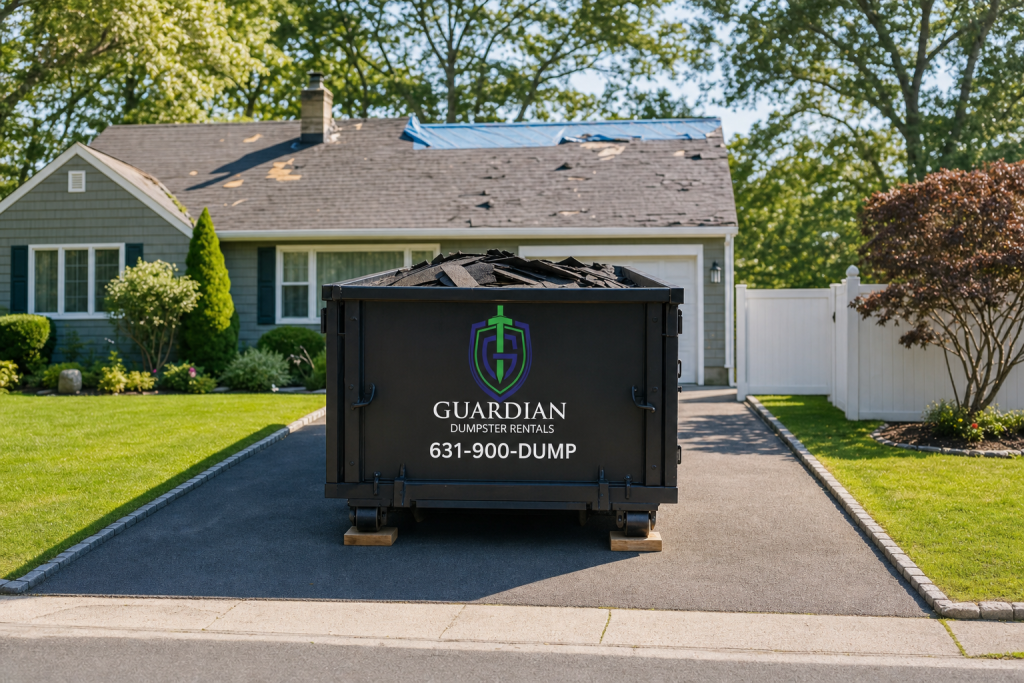
Roofing Dumpster Rental Commack NY New York is the fastest way to handle the shingles, underlayment, and flashing that come off a tear-off, and Guardian Dumpster Rental delivers 10, 20, and 30 yard roll-off containers right to your driveway. Most single-layer tear-offs on a typical Commack ranch or split-level fit comfortably in a 20 yard container. We place the dumpster before your roofer starts, you fill it as the old roof comes down, and we haul it away when the job wraps up.
What This Service Is
A roofing dumpster is a roll-off container dedicated to tear-off debris: asphalt shingles, felt and synthetic underlayment, drip edge, old flashing, rotted plywood, and the nails that come with all of it. Shingles are far heavier than most household debris, so sizing and weight allowances matter more here than on a typical cleanout.
Guardian Dumpster Rental offers three sizes for roof work. A 10 yard container suits small jobs like a garage roof or a partial repair. A 20 yard handles most full single-layer tear-offs on Commack homes, and a 30 yard covers large houses, steep multi-section roofs, or tear-offs with two layers of old shingles coming down.
One important note: our containers accept roofing and construction debris, but no brick, no concrete, no dirt, and no yard waste. If your project also includes masonry or landscaping work, let us know and we will talk through options. Contractors working on storefronts or larger buildings in town often pair a roof container with Commercial Dumpster Rental Commack NY service for the rest of the jobsite.
Common Problems
What Does Roofing Dumpster Rental Commack NY New York Cost, And What's Included?
Pricing depends on container size, rental length, and the weight of the load — and shingles are heavy, which is why a flat quote matters. A square of asphalt shingles (100 square feet) typically weighs 200 to 350 pounds, so a full tear-off adds up fast.
Our quotes include delivery, pickup, and a defined weight allowance, so you know the number before the first shingle comes off. The most common budget mistake we see is ordering a container that's too small to save money, then paying for a second delivery. If you're between sizes on a roof job, the larger container is almost always the cheaper outcome.
Be wary of any quote that doesn't spell out the tonnage included. With roofing debris, overage charges are where vague pricing turns into an ugly final bill.
What If The Dumpster Fills Up Mid-Tear-Off Or The Job Runs Long?
It happens — roofers open up the deck and find a second layer of shingles or more rotted plywood than anyone expected. That's common in Commack, where many homes date to the 1950s and 60s and have been re-roofed more than once.
If your container fills before the roof is stripped, call us. We run swap-outs: we haul the full dumpster away and drop an empty one so your crew keeps working. We can also extend your rental if weather pushes the schedule, which matters on Long Island where a nor'easter or a string of summer thunderstorms can stall a roof for days.
The best insurance is planning ahead. Tell us the roof's square footage and whether there's a second layer, and we'll size the container so a mid-job surprise doesn't become a mid-job shutdown. The same dispatch flexibility applies across our service area, including Roll Off Dumpster Rental in Islip and surrounding towns.
Does It Matter Which Dumpster Company My Roofer Uses?
Yes, more than most homeowners realize. A roofing crew that shows up to a jobsite with no container on the ground loses the morning — and you pay for that lost time one way or another. A good provider delivers on schedule, places the container where the crew actually needs it, and protects your driveway with boards under the rails.
Ask three questions before booking: Is delivery guaranteed for the morning the tear-off starts? What's the weight allowance, and what does overage cost per ton? Will they do a same-week swap if the load fills early?
Some homeowners consider hauling shingles themselves in a pickup truck. For anything beyond a small repair, it doesn't pencil out — a tear-off can mean a dozen dump runs, disposal fees at each one, and a weekend lost. A properly sized Dumpster Rental in Commack New York is the cheaper, faster path.
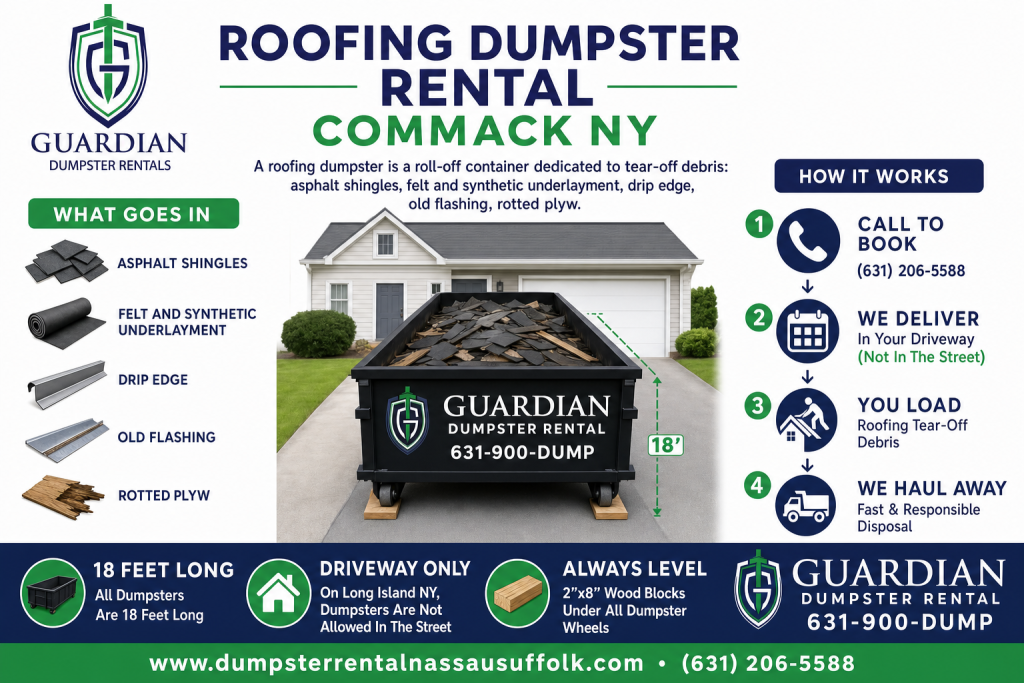
Our Process
Tell Us About Your Roof
Call or book online with the basics: approximate square footage, number of shingle layers coming off, and your tear-off start date. We'll recommend a 10, 20, or 30 yard container and give you a clear quote with the weight allowance spelled out. Most Commack homeowners get an answer in one short call.
We Deliver Before The Crew Arrives
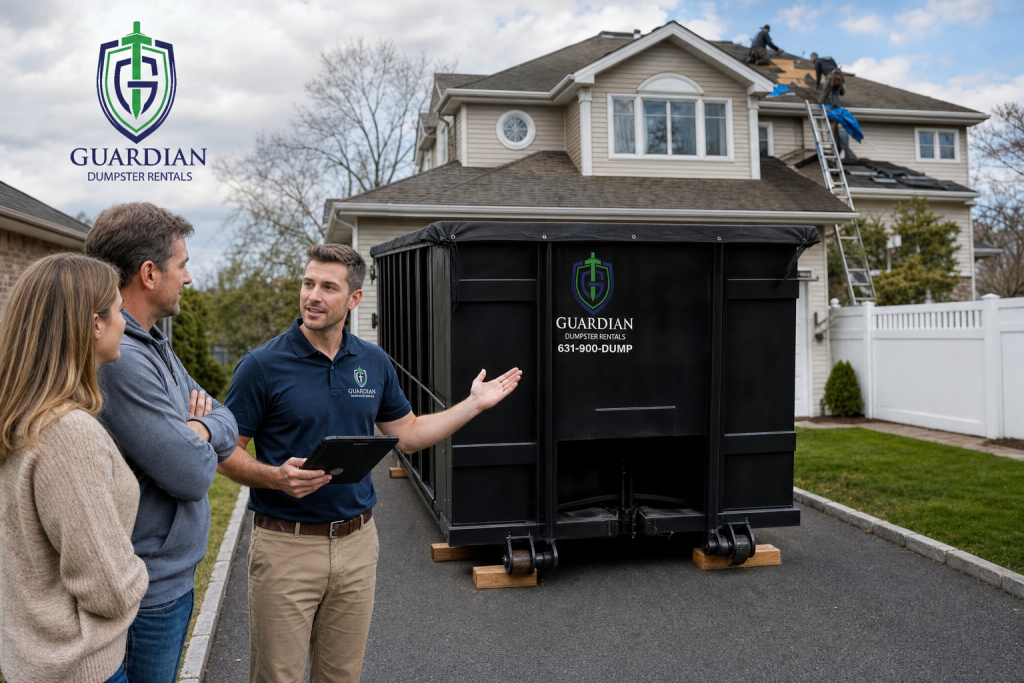
We place the roll-off where your roofer wants it — usually tight to the house so debris can be tossed straight from the roof. We lay boards under the container rails to protect asphalt and paver driveways, and we confirm the placement won't block garage access or the street.
Fill It, Call Us, We Haul It
Your crew loads shingles, underlayment, flashing, and old decking as the roof comes down. Keep debris level with the top rail for a safe, legal haul. When the job wraps — or if you need a swap-out mid-project — one call gets the container picked up and the debris disposed of properly.
| Container Size | Best For | Approximate Shingle Capacity | Typical Driveway Footprint |
|---|---|---|---|
| 10 Yard Dumpster | Single-layer tear-off on a small cape or garage roof, up to about 15 squares | Roughly 25-30 bundles of old shingles plus underlayment | About 12 ft long — fits a single-car driveway |
| 20 Yard Dumpster | Single-layer tear-off on most Commack ranches and colonials, or a two-layer job up to about 24 squares | Roughly 55-60 bundles plus flashing, felt, and drip edge | About 22 ft long — fits a standard two-car driveway |
| 30 Yard Dumpster | Large or multi-structure tear-offs, two to three layers, or house-plus-garage projects | Roughly 85-90 bundles with headroom for packaging from new materials | About 22 ft long with taller walls — needs clear overhead access |
Commonly Overlooked In The Dumpster Rental Industry
- Counting shingle layers before sizing the container — Most people size by roof square footage alone, but a hidden second or third layer can double the tonnage and max out a container halfway through the tear-off.
- Weight limits versus volume on shingle loads — Asphalt shingles are dense, so a container can hit its weight cap while still looking half empty — a surprise overage fee if nobody mentioned tonnage up front.
- Driveway protection boards under the container — A loaded shingle dumpster concentrates thousands of pounds on small contact points, and companies that skip boards leave gouges in asphalt that homeowners discover after pickup.
- Overhead wires and tree limbs at the drop site — Roll-off trucks need significant vertical clearance to tilt the container off, and a low service line nobody checked can stop a delivery with the roofing crew already on site.
- Positioning the open end toward the debris path — A container dropped facing the wrong way forces the crew to lift shingles over the sidewall all day instead of walking them in, slowing the tear-off noticeably.
- Prohibited materials mixed into roofing debris — Crews sometimes toss leftover brick, concrete, dirt, or yard waste into a shingle container, which violates the rental terms and can trigger rejected loads or extra disposal charges.
- A nail magnet sweep before the container leaves — Thousands of roofing nails come off in a tear-off, and skipping the magnet sweep around the container zone is how driveways and neighbors' tires end up with punctures.
- Scheduling pickup around the final roof inspection — Pulling the container before the roofer's punch list is done means leftover flashing scraps and packaging have nowhere to go, while leaving it a week too long racks up daily fees.
Case Studies
Case Study #1
Situation: A homeowner on Burr Road in Commack was having a 2,400-square-foot ranch re-roofed before selling. The roofing crew was scheduled for a Monday tear-off, and the homeowner called us the Thursday before needing a container on the driveway by Sunday evening.
Problem: The roof had two layers of asphalt shingles — an original 3-tab layer and architectural shingles installed over it in the early 2000s. The homeowner had been quoted a 10 yard dumpster by another company based only on square footage, without anyone asking how many layers were coming off.
Investigation: We asked three questions on the phone: how many layers, what pitch, and whether underlayment and old flashing were coming off too. A two-layer tear-off on 2,400 square feet is roughly 24 squares of material per layer, and wet or old shingles run heavy.
Findings: The total debris estimate came to roughly 4.5 to 5 tons of shingles plus felt, drip edge, and old pipe boots. A 10 yard container would have hit its weight limit before the crew finished the first layer, forcing a mid-job swap and an idle roofing crew billing by the hour.
Solution: We recommended a 20 yard dumpster with a reinforced floor, placed it Sunday afternoon on plywood boards to protect the asphalt driveway, and positioned the open end toward the garage so the crew could wheelbarrow debris straight in from the drop zone.
Outcome: The crew finished the full tear-off and loaded everything into the single 20 yard container with room to spare for packaging from the new materials. No swap, no second haul fee, and the roofers wrapped a day early. We picked up Tuesday morning before the open house photos were taken.
Lesson: Shingle layers matter more than roof size when sizing a container. Always confirm the layer count before booking — a two-layer tear-off almost always pushes a job from a 10 yard into a 20 yard dumpster.
Case Study #2
Situation: A roofing contractor we work with regularly took on a large colonial near the Commack Road corridor — a 3,800-square-foot home with a detached two-car garage, both getting new roofs in the same week. Cedar shake was coming off the garage, architectural shingle off the house.
Problem: The driveway was narrow and shared with a neighbor, and the contractor needed debris capacity for both structures without blocking the neighbor's access for five days. A single oversized container parked all week was going to create a dispute before the first shingle came off.
Investigation: We did a quick site visit the day before delivery — something we do free for multi-structure tear-offs in Suffolk County. We measured the driveway apron, checked the overhead for low wires near the garage, and walked the debris path the crew planned to use.
Findings: There was room for one 30 yard dumpster if we angled it tight against the house side of the driveway, leaving a clear lane for the neighbor. Combined debris from both roofs was estimated at just over 7 tons — too much for a 20 yard on weight, but comfortably inside a 30 yard container's capacity.
Solution: We delivered the 30 yard dumpster at 7 a.m. on day one, set on boards, angled per our site-visit plan. We also flagged that the old cedar shake had visible nails throughout and reminded the crew to magnet-sweep the shared driveway daily, since a neighbor's flat tire sours a project fast.
Outcome: Both roofs were torn off and loaded into the single container. The neighbor kept full driveway access all week, the magnet sweep caught several hundred roofing nails, and the contractor avoided the cost of two separate hauls. Pickup happened the morning after final inspection.
Lesson: On tight shared driveways, placement planning is worth as much as container size. A well-angled 30 yard dumpster with a measured site plan beats two smaller containers fighting for the same square footage.
| Your Roofing Scenario | Recommended Size | What It Depends On |
|---|---|---|
| Detached garage or shed re-roof, one layer | 10 Yard Dumpster | Roof under 10 squares and no wet or saturated shingles pushing the weight up |
| Cape or small ranch, single-layer asphalt tear-off | 10 Yard Dumpster | One confirmed layer; if a second layer is found during tear-off, call us before overfilling |
| Typical Commack ranch or colonial, single layer | 20 Yard Dumpster | Roof size of 16-30 squares; heavier architectural shingles lean toward this size even on smaller roofs |
| Two-layer tear-off on a mid-size home | 20 Yard Dumpster | Combined layers under about 5 tons; older 3-tab plus architectural combos usually fit |
| Large colonial, two or three layers | 30 Yard Dumpster | High tonnage from multiple layers — weight, not volume, is usually the limit on these jobs |
| House and detached garage re-roofed the same week | 30 Yard Dumpster | Whether one placement spot can serve both debris paths; we do free site checks for multi-structure jobs |
| Cedar shake removal plus new shingle install | 20 or 30 Yard Dumpster | Shake is bulkier than asphalt by volume — size up if the roof exceeds about 18 squares |

Reviews
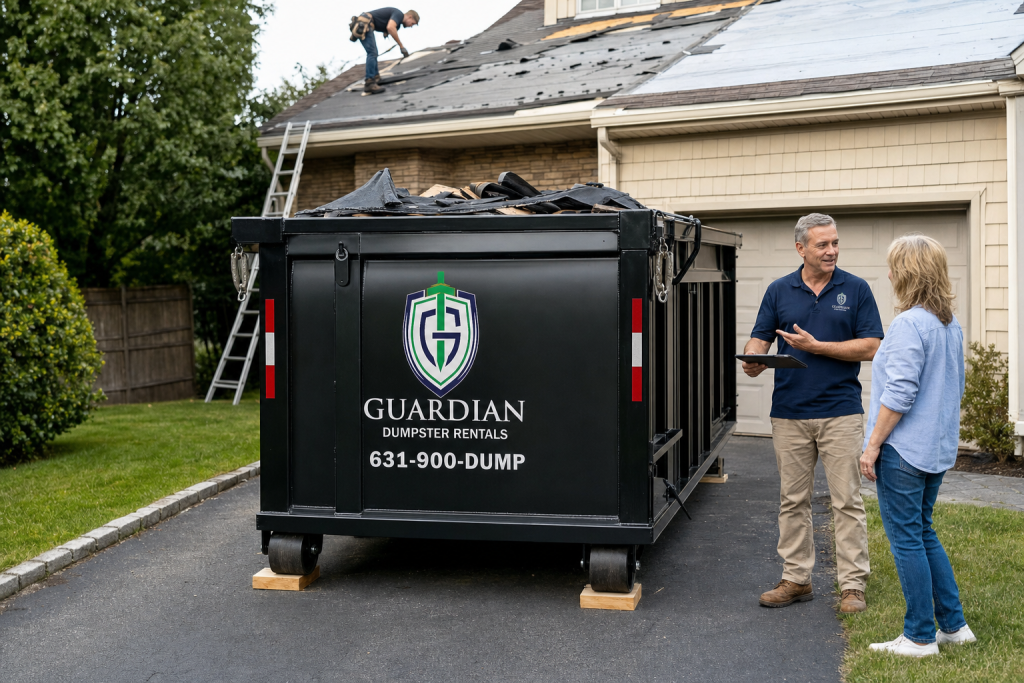
Had my roof torn off in September and Guardian set the 20 yard right where my roofer asked, up against the garage so the crew could toss shingles straight down into it. They put boards under the wheels so my driveway didn't get scratched. Two layers of old shingles went in no problem. Picked up the day after the job finished.
Dan Petrocelli
We weren't sure what size we needed for a single-layer tear-off on our cape in Commack. The guy on the phone asked about layers and roof size and steered us to a 10 yard instead of upselling us. It held all the shingles, felt paper, and the old gutters. Honest sizing advice is rare — would use them again.
Maria Castellano
I'm a roofing contractor working mostly in Suffolk County and I've used Guardian on probably a dozen tear-offs now. Deliveries show up when promised, which matters when my crew is standing on a stripped roof. The 30 yard they dropped for a big colonial off Jericho Turnpike handled two layers of architectural shingles with weight to spare. Only reason it's not perfect — I'd love Saturday pickups.
Rob Keaney
Frequently Asked Questions
What Size Dumpster Do I Need For Roofing Dumpster Rental Commack NY New York?
For most roof tear-offs in Commack, the right size comes down to the square footage of your roof and the number of shingle layers coming off. We carry three sizes: 10 yard, 20 yard, and 30 yard containers, and each has a clear sweet spot for roofing work.
A 10 yard dumpster handles roughly 20 to 25 squares of single-layer architectural shingles, which covers many of the ranches and smaller capes you see off Larkfield Road and in the neighborhoods near Commack Road. If your home has two layers of shingles, or you're tearing off a larger colonial, the 20 yard is the safer call — it manages around 40 to 45 squares and gives your crew room to toss underlayment, flashing, and drip edge without overfilling.
The 30 yard container is built for big jobs: oversized homes near the Hoyt Farm area, multi-building tear-offs, or projects where the roofer is also replacing plywood decking. Keep in mind that shingles are heavy, so weight limits matter as much as volume. When you call, tell us your roof's approximate square footage and how many layers are on it, and we'll match you to the right container so you're not paying for space you don't use or scrambling for a second box mid-job.
One important note: our containers are for roofing debris and general materials only. We do not accept brick, concrete, dirt, or yard waste in any size dumpster.
Can A Roll-Off Dumpster Sit In My Driveway Without Damaging It?
Yes — driveway placement is actually our standard approach for roofing jobs in Commack, and we take specific steps to protect your property. Before the container touches the ground, our drivers lay down wooden boards under the steel rails and rear rollers. This spreads the weight and prevents scratching, gouging, or cracking on asphalt and paver driveways, which are common throughout Suffolk County neighborhoods.
We also think about positioning. For a roof tear-off, the ideal spot is close enough to the house that your roofing crew can slide debris directly off the roof edge or down a chute into the container. That keeps shingles off your lawn and shortens cleanup time. Our drivers will work with you on the exact placement when they arrive, whether that's a 10 yard tucked near the garage or a 30 yard angled along a longer driveway.
One thing to watch in warmer months: fresh or sun-softened asphalt can be more vulnerable to indentation from a heavily loaded box. Shingle debris is dense, so a full 20 yard or 30 yard container carries real weight. If your driveway was recently sealed or paved, let us know when you book and we'll add extra protection or discuss an alternate spot.
If driveway placement isn't possible, street placement may be an option, though you'll want to check with the Town of Smithtown about any permit requirements for your specific street before delivery day.
What Can And Can't Go In A Roofing Dumpster From Guardian Dumpster Rental?
Our containers are built for roof tear-off debris, and that covers nearly everything a roofing project generates. You can load asphalt shingles (including multiple layers), underlayment and tar paper, old flashing, drip edge, ridge vents, roofing nails, plywood and OSB decking that's being replaced, gutters coming down during the job, and general packaging from the new materials being installed.
There are firm restrictions you need to know before loading. We do not accept brick, concrete, dirt, or yard waste in any of our containers — not in the 10 yard, the 20 yard, or the 30 yard. If your project involves masonry work around a chimney or landscaping cleanup alongside the roof job, those materials need a separate disposal plan, and we're happy to point you in the right direction when you call.
Standard prohibited items also apply: no liquids, paints, solvents, propane tanks, tires, batteries, or hazardous materials of any kind. Hot tar in liquid form is not accepted either, though hardened tar paper and built-up roofing debris are fine.
One practical tip for Commack homeowners: have your roofer confirm what's coming off the roof before you book. A straightforward shingle tear-off loads differently than a job with heavy decking replacement, and knowing the mix helps us recommend whether a 20 yard or 30 yard container keeps you under the weight limit. Loading smart on day one avoids overage fees when the box is picked up.
How Fast Can I Get Roofing Dumpster Rental Commack NY New York Delivered, And How Long Can I Keep It?
In most cases, Roofing Dumpster Rental Commack NY New York can be delivered next business day, and same-day delivery is often possible if you call in the morning. Roofing contractors work on tight weather windows here on Long Island, so we prioritize getting containers on site before the crew shows up — nothing stalls a tear-off like a missing dumpster.
Our standard rental period runs long enough to cover a typical residential roof replacement, which most Commack crews finish in one to three days. If your project runs longer because of rain delays or unexpected decking repairs, extending the rental is simple — just call before your scheduled pickup and we'll adjust it. Extra days are billed at a modest daily rate, far cheaper than rushing a job to beat a deadline.
For scheduling, we recommend booking two to three days ahead during peak roofing season, roughly April through November, when demand across Suffolk County climbs. Spring and fall are especially busy after storm seasons. If a nor'easter or windstorm has just come through, call early — emergency roof repairs spike demand on 10 yard and 20 yard containers in particular.
Pickup works the same way delivery does: when the job wraps up, call or schedule online and we'll haul the loaded container away, usually within a business day. Make sure debris sits level with the top rails — overloaded boxes can't legally be transported on local roads, and that delay costs everyone time.
How Much Does Roofing Dumpster Rental Commack NY New York Cost?
Pricing depends mostly on container size and the weight of your shingle debris. Our 10 yard dumpster is the most budget-friendly option and handles most single-layer tear-offs on smaller Commack homes. The 20 yard is the workhorse for typical ranches and colonials around Marion Carll Farm and the Mayfair area, and the 30 yard covers large homes or multi-layer tear-offs.
Every quote includes delivery, pickup, the rental period, and a set weight allowance. Roofing shingles are deceptively heavy — asphalt architectural shingles run roughly 300 to 400 pounds per square — so we build realistic tonnage into our roofing quotes rather than surprising you at pickup.
If your load comes in over the included allowance, you only pay the per-ton overage at the Suffolk County transfer station rate, never an inflated markup. Tell us your roof's approximate square footage and how many layers are coming off, and we'll recommend the right size so you're not paying for space you don't need or ordering a second container mid-job.
One thing to keep in mind: our containers are for roofing and general construction debris only. We don't accept brick, concrete, dirt, or yard waste, so those materials never factor into your weight charges. Call Guardian for a firm, written quote before your crew shows up — most Commack homeowners are pleasantly surprised at how straightforward the numbers are.
Do I Need A Permit To Put A Roofing Dumpster On My Property In Commack?
If the container sits entirely on your own driveway or private property, no permit is required anywhere in Commack. That covers the vast majority of roofing jobs we deliver for in the hamlet.
It gets more specific if the dumpster has to sit in the street. Commack is split between two townships — roughly everything north and west falls under the Town of Huntington, while the southeast portion is Town of Smithtown. Each town handles street-placement permits through its own highway or engineering department, and requirements and fees differ between the two.
When you book with Guardian Dumpster Rental, tell us your cross streets and we'll confirm which township you're in and whether a permit applies to your situation. We've placed hundreds of containers across both sides of Commack, so we know which blocks have the narrow roadways and parking considerations that make driveway placement the smarter call.
Practically speaking, we can almost always avoid the permit question entirely. Our 10 yard container fits in nearly any Commack driveway with room to spare, and even the 20 yard fits comfortably in a standard two-car driveway. The 30 yard needs about 22 feet of length plus truck clearance, which most driveways off Jericho Turnpike and Commack Road handle fine. If you're unsure, send us a photo of your driveway and we'll tell you honestly what fits before you commit.
How Does Weight Work With Shingle Debris, And How Do I Avoid Overage Fees?
Roofing debris is one of the heaviest materials we haul, which is exactly why Roofing Dumpster Rental Commack NY New York quotes are structured differently than a general cleanout rental. Each container size comes with an included tonnage, and anything above that is billed per ton at the actual disposal rate.
Here's the practical math. A single layer of asphalt shingles weighs around 300 to 400 pounds per 100 square feet. A typical 2,000-square-foot Commack roof produces roughly 3 to 4 tons of debris for one layer — double that if there's a second layer underneath, which is common on older homes in neighborhoods like Indian Head and Valmont Village.
The biggest mistake we see is ordering a 10 yard container for a two-layer tear-off. The debris may physically fit, but the weight can exceed safe hauling limits. For multi-layer jobs, we'll usually steer you to a 20 yard or 30 yard so the load stays legal and your per-ton costs stay predictable.
Two more tips from our drivers: keep the load level with the top rail, never mounded above it, and don't let anyone toss in brick, concrete, dirt, or yard waste — we don't accept those materials, and they'd add serious weight anyway. Spread shingles evenly rather than piling them at one end, which keeps the container balanced for pickup and avoids delays on haul day.
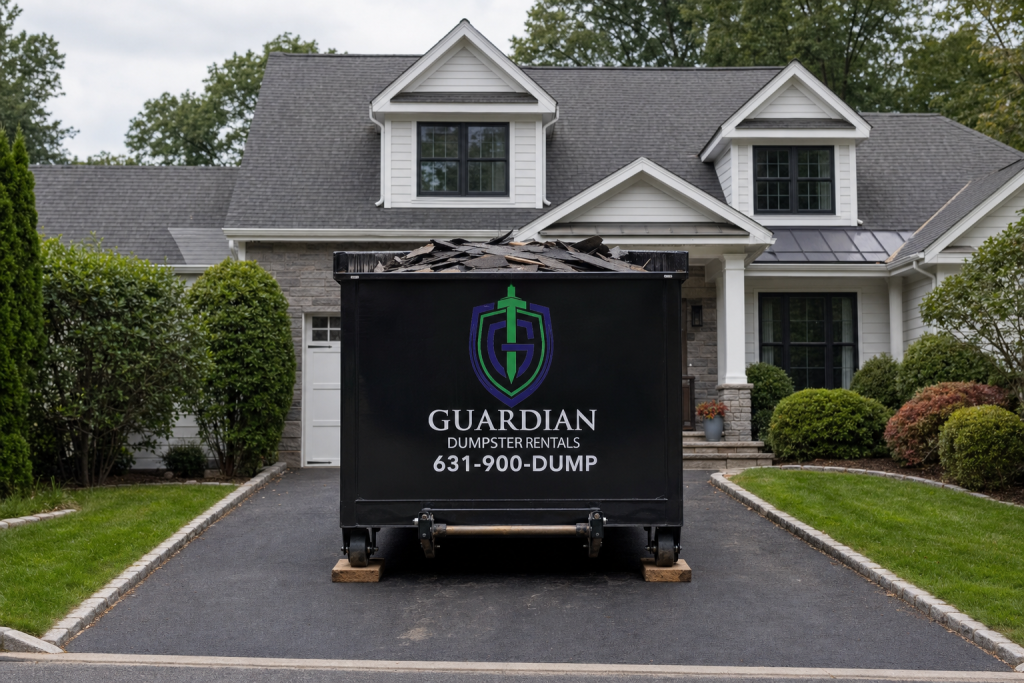
Does Guardian Deliver Roofing Dumpsters Beyond Commack, And Can You Coordinate With My Roofer?
Yes to both. While Commack is home base, we run daily routes throughout Suffolk County, including East Northport, Smithtown, Hauppauge, Dix Hills, Kings Park, and Brentwood. If your roofer is doing your house this week and your parents' place in Kings Park next week, we can line up both containers on one schedule.
Coordinating with roofing contractors is honestly the best part of our job. Most crews want the container on site the morning they start tearing off, positioned close to the drop zone so debris goes straight from the roof into the box. Give us your contractor's name and start date, and we'll deliver the afternoon before or first thing that morning — whichever the crew prefers.
We also handle swap-outs for bigger jobs. If a crew fills a 20 yard faster than expected on a large tear-off, we can haul the full container and drop an empty one, often the same day, so the job never stalls waiting on disposal.
For contractors working multiple Commack-area roofs in a season, we offer straightforward repeat-customer scheduling: one call, your sizes reserved, your preferred placement noted on file. Whether you need a 10 yard for a small garage roof, a 20 yard for a standard house, or a 30 yard for a large multi-layer project, having a local hauler who answers the phone and knows the streets around here makes the whole project run smoother.
Where Is The Best Spot To Place A Roofing Dumpster At My Commack Home?
For most tear-offs in Commack, the driveway is the ideal spot. Your roofing crew can position the container close to the eaves so shingles slide almost directly off the roof into the box, which keeps your lawn clean and speeds up the job considerably.
When you book with Guardian, we ask a few quick questions about your property: how long and wide the driveway is, whether there are low-hanging branches or wires, and which side of the house the crew will be stripping first. A 10 yard container needs roughly 50 feet of straight clearance for the truck to roll it off, while a 20 yard or 30 yard box needs a bit more room.
If your driveway is short — common on some of the older lots near Commack Road and Jericho Turnpike — we can often angle the container or place it at the apron, as long as it stays fully on your property. We recommend parking cars on the street the morning of delivery so the driver has a clear path.
One tip from experience: ask your roofer which section of the roof they plan to tear off first, and have us place the dumpster on that side. It saves the crew hundreds of trips with debris carts, and it usually means the box gets loaded more evenly, which matters when you're dealing with heavy shingle loads. Our drivers set every container on protective boards, so you don't have to worry about the steel rails resting directly on your asphalt or pavers.
What If My Project Generates More Debris Than Expected With Roofing Dumpster Rental Commack NY New York?
It happens more often than you'd think, especially on older Commack homes where the roofer discovers a second or even third layer of shingles under the top layer. If your container fills up before the tear-off is done, call us and we'll schedule a swap-out: we haul away the full box and drop an empty one in its place, usually the same day or next morning.
A swap is almost always cheaper and safer than overloading. Shingle debris is dense, and every container has a fill line for a reason — drivers legally can't transport a box that's heaped above the rim, and an overweight load can trigger steep per-ton overage charges.
To avoid the problem entirely, tell us the square footage of your roof and how many layers are coming off when you book Roofing Dumpster Rental Commack NY New York. One layer on a typical 1,500 to 2,000 square foot ranch usually fits in a 10 yard container. Two layers, or a larger colonial, generally calls for a 20 yard. Big tear-offs with multiple layers or steep, complex rooflines are 30 yard territory.
When in doubt, size up. The price difference between a 10 yard and a 20 yard is modest compared to the cost of a second delivery. And remember to keep the load to roofing debris only — no brick, concrete, dirt, or yard waste goes in the box, since those materials change the weight profile and disposal requirements entirely.
How Should The Dumpster Be Loaded During A Commack Roof Tear-Off To Get The Most Out Of It?
Loading technique makes a real difference with shingle debris. Asphalt shingles are heavy but irregular, and a sloppily loaded container can hit its weight limit while looking half empty.
The best practice is to load flat and layer evenly. Have the crew break down bundles of torn-off shingles rather than tossing them in tangled heaps, and spread each load across the floor of the box before building upward. Felt paper, drip edge, and old flashing should be worked into the gaps between shingle layers instead of piled on top.
Distribute weight front to back. A 10 yard, 20 yard, or 30 yard container that's loaded heavily at one end is harder for our driver to winch onto the truck and can shift during transport. Roofers who work in Suffolk County regularly know this, but if you've hired a smaller crew, it's worth mentioning on day one.
Keep everything below the rim. Nothing can stick up past the top edge of the container — our drivers tarp every load before leaving your street, and anything above the fill line has to come off before the box moves.
Finally, keep the load clean. Roofing debris only: shingles, underlayment, flashing, nails, and rotted decking boards your roofer replaces. Brick, concrete, dirt, and yard waste are never allowed in our containers, so if your project includes landscaping or masonry work, keep those materials completely separate from the roofing box.
Is A Roofing Dumpster Different From A Standard Container, And Which One Do I Actually Need?
The steel boxes themselves are the same — what changes is how the rental is set up. When you tell Guardian you're doing a roof tear-off in Commack, we price and plan the rental around shingle weight, which behaves very differently from household junk or renovation debris.
A cubic yard of asphalt shingles can weigh several times what a cubic yard of mixed household material weighs. That's why we steer roofing customers toward the right size early: a 10 yard container handles a single-layer tear-off on a smaller ranch or cape, a 20 yard covers most two-layer jobs and mid-size colonials, and a 30 yard is the right call for large homes, multiple layers, or projects where decking is being replaced too.
With Roofing Dumpster Rental Commack NY New York, your quote is built around realistic shingle tonnage rather than a generic weight allowance, so you're far less likely to get surprised by overage fees after pickup. We also set the container with protective boards under the rails, since roofing boxes get loaded hard and heavy.
One thing to know before booking: our roofing containers are for roofing debris, period. If your project also involves tearing out a patio, regrading soil, or clearing brush, none of that can go in the box — brick, concrete, dirt, and yard waste aren't accepted in any of our containers. Keeping the load pure roofing material keeps your disposal straightforward and your final bill predictable, which is exactly what you want mid-project.
How Should I Prepare My Property Before Roofing Dumpster Rental Commack NY New York Arrives?
A little prep goes a long way. Before the truck shows up, clear a spot roughly 60 feet long and 10.5 feet wide so the driver has room to back in and tilt the container off the bed. Move cars out of the driveway the night before, since most roof tear-offs in Commack start early and our deliveries often arrive between 6 and 9 a.m.
Check overhead clearance too. The truck needs about 20 feet of vertical space to raise the bed, so look for low branches, basketball hoops, and utility lines along your driveway. If you have a sprinkler system near the apron, flag the heads so the driver can avoid them.
If you want extra protection for the surface, lay down plywood sheets where the container will rest. We place wood under the rails on request, but many homeowners on older driveways like the added coverage. Finally, talk with your roofer about which side of the house they plan to strip first, and position the container as close to that side as the driveway allows. The shorter the carry distance for loaded debris, the faster the crew works and the cleaner your yard stays. Whether you book a 10 yard, 20 yard, or 30 yard container, this same prep applies.
Do I Need To Be Home When Guardian Delivers Or Picks Up The Roofing Dumpster?
No, and most of our Commack customers aren't. As long as we have clear placement instructions, the driver can deliver and pick up without anyone on site. When you book, tell us exactly where you want the container: left side of the driveway, right side, close to the garage, angled toward the back of the house. Many people text us a photo of the driveway with an X marking the spot, which works perfectly.
For delivery, just make sure vehicles are moved and the area is clear. The driver will set the container, place wood under the rails if requested, and send a confirmation. If something blocks the spot, we'll call before improvising.
For pickup, the main rule is that debris must not be loaded above the top rail. DOT regulations require a level load for safe transport, so anything sticking up over the sides has to come off before the driver can haul it. Also double-check that nothing prohibited went in, since no brick, concrete, dirt, or yard waste is allowed in the container.
If you'd rather be home for peace of mind, that's fine too. We give a delivery window the day before so you can plan around it, whether it's a 10 yard for a small ranch or a 30 yard for a large colonial tear-off.
What Happens To The Roofing Debris After Guardian Hauls It Away From My Commack Home?
Once the container leaves your driveway, it goes to a licensed transfer station here in Suffolk County, where the load is weighed, sorted, and processed. Asphalt shingles are one of the most recyclable materials in residential construction, and a large portion of the shingle tonnage we haul is ground down and reused, often as a component in asphalt pavement for Long Island roadwork.
That's one reason we ask customers to keep loads clean. A container filled with shingles, underlayment, nails, and flashing is easy to process. Mixing in prohibited materials like brick, concrete, dirt, or yard waste contaminates the load, forces hand-sorting at the facility, and can trigger extra charges passed back to you.
Metal components like drip edge, old gutters, and flashing are typically separated at the facility and sent to scrap recyclers. Wood decking that comes off during a re-sheathing job is processed separately as well.
For homeowners who care about where their tear-off ends up, this matters: a typical Commack roof produces two to four tons of debris, and keeping that material in the recycling stream instead of a landfill is a real difference. It's the same responsible disposal process whether you rent a 10 yard, 20 yard, or 30 yard container from us.
Can A Homeowner Doing A DIY Tear-Off Use Roofing Dumpster Rental Commack NY New York, Or Is It Contractors Only?
Roofing Dumpster Rental Commack NY New York is available to homeowners and contractors alike, and we work with plenty of hands-on Commack residents stripping their own roofs. There's no contractor license required to rent from us, and the pricing, delivery, and pickup process are identical either way.
That said, DIY tear-offs come with a few practical tips. First, size up rather than down. A homeowner working weekends generates debris in bursts, and a 20 yard container gives you breathing room that a 10 yard might not, especially if your roof has two layers of shingles. For larger homes or anything over 2,500 square feet of roof surface, the 30 yard is usually the safer call.
Second, ask about rental length when you book. DIY projects take longer than a professional crew's one-day strip, and we'd rather set realistic expectations up front than have you rushing on a Sunday afternoon.
Third, load smart. Drop or carry shingles directly into the container rather than piling them on the lawn first, since double-handling wet shingle bundles is exhausting and tears up the grass. Break down loads evenly, keep everything below the top rail, and remember the material rules: shingles, underlayment, flashing, and nails are fine, but no brick, concrete, dirt, or yard waste. Call us with your roof's square footage and layer count, and we'll help you pick the right size before you commit.
Local Relevance
Commack's housing stock is a big part of why roof tear-offs here generate so much debris. Much of the hamlet was built out during Long Island's postwar boom, and those ranches, capes, and split-levels have often been re-roofed two or three times. When a roofer strips a second layer, the debris volume can nearly double — which is exactly when container sizing matters.
The weather does roofs here no favors either. Humid summers, freeze-thaw winters, and the occasional nor'easter or tropical remnant mean Suffolk County roofs tend to need replacement on the earlier end of their rated lifespan. After a big wind event, tear-off season gets busy fast, so booking your container early keeps your roofer on schedule.
Guardian Dumpster Rental serves Commack and the surrounding area daily, with the same roof-ready containers available for Roofing Dumpster Rental in Dix Hills and neighbors throughout the Dumpster Rental Deer Park New York area. Local routes mean faster delivery and reliable swap-outs when a job runs bigger than planned.
Because so many Commack homes went up in the 1950s and 60s, roofers here frequently uncover a second layer of shingles under the visible one — and a double-layer tear-off on a typical split-level can push a 20 yard load toward 30 yard territory, so it pays to confirm layer count before you book a size.
Get A Roofing Dumpster On Your Driveway Before The First Shingle Comes Off
Tell us your roof size and tear-off date, and Guardian Dumpster Rental will have the right 10, 20, or 30 yard container placed and ready for your crew. Clear pricing, driveway protection, and fast swap-outs when the job runs big — that's how roof debris should be handled in Commack.
Call us: (631) 206-5588
Helpful Resources
- EPA guidance on construction and demolition materials — Federal guidance on handling and recycling tear-off and construction debris
- OSHA roofing safety resources — Safety standards for roof tear-off work
Serving Commack · Suffolk County NY
Last updated: October 4, 2026