
Roofing Dumpster Rental West Islip — Containers Sized For South Shore Shingle Tear-Offs, Delivered Before The Crew Arrives
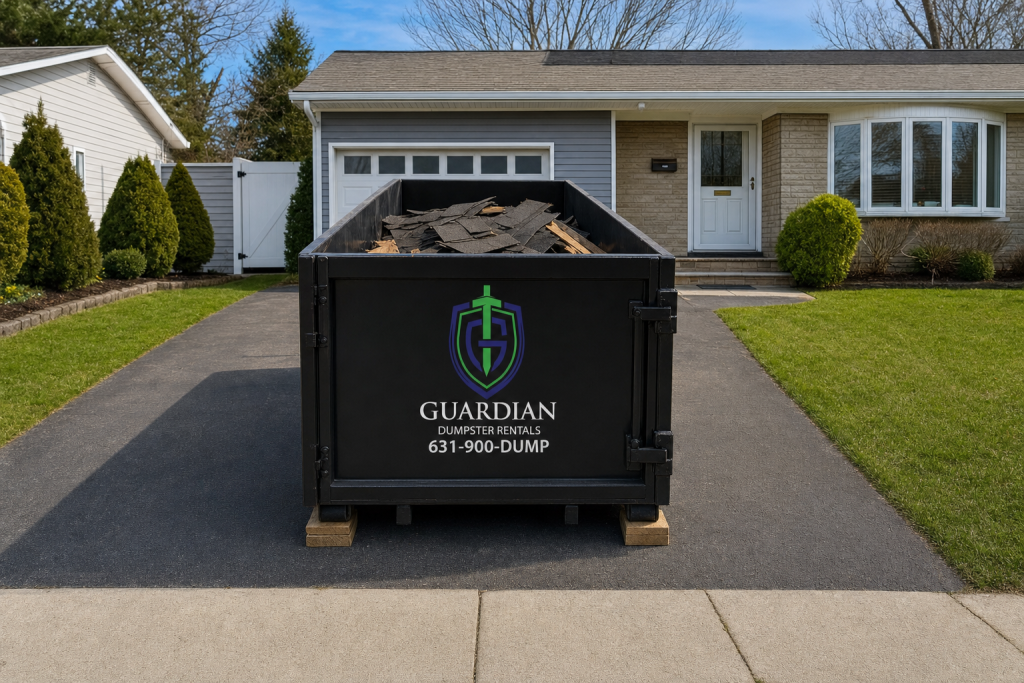
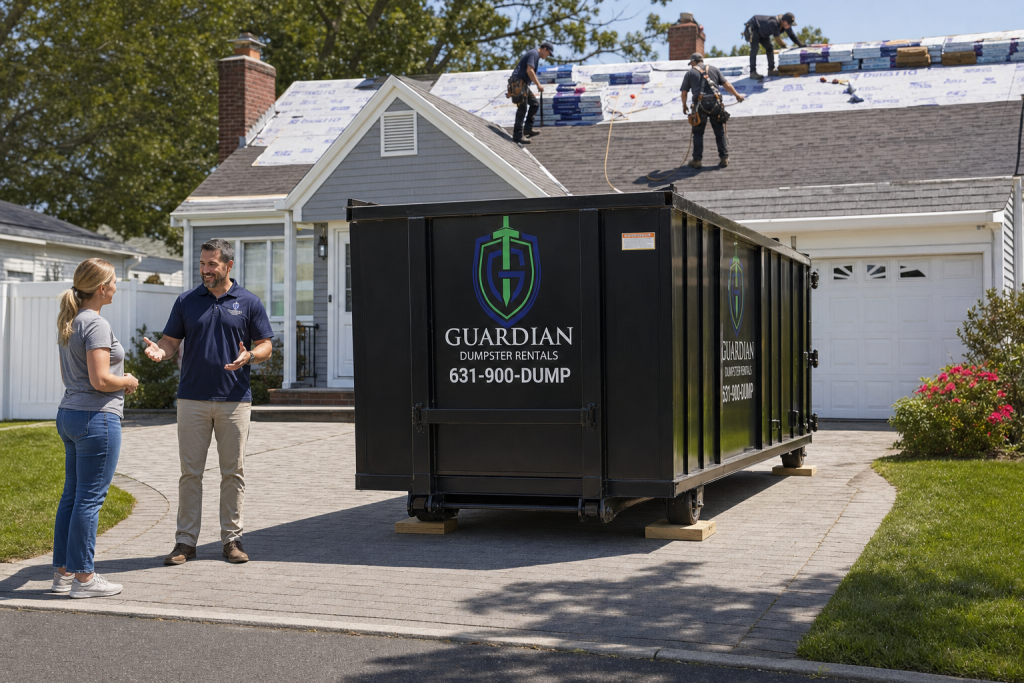
Roofing Dumpster Rental West Islip from Guardian Dumpster Rental puts a 10, 20, or 30 yard roll off container in your driveway before your tear-off begins, so old shingles, underlayment, and flashing go straight from the roof into the box. Most single-layer tear-offs on a typical South Shore cape or ranch fit comfortably in a 10 or 20 yard container, while larger colonials or double-layer roofs usually call for a 30. We confirm placement, protect your driveway with boards, and haul the load out as soon as the roofers wrap up.
What This Service Is
A roofing dumpster is a roll off container dropped as close to the house as safely possible, positioned so the crew can toss debris directly off the roof edge or down a chute into the box. Shingle debris is deceptively heavy — asphalt shingles weigh far more per cubic yard than household junk — so sizing is about weight as much as volume. That is why we only recommend three containers for roof work: the 10 yard for small single-layer tear-offs, the 20 yard for most full-house jobs, and the 30 yard for big colonials, double layers, or roofs with lots of plywood decking coming off. If your project leans more toward a standard tear-off on an average-size home, our 20 Yard Dumpster Rental West Islip NY page breaks down exactly what fits in that size. One important note: our containers accept roofing debris and general construction material, but no brick, no concrete, no dirt, and no yard waste — those materials overload the box and require different disposal.
Common Problems
What Does Roofing Dumpster Rental West Islip Cost, And What's Actually Included?
Pricing is driven by three things: container size, rental period, and the weight of the load. Shingles are heavy, so the quoted price should include a weight allowance that realistically covers a tear-off — if a quote looks suspiciously cheap, the tonnage cap is usually where they get you back. Our quotes spell out the included tonnage, the rental window, delivery, and pickup, so the number you hear is the number on the invoice. The most common overcharge we see homeowners hit with elsewhere is ordering a box too small, then paying for a second delivery; we help you size it right the first time.
The Roofers Start At 7 A.M. — What Happens If The Dumpster Isn't There, Or Fills Up Mid-Job?
A late container means a roofing crew standing around on your dime, or worse, shingles piling up on your lawn. We schedule roofing drops the day before or first thing in the morning so the box is sitting in the driveway before the first ladder goes up. If a double layer or rotted decking produces more debris than expected, we run swap-outs — the full box leaves and an empty one lands in its place, usually the same day. We coordinate this with crews across the South Shore, including jobs tied to Roofing Dumpster Rental Bay Shore NY projects, so mid-job timing is something we handle constantly.
Should I Book The Container Myself Or Let My Roofer Handle It?
Either works, but booking it yourself often saves money — many roofers add a markup when they arrange disposal, and you lose visibility into what you're paying for. If you book directly, you control the size, the drop date, and where the box sits on your property. A good provider will ask about your roof's square footage, how many layers are coming off, and whether decking is being replaced before recommending a size. If a company quotes you a container without asking those questions, that's a sign they're guessing with your money. Homeowners handling broader cleanouts alongside a roof job can also look at our general Dumpster Rental West Islip New York options to combine projects into one delivery.
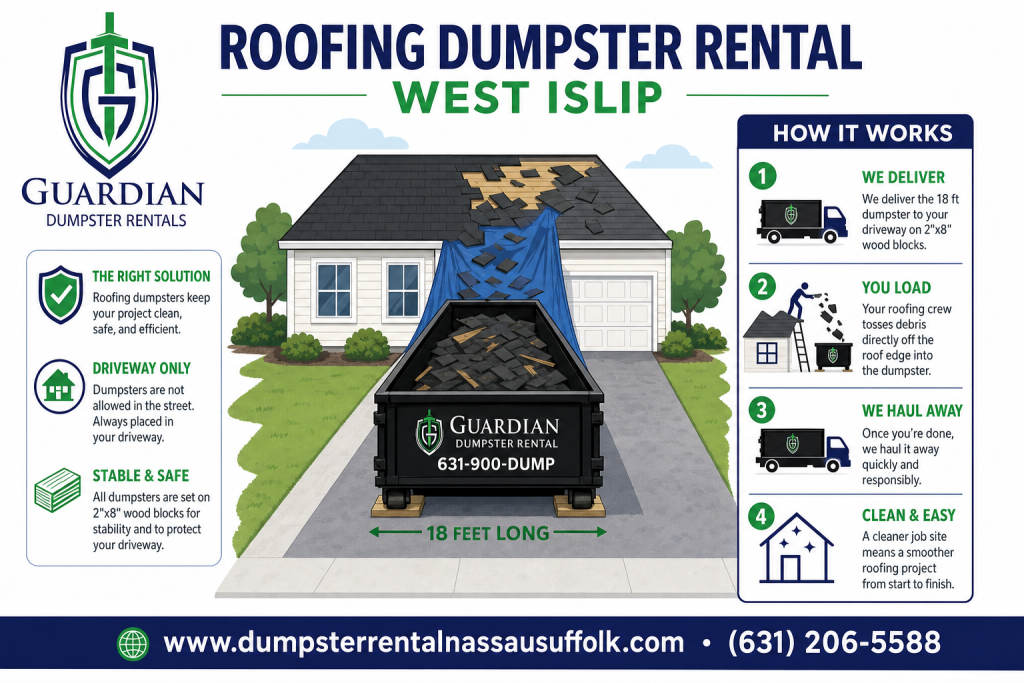
Our Process
Tell Us About The Roof
Give us the rough square footage, the number of shingle layers, and whether plywood is being replaced. From that, we'll recommend a 10, 20, or 30 yard container — no oversized box you don't need, no undersized box that stalls the job.
We Deliver And Position The Container
We place the box where the crew can throw debris directly into it, lay down boards to protect your driveway, and leave the door end accessible. Delivery is timed to beat the crew's start, typically the afternoon before or early that morning.
Load It, Call Us, And It's Gone
The crew fills the container with shingles, felt, flashing, and tear-off debris — remember, no brick, concrete, dirt, or yard waste. When the job wraps, we pick up promptly so a loaded dumpster isn't sitting in your driveway all week. Need a swap mid-job? One call handles it.
| Container Size | Typical Roofing Job | Approx. Shingle Capacity | Footprint |
|---|---|---|---|
| 10 Yard | Garage roofs, small repairs, partial tear-offs up to ~1,000 sq ft (single layer) | Around 25–30 squares of shingles | 12 ft long — fits short driveways and tight side yards |
| 20 Yard | Full single-layer tear-offs on most West Islip homes, 1,500–2,500 sq ft | Around 50–60 squares of shingles | 18 ft long — the most common choice for residential re-roofs |
| 30 Yard | Large homes, double-layer tear-offs, or roofs with heavy decking replacement | Around 80–90 squares of shingles | 20 ft long — needs a longer driveway or street placement |
Commonly Overlooked In The Dumpster Rental Industry
- Hidden second shingle layers — Older West Islip homes were often re-roofed directly over the original shingles, and nobody checks the edge until the tear-off reveals twice the debris they planned for.
- The weight of wet shingles — Shingles soaked by a storm or a long-standing leak can weigh 30 to 40 percent more than dry ones, which quietly pushes a container past legal hauling limits.
- Driveway protection boards — A loaded 20 or 30 yard container concentrates tons of weight on small steel wheels, and asphalt driveways get gouged when nobody puts plywood down first.
- Nail and debris cleanup at pickup — Roofing nails scatter well beyond the container during loading, and homeowners find them with their tires weeks later if the area around the box is never swept or magnet-rolled.
- Placement relative to the roof slope — A container parked on the wrong side of the house forces the crew to wheelbarrow every shingle around it, slowing the job and spreading debris across the yard.
- Prohibited materials mixed into the load — Crews sometimes toss chimney brick, old concrete walkway chunks, or dirt from gutter work into a roofing container, not realizing those materials are not allowed and can void the haul.
- Timing the swap on multi-day tear-offs — When a box fills mid-job, every hour waiting on an exchange is an hour the roof sits open, yet most people never ask about same-day swap availability before booking.
- Low-hanging wires and tree limbs over the drop zone — The roll-off truck needs vertical clearance to tilt the container off, and an overhead cable or branch nobody noticed can block delivery entirely on arrival day.
Case Studies
Case Study #1
Situation: A homeowner on Higbie Lane was having a 2,100 square foot architectural shingle roof torn off and replaced ahead of hurricane season. The roofing crew was scheduled for a Friday start and needed a container on site Thursday afternoon.
Problem: The driveway was short and shared with a neighbor, and the roofer originally requested a 30 yard container. A 30 yard box would have blocked the neighbor's access completely and left no room for the crew's trailer.
Investigation: We asked for the roof's square footage, the shingle type, and the number of layers coming off. The homeowner confirmed it was a single layer of architectural shingles over plywood, with no second layer hiding underneath.
Findings: A single-layer tear-off of 2,100 square feet of architectural shingles typically weighs around 2.5 to 3 tons. That load fits comfortably in a 20 yard container, which is also four feet shorter than a 30 yard and sits cleaner in a tight shared driveway.
Solution: We delivered a 20 yard dumpster Thursday afternoon, placed on plywood boards to protect the asphalt, positioned so the roofers could toss debris directly off the rear slope into the box. The neighbor kept full access to their side of the driveway.
Outcome: The tear-off filled the container to about 85 percent capacity with room to spare for underlayment, flashing, and packaging. Pickup happened Monday morning, and the homeowner avoided paying for 10 extra yards of capacity she never needed.
Lesson: Shingle layers, not roof size alone, determine the right container. A single-layer tear-off in West Islip rarely needs more than a 20 yard box, and the smaller footprint often solves driveway problems a bigger container would create.
Case Study #2
Situation: A roofing contractor working a full replacement on a larger colonial near Beach Street called us mid-job on a Tuesday. His crew had started tearing off what the estimate listed as one layer of three-tab shingles.
Problem: Halfway through the tear-off, the crew discovered a second layer of old shingles underneath, plus waterlogged decking along the eaves. The 20 yard container on site was already near capacity with half the roof still to come.
Investigation: We talked through what was left: roughly 1,400 square feet of double-layer shingles, soaked felt paper, and about a dozen sheets of rotted plywood. We also confirmed none of the debris was mixed with masonry or soil, since brick, concrete, and dirt are not permitted in our containers.
Findings: Wet shingles and saturated decking run significantly heavier than dry material. Loading all of it into the existing 20 yard box risked an overweight container that the truck could not legally haul on Suffolk County roads.
Solution: We ran a same-day swap: picked up the full 20 yard container Tuesday afternoon and dropped a fresh 30 yard in its place within three hours, so the crew never stopped working. The larger box handled the heavier double-layer debris without pushing weight limits.
Outcome: The contractor finished the tear-off Wednesday and dried the roof in before rain arrived Thursday. He now asks every West Islip homeowner about shingle layers before ordering a container, and calls us when the answer is uncertain.
Lesson: Hidden second layers are common on older South Shore homes. If there is any chance of a double layer or wet decking, planning for a 30 yard container, or a fast swap option, protects the schedule and keeps the load street-legal.
| Your Situation | Best Size | What It Depends On |
|---|---|---|
| Detached garage or shed roof | 10 Yard | Usually one layer and under 1,000 sq ft; a 10 yard handles it with room for felt and flashing |
| Typical ranch or cape, one shingle layer | 20 Yard | Most single-layer tear-offs in town fall between 1,800 and 2,400 sq ft — squarely 20 yard territory |
| Two shingle layers coming off | 30 Yard | Double layers nearly double the weight and volume; a 20 yard will fill before the roof is done |
| Large colonial or roof over 2,800 sq ft | 30 Yard | Square footage plus ridge caps, underlayment, and decking scraps add up fast on bigger homes |
| Tear-off after a leak, with wet decking | 30 Yard | Waterlogged shingles and rotted plywood weigh far more than dry debris, so extra capacity keeps the load haulable |
| Short or shared driveway | 10 or 20 Yard | A 20 yard is 18 ft long; if space is tight, splitting the job across two smaller hauls can beat forcing a bigger box |
| Not sure how many layers you have | Call first | Lift a shingle at the roof edge or ask your roofer; layer count changes the right answer more than anything else |

Reviews
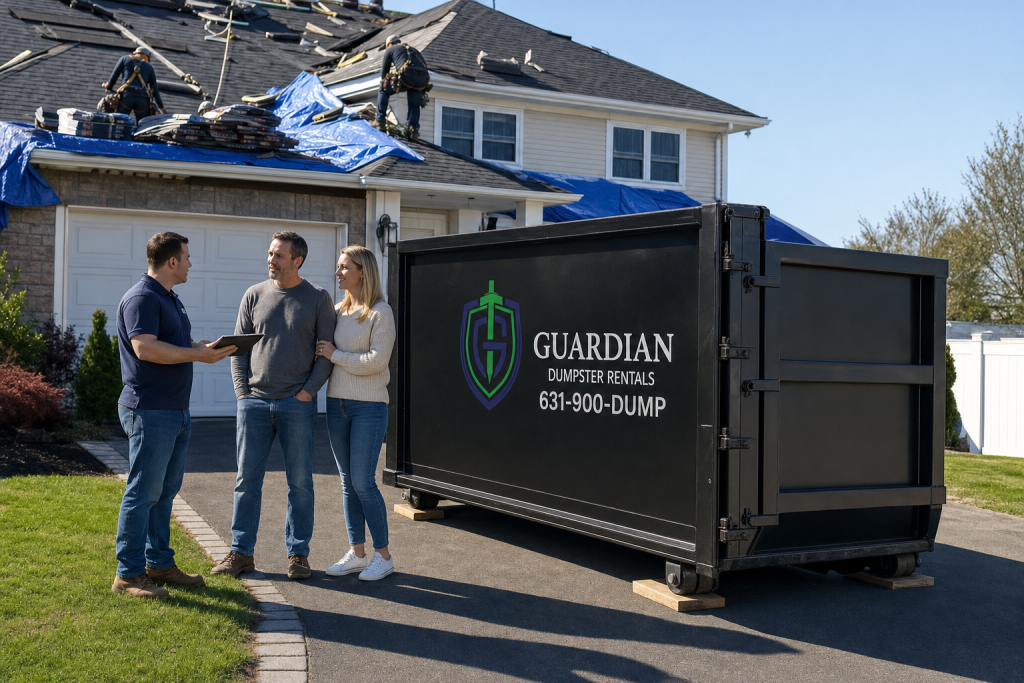
Had my roof replaced in August and Guardian dropped a 20 yard dumpster the day before my roofer started. They put boards down so the container never touched my driveway, and the driver angled it so the crew could throw shingles straight off the roof into the box. Picked up the day after the job wrapped. Zero hassle.
Tom R., West Islip
I'm a roofing contractor and I use Guardian for tear-offs all over the South Shore. When we found a second shingle layer on a job near Udalls Road, they swapped my full 20 for a 30 yard the same afternoon. My guys never stood around waiting. That kind of turnaround is rare in Suffolk County.
Danielle M., West Islip
Small job for us, just a garage roof and some fascia repair, so we only needed a 10 yard container. They didn't try to upsell me into something bigger. The dumpster fit next to the garage without blocking the sidewalk, and pricing was exactly what they quoted on the phone. Would use again for the main house.
Kevin P., West Islip
Frequently Asked Questions
What Size Dumpster Do I Need For A Roofing Dumpster Rental West Islip Project?
For most homes in West Islip, the right size comes down to how many squares of shingles you're tearing off. A square is 100 square feet of roof, and asphalt shingles are heavier than most people expect.
Our 10 yard dumpster handles roughly 20 to 25 squares of a single-layer tear-off, which covers many of the capes and smaller ranches you'll find off Higbie Lane and around the Udall Road area. It's also the easiest container to position on a shorter driveway.
The 20 yard dumpster is our most popular choice for roofing. It fits 35 to 45 squares, which suits the larger colonials and high-ranches common near the Great South Bay. If your home has two layers of old shingles, the extra capacity matters because you're essentially doubling the debris weight.
For big roofs, multi-layer tear-offs, or whole-house renovations that include the roof, the 30 yard dumpster gives you room for 55-plus squares along with underlayment, flashing, and damaged plywood decking.
When you call Guardian Dumpster Rental, tell us your approximate roof size and how many shingle layers are coming off. We'll recommend the size that avoids two common problems: paying for space you don't use, or needing a costly second haul mid-project. Most West Islip roofers we work with order the 20 yard as their default and step up to the 30 only for larger or layered jobs.
What Can And Can't Go In A Roofing Dumpster In West Islip?
Your rental is built for roofing debris: asphalt shingles, felt and synthetic underlayment, drip edge, flashing, ridge vents, old gutters, rotted plywood or OSB decking, nails, and the general packaging waste that comes with a re-roof. Wood trim and fascia boards are fine too.
A few materials are strictly off-limits in our containers: no brick, no concrete, no dirt, and no yard waste. That means masonry chimney debris, concrete chunks, soil, sod, branches, and leaves cannot be mixed in with your shingles. These materials cause overweight loads and can result in extra charges or a refused pickup, so plan to dispose of them separately.
Also keep out hazardous items like paint, solvents, sealant cans with liquid remaining, propane tanks, and anything containing asbestos. If your West Islip home was built before the 1980s and you suspect asbestos roofing material, have it tested before the tear-off begins — that requires a licensed abatement process, not a standard container.
To get the most out of your space, spread shingles evenly rather than piling them in one corner, and break down any large sheets of decking so they lie flat. Keep the load level with the top rail of the 10, 20, or 30 yard container; anything mounded above the sides can't be legally transported on Suffolk County roads.
If you're unsure about a specific item, just ask when you book. Our team answers these questions every day and would rather tell you upfront than surprise you at pickup.
Do I Need A Permit To Put A Dumpster In My West Islip Driveway Or On The Street?
If the container sits entirely on your own driveway or property, you typically don't need a permit — and that's where we place the vast majority of roofing dumpsters in the area.
If the dumpster must go on the street or any public right-of-way, the Town of Islip generally requires a permit, and placement rules can differ if you're in an incorporated village. We recommend calling the Town of Islip offices before your delivery date to confirm current requirements, since fees and processing times change. Allow a few business days so the paperwork doesn't delay your roofer.
Driveway placement is almost always the better option anyway. It keeps the container closer to the roofline so your crew can toss shingles directly in, and it avoids blocking traffic on narrower residential streets near the bay.
To protect your driveway, we place boards under the container's contact points on request — shingle loads get heavy, and this simple step prevents scratches or depressions in asphalt, especially during hot Long Island summers when blacktop softens.
Plan for clearance too. Our trucks need roughly 60 feet of straight approach and about 20 feet of overhead clearance free of wires and branches to roll a container off safely. A 10 yard unit fits almost any driveway; the 20 and 30 yard containers need a bit more length. Tell us about any tight spots, low wires, or shared driveways when you book, and our driver will come prepared.
How Much Does Roofing Dumpster Rental West Islip Cost, And How Does Scheduling Work?
Pricing depends on the container size and the weight of your debris. Shingles are dense, so roofing loads are priced with realistic tonnage allowances rather than the lighter limits used for household junk. A 10 yard container is the most economical for small tear-offs, the 20 yard offers the best value per square for typical West Islip homes, and the 30 yard covers large or multi-layer roofs. Call Guardian Dumpster Rental for a current quote — we give flat, upfront pricing that includes delivery, pickup, the rental period, and the stated weight allowance, with no hidden fuel or environmental surcharges.
Scheduling is straightforward. Most orders placed by early afternoon can be delivered next business day anywhere in West Islip, from the Babylon border over to Bay Shore. During peak roofing season in late spring and fall, we suggest booking two to three days ahead to lock in your preferred morning drop-off.
Standard rentals run several days to a week, which is more than enough since most residential tear-offs finish in one to two days. If weather pushes your project back — not uncommon with the wind coming off the Great South Bay — just call and we'll extend the rental for a modest daily rate.
When your roof is done, request pickup and we'll typically haul the container away within one business day. One quick tip: have the dumpster delivered the morning your roofer starts, not days early, so you're not paying for idle time in the driveway.
How Many Squares Of Shingles Fit In A Roofing Dumpster Rental West Islip Container?
As a rule of thumb, one "square" of roofing (100 square feet) of standard three-tab asphalt shingles weighs roughly 230 to 250 pounds per layer. Our 10 yard container comfortably handles about 25 to 30 squares of single-layer tear-off, which covers most smaller capes and ranches in West Islip.
The 20 yard dumpster is our most popular choice for roofing work in Suffolk County. It holds roughly 50 to 60 squares of single-layer shingles, which suits the typical two-story colonial or high-ranch you see throughout the neighborhoods off Higbie Lane and Udall Road.
For larger homes, multi-layer tear-offs, or architectural shingles (which run heavier, closer to 400 pounds per square), the 30 yard container gives you the headroom to finish without ordering a swap mid-job. If your roof has two or three layers coming off, the weight adds up fast, so size up rather than down.
Keep in mind that shingle debris is dense, so weight matters more than volume for roofing loads. When you call Guardian Dumpster Rental, tell us your roof's approximate square footage and how many layers are being removed. We'll match you to the right container the first time, which saves you the cost and delay of a second haul. One honest five-minute conversation up front almost always prevents an overloaded or undersized dumpster later.
Will The Dumpster Damage My Driveway During A Roof Tear-Off In West Islip?
This is one of the most common concerns we hear from homeowners in West Islip, and it's a fair one. A loaded roofing container is heavy, and asphalt driveways soften in summer heat, especially during July and August on the South Shore.
Guardian Dumpster Rental takes driveway protection seriously on every roofing delivery. Our drivers place plywood boards or protective planks under the container's contact points before setting it down. This spreads the weight and prevents the steel rails and wheels from pressing divots into asphalt or scuffing pavers.
Placement matters just as much as padding. We position the 10, 20, or 30 yard container on the flattest, most stable section of your driveway, ideally close to the roofline so your crew can toss shingles directly in without dragging debris across the property. Shorter carry distance also means less chance of stray nails ending up in your lawn or tires.
If your driveway is newly sealed, stamped, or made of pavers, mention it when you book. We can adjust placement, add extra board protection, or discuss a street placement if your situation allows for it. Tear-offs in West Islip typically wrap up in one to three days, so the container isn't sitting under load for long. With proper boards underneath and smart positioning, driveway damage is rare, and we stand behind our careful delivery and pickup process on every job.
How Long Can I Keep The Container If My Roofing Job Runs Long Or Weather Delays The Work?
Roofing on Long Island lives and dies by the weather. A surprise nor'easter or a stretch of summer thunderstorms can push a tear-off back by days, and we build flexibility into every rental because of it.
Our standard rental period covers the typical West Islip roofing timeline, which is usually one to three days for the tear-off itself plus a buffer for cleanup. Most residential roof replacements here finish well within the included window, so the majority of customers never pay a dime extra.
If rain rolls in off the Great South Bay and your roofer pushes the schedule, just call us. Extensions are straightforward and billed at a fair daily rate, whether you're working with a 10 yard, 20 yard, or 30 yard container. We'd much rather extend your rental than have you rush a half-finished roof or leave debris exposed.
One practical tip for weather delays: if shingles are already in the container and heavy rain is coming, don't worry about water weight affecting your haul. Wet shingles do weigh more, but we account for normal rain exposure. If a multi-day storm is forecast, a tarp over the open top keeps excess water out and your load lighter.
When the job wraps, pickup is just as flexible. Call or text when you're done, and we'll typically haul the container away within a business day so your driveway is clear again.
Can My Roofing Contractor Coordinate Directly With Roofing Dumpster Rental West Islip Service For Delivery Timing?
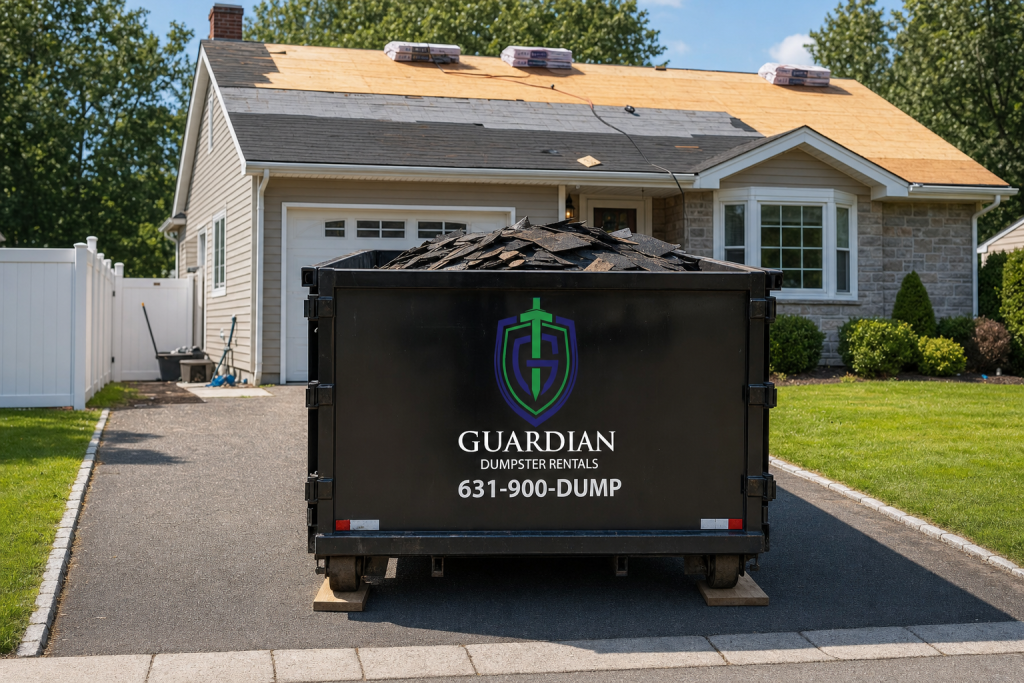
Absolutely, and we encourage it. With Roofing Dumpster Rental West Islip jobs, timing is everything: the container needs to be in place before the first shingle comes off, and ideally gone shortly after the last bundle goes on. Guardian Dumpster Rental works directly with roofing crews across Suffolk County every week, and we're happy to take scheduling instructions straight from your contractor.
Here's how it usually works. You book and pay as the homeowner, then give us your roofer's name and number. We confirm the tear-off date with the crew, deliver the 10, 20, or 30 yard container the afternoon before or early that morning, and place it exactly where the foreman wants it for the fastest debris flow off the roof.
During the job, your contractor can call us directly if anything changes, whether that's a rain delay, a request for an earlier pickup, or a discovery that the roof has an extra layer and the load will run heavier than planned. That direct line keeps you out of the middle and keeps the project moving.
One thing to communicate to your crew ahead of time: shingles, underlayment, flashing, wood decking, and nails are all fine, but we cannot accept brick, concrete, dirt, or yard waste in any of our containers. A quick heads-up to the crew prevents a mixed load and any sorting fees. Most local roofers already know our rules and load clean every time.
How Is Weight Handled With Roofing Dumpster Rental West Islip, And What Happens If My Shingles Come In Heavier Than Expected?
Every rental from Guardian Dumpster Rental includes a weight allowance that scales with container size. Our 10 yard holds the least tonnage, the 20 yard sits in the middle, and the 30 yard carries the largest allowance — which matters because asphalt shingles are deceptively heavy, roughly 200 to 350 pounds per square depending on whether it's architectural or three-tab.
If your load comes in over the included allowance, you're billed a per-ton overage at the rate quoted upfront. We confirm the actual weight at the Suffolk County transfer station scale, so you only pay for what the ticket shows — never an estimate.
The most common cause of surprise overages on West Islip roofs is a second layer of shingles the homeowner didn't know about. Many homes near Higbie Lane and south of Montauk Highway were re-roofed over the original layer decades ago. If your contractor finds two layers during tear-off, tell us right away; it's usually cheaper to size up to a 20 or 30 yard than to pay overage on a container that's too small.
One more weight tip: keep the lid or tarp on if rain is forecast. Water-soaked shingles and felt paper can add several hundred pounds to a load overnight, and that's weight you'd pay for. We're happy to run the math on your square count before delivery so the allowance fits the job.
How Much Space Do You Need To Deliver A Roofing Dumpster To My West Islip Property?
For most tear-offs in West Islip, we place the container in the driveway, and the space requirements are straightforward. A 10 yard container needs roughly 11 feet of length, a 20 yard needs about 22 feet, and a 30 yard needs around 22 feet as well but stands taller at about 6 feet high.
The bigger consideration is the delivery truck itself. The roll-off truck needs about 10.5 feet of width to back in, roughly 14 feet of overhead clearance for the lift arm, and 40 to 60 feet of straight-line approach depending on container size. Low-hanging branches, basketball hoops, and overhead wires are the usual obstacles on residential streets off Udall Road and Sequams Lane, so take a quick look up before delivery day.
We also think about placement relative to the roof. Ideally the container sits directly below the eave where the crew is tearing off, so shingles can be tossed or slid straight in. That cuts labor time and keeps debris off your lawn. Tell us which side of the house the work starts on and we'll position the door and the container accordingly.
If your driveway is short or shared, we can often angle the container or place it closer to the garage. Send us a photo of the driveway when you book and our driver will arrive with a plan rather than figuring it out on the spot.
Do I Need To Be Home When The Dumpster Is Delivered Or Picked Up?
No — most of our West Islip roofing deliveries happen without the homeowner present, and that's by design. Tear-off crews typically start early, so we schedule drop-offs the afternoon or evening before the job begins. As long as we have clear placement instructions and the driveway is empty, our driver handles everything.
When you book, we'll ask exactly where you want the container: which side of the driveway, how close to the garage, and which direction the door should face. If you want to be extra clear, chalk marks or a couple of cones on the driveway work perfectly. Our driver will also text a photo once the container is set, so you can confirm placement from work or anywhere else.
Pickup is even simpler. When the roof is done, call or text us and we'll schedule the haul-away — usually within one to two business days in the West Islip and greater Babylon Town area. Just make sure nothing is parked in front of the container, the debris doesn't rise above the top rail, and no one has tossed in prohibited material like dirt, concrete, brick, or yard waste, since those can delay or void the pickup.
The only time we'd ask you to be reachable by phone is if the placement is unusual — a tight shared driveway, a sloped apron, or a spot near overhead wires. In those cases a two-minute call with the driver solves everything.
Can I Rent A Roofing Container For A DIY Tear-Off, Or Do You Only Work With Contractors?
We rent to both, and DIY tear-offs are more common in West Islip than most people think. If you're stripping your own roof, Roofing Dumpster Rental West Islip service from Guardian works exactly the same as it does for a contractor — same containers, same pricing, same scheduling. The main difference is that we'll spend a little more time helping you size the job.
For a typical capes-and-colonials neighborhood like ours, a 10 yard handles small single-layer jobs up to about 25 squares, a 20 yard covers most full single-family tear-offs, and a 30 yard is the right call for large homes, steep multi-section roofs, or double-layer strips. If you're unsure of your square count, measure the roof footprint, multiply by your pitch factor, and divide by 100 — or just call us and we'll walk through it together.
A few DIY-specific pointers: load shingles flat rather than tossing them in bundles, because flat loading can fit noticeably more debris in the same container. Keep the load level with the top rail so we can legally tarp and haul it. And remember the container is for roofing debris — shingles, felt, underlayment, flashing, rotted decking, and nails — not for dirt, concrete, brick, or yard waste, which we can't accept.
Many homeowners also split the work: they do the tear-off themselves over a weekend and hire a roofer for the install. We can time delivery for Friday afternoon so you get the full weekend without paying for extra idle days.
When Should I Schedule My Roofing Dumpster Rental West Islip Delivery Relative To The Tear-Off Date?
The best approach is to have the container arrive the afternoon before your tear-off begins, or first thing that morning. Roofing crews in West Islip typically start stripping shingles by 7 or 8 a.m., and nothing stalls a job faster than debris piling up on tarps with nowhere to go.
When you book your Roofing Dumpster Rental West Islip delivery with Guardian, we confirm a delivery window that works around your contractor's start time. Day-before placement is popular because it removes any morning-of risk — if there's traffic on Montauk Highway or a delay at a prior stop, your crew isn't standing around waiting.
If your roofer reschedules because of wind or rain, just call us. We'd much rather shift your delivery a day or two than have an empty container sitting in your driveway burning rental days. Most of our West Islip roofing customers keep the box for three to five days total, which comfortably covers a one- or two-day tear-off plus cleanup.
One practical tip: have your contractor confirm whether they want the 10 yard, 20 yard, or 30 yard size before you book. The crew knows how many squares are coming off and whether there are multiple layers, and matching the container to the actual debris load the first time avoids a mid-job swap. Once the tear-off wraps and the magnet sweep for nails is done, call us and we'll typically pick up within one business day.
Can I Throw Household Junk Or Other Debris Into The Roofing Container Along With The Shingles?
To a point, yes — but roofing containers come with important limits, and loading them wrong can cost you money. Shingles are dense, so our West Islip roofing boxes are priced around a weight allowance that assumes mostly tear-off debris: asphalt shingles, underlayment, tar paper, drip edge, rotted decking, and roofing nails.
Lightweight household items like a few bags of trash, old cardboard, or a broken piece of furniture usually aren't a problem if there's room left below the fill line. Always ask us first so we can confirm it won't affect your rate.
What you absolutely cannot add: brick, concrete, dirt, or yard waste. None of those materials are allowed in our dumpsters under any circumstances, even in small amounts. They're processed through different disposal streams, and mixing them with shingles can result in a rejected load or extra handling fees at the facility. The same goes for prohibited items like paint cans, propane tanks, tires, batteries, and anything containing asbestos — older West Islip homes with roofs from the 1960s or earlier should have suspect material tested before tear-off.
If you're planning a combined project, like a roof replacement plus a garage cleanout, tell us when you book. Sometimes it makes sense to size up from a 20 yard to a 30 yard container, and sometimes two separate hauls of a 10 yard box is the smarter move. We'll run the numbers both ways so you're not guessing.
How Full Can I Load The Dumpster, And What Happens If It's Overfilled?
Every container we deliver — 10 yard, 20 yard, and 30 yard — has a clearly marked fill line, and debris must stay level with or below the top rails. This isn't us being fussy. New York law requires loads to be safely contained and tarped for transport, and our drivers cannot legally haul a box with shingles mounded above the walls.
With roofing debris specifically, overfilling is a weight issue as much as a height issue. Shingles run roughly 200 to 350 pounds per square depending on type and layers, so a heaped container can exceed what our trucks are rated to lift off your West Islip driveway. If a driver arrives and the load is over the line, they'll ask you to redistribute or remove material before pickup, which usually means a return trip fee and a day's delay.
The good news is this is easy to avoid. Have your roofing crew load shingles flat and distribute them evenly front to back rather than tossing everything into one end. Flat loading lets you fit noticeably more debris under the rail than random dumping does.
If you're mid-job and can see the box filling faster than expected — common with double-layer tear-offs — call Guardian before you hit the line. We can often schedule a swap-out, hauling the full container and dropping an empty one the same day, so your crew in West Islip never has to stop working.
Where Does The Debris From A Roofing Dumpster Rental West Islip Job Actually Go After Pickup?
Once we haul your container, the load goes to a licensed transfer station serving Suffolk County, where it's weighed, inspected, and sorted. Asphalt shingles from a Roofing Dumpster Rental West Islip pickup are increasingly separated for recycling — ground shingles are reused in hot-mix asphalt for road paving, which keeps a surprising amount of tear-off material out of landfills.
Mixed roofing debris like underlayment, felt paper, and damaged plywood decking that can't be recycled is processed as construction and demolition waste at permitted facilities. Everything is handled through documented, legal disposal channels — important in Suffolk County, where illegal dumping enforcement is active and fines fall on whoever generated the waste, not just whoever dumped it.
This is one reason to be careful about bargain haulers with no verifiable disposal process. If debris from your roof ends up dumped illegally, it can be traced back to your address. With Guardian, your material is weighed at a certified scale, and we can tell you the actual tonnage from your job, which is how any overage charges are calculated. There's no guesswork or rounded-up estimates.
It's also why we're strict about what goes in the box. Brick, concrete, dirt, and yard waste are never accepted in our containers, because the facilities that take shingle loads won't process them mixed together. Keeping the load clean means faster processing, better recycling rates, and no surprise rejection fees passed along to you after your West Islip project wraps up.
Local Relevance
West Islip sits right on Suffolk County's South Shore, where salt air, nor'easters, and the occasional tropical system are hard on asphalt roofs. Many of the capes, ranches, and split-levels here date to the mid-twentieth century, and it's common to find a second shingle layer hiding under the top one — which can double the debris and the weight of a tear-off. That's exactly why we size roofing containers conservatively for this area and keep swap-outs fast. We run daily routes through the surrounding towns too, from Roofing Dumpster Rental Babylon NY jobs to the west to roll off deliveries in neighboring Dumpster Rental Islip New York territory to the east, so a West Islip drop is never out of our way.
Because so many West Islip homes were built in the postwar decades, roofers here often discover a second shingle layer or storm-weathered decking once the tear-off starts — so when we size a container for a South Shore roof, we tend to plan for that extra layer rather than assume a clean single-layer job.
Get The Right Box In Your Driveway Before The First Shingle Comes Off
Tell us your roof size and how many layers are coming off, and we'll quote the right 10, 20, or 30 yard container with the weight allowance a real tear-off needs. Delivery is timed around your roofer's schedule, with driveway protection included and fast swap-outs if the job runs bigger than expected.
Call us: (631) 206-5588
Helpful Resources
- EPA guidance on construction and demolition materials — Federal guidance on handling and recycling C&D debris
- OSHA roofing safety resources — Official safety standards for roofing work
Serving West Islip · Suffolk County NY
Last updated: October 20, 2026