
Roofing Dumpster Rental Islip NY: Right-Sized Roll Offs For Shingle Tear-Offs On South Shore Homes
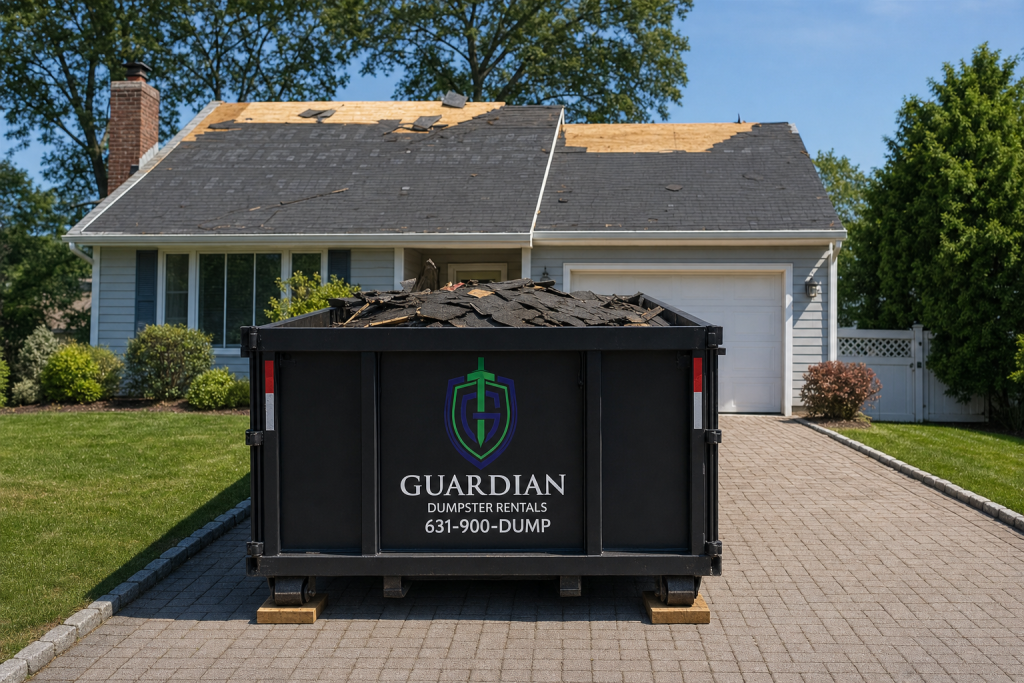
Roofing Dumpster Rental Islip NY is the fastest way to handle tear-off debris: Guardian Dumpster Rental delivers a driveway-ready roll off sized to your roof’s square count, usually within a day of your call. Most single-layer tear-offs on Islip capes and ranches fit a 10 or 20 yard container, while larger homes or double-layer roofs typically call for a 30 yard. We place boards under the wheels to protect your driveway, and we haul the shingles out the moment your roofer is done.
What This Service Is
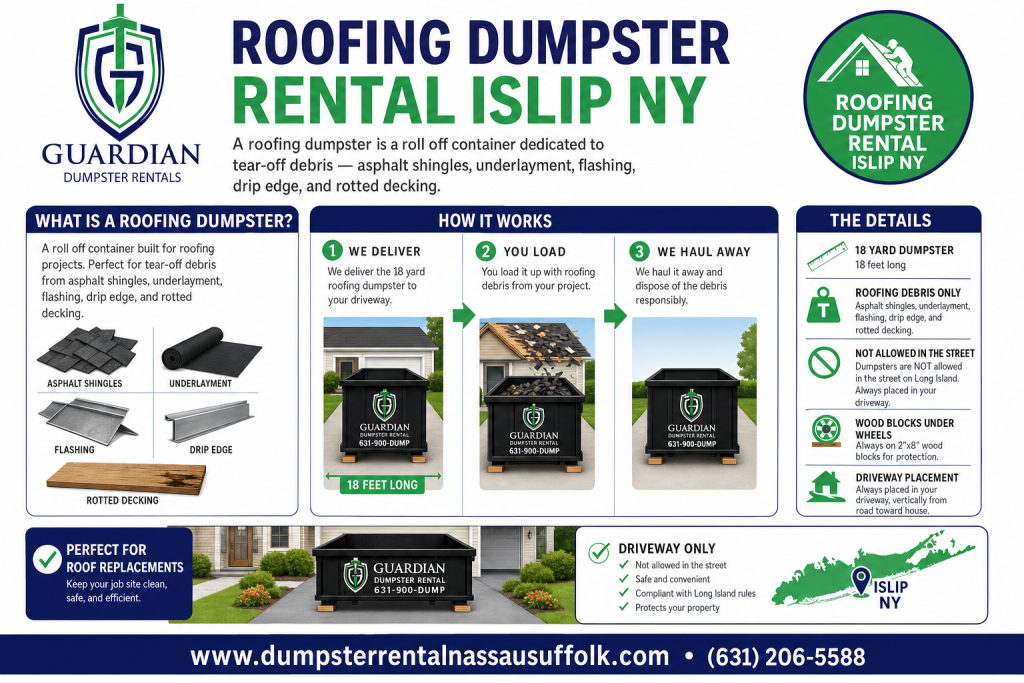
A roofing dumpster is a roll off container dedicated to tear-off debris — asphalt shingles, underlayment, flashing, drip edge, and rotted decking. Shingles are deceptively heavy, so this service is really about matching container size and weight allowance to your roof, not just picking the biggest box.
Guardian Dumpster Rental carries three sizes: 10 yard, 20 yard, and 30 yard. A 10 yard suits small roofs and partial tear-offs, a 20 yard handles most single-family homes in Islip, and a 30 Yard Dumpster Rental in Islip NY covers big colonials, multi-layer tear-offs, or roofing combined with other construction debris removal.
One important note: our containers are for roofing and general construction debris only. We do not accept brick, concrete, dirt, or yard waste, which keeps loads legal on the road and keeps your price predictable.
Common Problems
What Does A Dumpster Rental For Shingles Actually Cost — And What’s Included?
The honest answer: the container size matters less than the weight allowance. Asphalt shingles run roughly 200 to 350 pounds per square, so a 25-square tear-off can weigh two to four tons before you add underlayment and bad decking.
A quote for a roofing dumpster should spell out the included tonnage, the per-ton overage rate, and the rental period. If a company quotes a flat price without mentioning weight, that is usually where the surprise charge comes from.
We quote Islip roofing loads with realistic tonnage built in, and the same straight-pricing approach applies to any Dumpster Rental in Islip New York, whether it is a roof, a renovation, or a cleanout.
What If The Dumpster Overloads, Blocks The Driveway, Or Isn’t There When The Roofers Show Up?
The most common roofing-day failure is timing. Roofing crews start early, and if the container is not on site before the first shingle comes off, debris ends up on your lawn and in your flower beds. We schedule delivery for the day before your tear-off whenever possible so there is zero gap.
The second failure is overloading. Shingles must stay level with the container rim — overfilled boxes cannot legally be hauled, and the driver will ask you to offload before pickup. If your roofer discovers a second layer mid-job, call us; a swap-out or a second container solves it the same day in most cases.
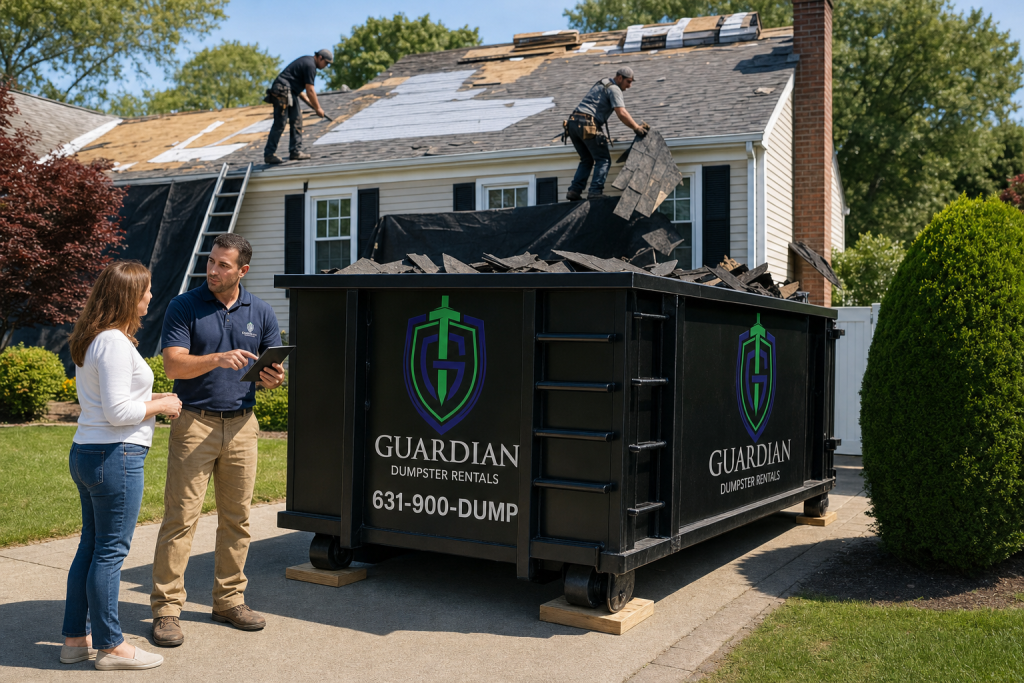
Placement problems are preventable too. Tell us where the roofer wants it — ideally close to the eaves so crews can toss debris directly in — and we will set it on protective boards in that spot.
How Do I Choose A Company For Roofing Dumpster Rental Islip NY?
Look for three things. First, local trucks and local dispatch — a hauler who actually works Suffolk County can deliver and swap containers fast enough to keep a roofing crew moving. Guardian runs the same roll offs for projects like a Roofing Dumpster Rental in Bay Shore NY, so our drivers know these neighborhoods and these driveways.
Second, clear rules in writing: included tonnage, prohibited materials, rental length, and driveway protection. A good provider volunteers this before you ask.
Third, size honesty. A company that pushes every customer into the biggest box, or every budget shopper into the smallest, is guessing. We ask about your roof’s square count and layer count, then recommend the 10, 20, or 30 yard that actually fits the job.
Our Process
Tell Us About Your Roof
Give us your roof’s approximate square footage or square count, the number of shingle layers, and whether decking is being replaced. From that, we recommend a 10, 20, or 30 yard container with the right weight allowance — no guesswork, no oversized box you are paying for and not using.
We Deliver Before The Tear-Off Starts
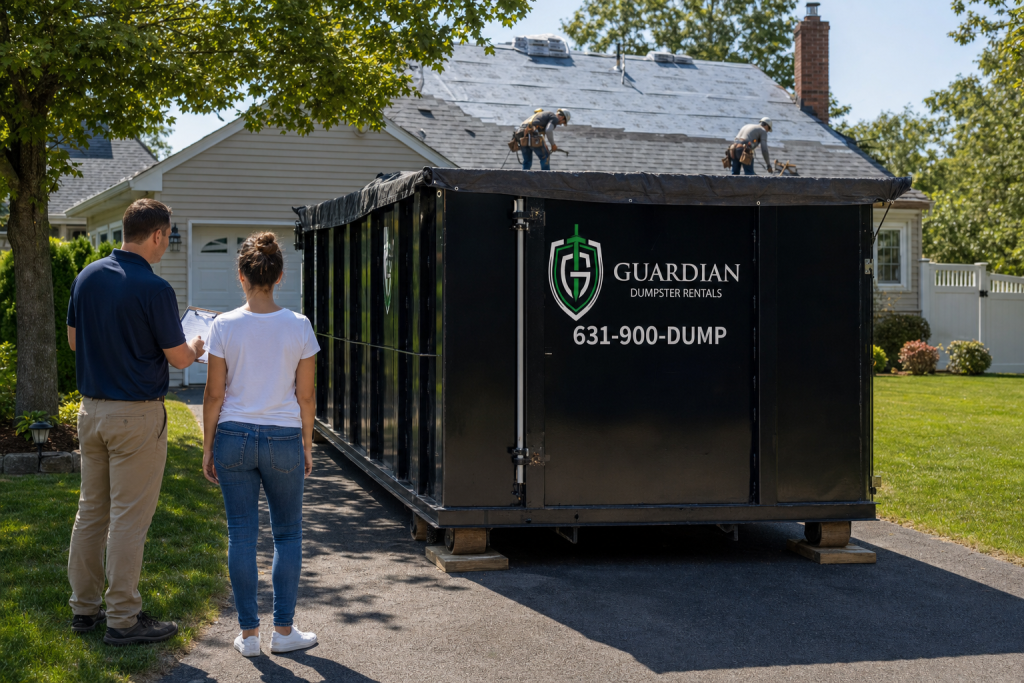
We coordinate with you or your roofing contractor so the container is in place before the crew arrives, usually the afternoon before. The driver sets it on wood boards to protect asphalt or paver driveways and positions it where the crew can throw shingles straight in from the roof edge.
Fill It And We Haul It Away
Load shingles, underlayment, flashing, and old decking level with the rim — no brick, concrete, dirt, or yard waste. When the roof is done, call or text and we pick up promptly, usually within a business day, so you are not staring at a loaded container in your driveway all week.
| Container Size | Roof Debris Capacity | Best For | Typical Footprint |
|---|---|---|---|
| 10 Yard Dumpster | Roughly 10–15 squares of asphalt shingles, single layer | Small tear-offs, garage roofs, partial repairs, porch and dormer sections | About 12 ft long x 8 ft wide — fits a single-car driveway |
| 20 Yard Dumpster | Roughly 20–30 squares of asphalt shingles, single layer | Full tear-offs on most Islip capes, ranches, and average two-story homes | About 22 ft long x 8 ft wide — standard residential driveway |
| 30 Yard Dumpster | Roughly 35–45 squares, or double-layer tear-offs | Large colonials, multi-layer removals, cedar shake conversions, contractor jobs | About 22 ft long x 8 ft wide with taller walls — needs full driveway length |
Commonly Overlooked In The Dumpster Rental Industry
- Counting shingle layers before choosing a size — Most homeowners only know their roof’s square footage, and a hidden second layer discovered mid-tear-off can double the debris and overload the container.
- Shingle weight versus container volume — Asphalt shingles are dense, so a dumpster can be well under the fill line and still blow past the included weight allowance, triggering per-ton overage fees.
- Driveway protection boards under the container — A loaded roofing dumpster concentrates thousands of pounds on small contact points, and skipping plywood boards leaves gouges in asphalt that nobody notices until pickup day.
- Overhead wire and tree-branch clearance at drop-off — Roll-off trucks need significant vertical clearance to tilt the bed, and older Islip streets with low utility lines can make a planned placement spot unusable.
- Mixing prohibited material in with shingles — People assume anything heavy can ride along, but brick, concrete, dirt, and yard waste aren’t allowed in the container and will cause rejected loads or extra charges at the scale.
- Scheduling delivery the day before the tear-off, not the day of — Roofing crews start early, and a container arriving at 10 a.m. means hours of shingles piling on tarps and lawns before there’s anywhere to put them.
- Nails and old felt left around the container footprint — Roofing nails scatter beyond the tarp line during loading, and skipping a magnetic sweep around where the dumpster sat leads to flat tires weeks later.
- Filling above the top rail — An overfilled box can’t be legally tarped and hauled on Suffolk County roads, so debris mounded past the rim gets offloaded by hand or delays the pickup entirely.
Case Studies
Case Study #1
Situation: A homeowner on Saxon Avenue in Islip was replacing a 24-square architectural shingle roof on a two-story colonial, with two existing layers of shingles that both had to come off before the new roof could go on.
Problem: Their roofer quoted the tear-off but told them to arrange their own container. The homeowner guessed at a 10 yard dumpster to save money, not realizing two layers of architectural shingles across 24 squares would far exceed its weight and volume limits.
Investigation: When they called Guardian Dumpster Rental, we asked three questions we always ask for roof jobs: how many squares, how many layers, and what shingle type. We also asked about driveway access, since the house had a narrow asphalt drive with a slight slope.
Findings: Two layers over 24 squares of architectural shingle works out to roughly 48 squares of debris. That load would have overweighted a 10 yard container badly, triggering overage fees and possibly a second haul. A 30 yard container handled the full tear-off in one pull.
Solution: We delivered a 30 yard dumpster the morning before the tear-off started, placed it on plywood boards to protect the asphalt, and positioned the low rear door toward the garage so the crew could wheelbarrow shingles straight in instead of throwing everything over the high side.
Outcome: The crew finished the tear-off in a day and a half, filled the container level with the top rail, and we hauled it away two days later. One delivery, one pickup, no overage charges, and no gouges in the driveway.
Lesson: Layer count matters as much as roof size. A second layer of shingles effectively doubles your debris, and sizing up to a 30 yard container up front is almost always cheaper than paying overweight fees or a second haul on a smaller box.
Case Study #2
Situation: A roofing contractor working a cedar-shake-to-asphalt conversion on a bayfront home near Islip Beach called us mid-job. The house sat on a tight lot off a narrow private lane with overhead utility lines crossing the driveway apron.
Problem: The container company he normally used sent a truck that couldn’t clear the lines or make the turn into the lane. His crew had already started stripping shakes and had debris piling up on tarps with rain in the forecast.
Investigation: We pulled the address up, reviewed the lane width and wire height with the contractor over the phone, and sent a driver to eyeball the approach before committing. We measured roughly 13 feet of clearance under the lines and a turning radius too tight for a 30 yard box on that chassis.
Findings: A single 30 yard container wasn’t going to fit the site. But two 20 yard dumpsters, delivered in sequence, could each be rolled off in the one workable spot beside the garage, and the shorter box length cleared the turn with room to spare.
Solution: We dropped the first 20 yard dumpster that same afternoon so the crew could clear the tarps before the rain. When it was full, we swapped it for the second 20 yard container the next morning on a scheduled live exchange so the crew never stopped working.
Outcome: The conversion stayed on schedule, all the cedar shake and old felt went out in two clean pulls, and the contractor avoided a soaked debris pile and an unhappy homeowner. He now calls us first for any waterfront job in Suffolk County.
Lesson: On tight South Shore lots, two 20 yard containers swapped in sequence can beat one 30 yard box. Site access — lane width, wire height, turning room — should be confirmed before the first shingle comes off, not after.
| Your Roof Situation | Recommended Size | What It Depends On |
|---|---|---|
| Shed, detached garage, or porch roof | 10 Yard Dumpster | Under about 12 squares and one shingle layer; otherwise step up to a 20 |
| Partial repair or storm-damage section | 10 Yard Dumpster | How much of the roof is being replaced — more than a third usually means a 20 yard box |
| Typical Islip cape or ranch, single layer | 20 Yard Dumpster | Square footage of the roof; most 1,200–2,000 sq ft homes fit a 20 comfortably |
| Two-story colonial, single layer | 20 Yard Dumpster | Roof pitch and overhangs — steep or complex roofs add debris and may push you to a 30 |
| Any home with two shingle layers | 30 Yard Dumpster | A second layer roughly doubles debris weight; a 10 or 20 will overload fast |
| Cedar shake removal or full re-deck | 30 Yard Dumpster | Shakes and old decking boards are bulky; plywood sheets eat volume quickly |
| Contractor running back-to-back jobs | 20 or 30 Yard with scheduled swaps | Crew pace and driveway access — tight lots sometimes favor two 20s over one 30 |

Reviews
Tore off a 30-year-old roof on our cape near Main Street and Guardian talked me out of the 10 yard I thought I needed. The 20 yard dumpster they recommended was right — we filled it almost exactly with one layer of shingles plus the old felt and drip edge. Driver put boards down under the wheels so our new driveway didn’t get scratched. Picked up the next morning after the roofers finished.
Mike R., Islip
Our roofer scheduled the tear-off for a Monday and Guardian had the 30 yard container in the driveway Saturday morning so we weren’t scrambling. Two layers of shingles off a big colonial and it all fit in one box. They were upfront that shingles are heavy and that no concrete or dirt could go in with them, which kept us from making an expensive mistake with some old pavers we almost tossed in.
Danielle S., East Islip
I run three or four tear-offs a week and Guardian is the only company I use in the Islip area now. Dispatch actually answers the phone, the 20 and 30 yard boxes show up when promised, and their live swaps keep my crews moving. Only knock is a Saturday pickup once ran a couple hours late, but they called ahead to let me know. That communication alone puts them ahead of everyone else I’ve used.
Tom B., roofing contractor, Suffolk County
Frequently Asked Questions
What Size Dumpster Do I Need For Roofing Dumpster Rental Islip NY?
For most roof tear-offs in Islip, the right container comes down to the square footage of your roof and the number of shingle layers coming off. Guardian Dumpster Rental carries three sizes that cover virtually every residential and light commercial roofing job in the area.
A 10 yard dumpster handles roughly 20 to 25 squares of single-layer asphalt shingles, which fits most capes and smaller ranches you see throughout Islip hamlet and Bay Shore. It is also the easiest to position on a tight driveway.
A 20 yard dumpster is our most popular choice for roofers working in Suffolk County. It comfortably takes a full tear-off on a typical two-story colonial, including underlayment, flashing, and drip edge, with room to spare if the crew finds a second layer of shingles under the first.
A 30 yard dumpster is the right call for larger homes along the South Shore, multi-layer tear-offs, or jobs where the roofing work is part of a bigger renovation. Keep in mind that shingles are heavy, so on bigger projects we often recommend the 30 yard for volume while watching the weight.
If you tell us your roof’s approximate square footage and how many layers are being removed, we will recommend the exact size so you are not paying for space you do not need or scrambling for a swap-out mid-job.
What Materials Can I Put In A Roofing Dumpster In Islip, And What Is Prohibited?
Our roofing containers are built for standard tear-off debris. That means asphalt shingles, roofing felt and underlayment, tar paper, flashing, drip edge, ridge vents, damaged plywood or OSB decking, nails, and old gutters pulled during the job. Packaging from new materials, like shingle wrappers and pallet banding, is fine too.
There are a few hard rules. We do not allow brick, concrete, dirt, or yard waste in any of our dumpsters. That includes concrete chimney caps, masonry rubble from chimney work, soil disturbed around the foundation, and branches or leaves cleared off the roof before the tear-off. Those materials have to be handled separately.
Hazardous items are also prohibited: paint, solvents, adhesives in liquid form, propane tanks, and asbestos-containing materials. Older Islip homes occasionally have asbestos roofing shingles or siding, and those require a licensed abatement contractor, not a standard roll-off.
If your contractor finds something unexpected mid-job, like rotted framing or old cedar shakes under the asphalt layer, give us a call before loading it. Wood decking and shakes are generally fine in the 10, 20, or 30 yard containers, but confirming first avoids surprise fees at pickup.
Following these rules keeps your final invoice matching your quote. Loads contaminated with prohibited material can be rejected at the transfer station, and those costs pass back to the renter, so a quick question up front is always worth it.
Will A Roll-Off Dumpster Damage My Driveway, And Where Can It Be Placed In Suffolk County?
This is the question we hear most from Islip homeowners, and it is a fair one. A loaded container full of shingles is heavy, so protection matters. Guardian Dumpster Rental places wood boards under the container rails on every residential delivery at no extra charge, which spreads the weight and protects asphalt and paver driveways.
Placement is flexible. Most customers put the dumpster in the driveway as close to the roofline as possible so the crew can toss shingles directly in, which speeds up the tear-off and keeps your lawn clean. Our drivers are experienced with the tighter driveways common in older Islip neighborhoods and can position a 10 yard or 20 yard container in surprisingly compact spaces.
If your driveway will not work, street placement is sometimes an option, but the Town of Islip may require a road obstruction permit for a container in the public right-of-way. Rules vary by hamlet and whether you are on a town, county, or state road, so check with the town before scheduling if street placement is your only choice.
A few practical tips: avoid placing the container over cesspool or septic covers, which are common in Suffolk County yards, and leave about 60 feet of straight clearance for the delivery truck plus roughly 20 feet of overhead space for the hoist. Tell us about low wires or tree limbs when you book and we will plan the drop accordingly.
How Much Does Roofing Dumpster Rental Islip NY Cost, And How Does The Weight Limit Work?
Pricing is based on container size, included weight allowance, and rental period. The 10 yard is the most economical for small tear-offs, the 20 yard offers the best value per cubic yard for a typical full roof, and the 30 yard costs more up front but prevents expensive second hauls on large or multi-layer jobs. Call Guardian Dumpster Rental for a current flat-rate quote, since disposal costs at Long Island transfer stations shift periodically.
Every rental includes delivery, pickup, a set number of rental days, and a tonnage allowance. Shingles are dense, which is why weight matters more on roofing jobs than almost any other project. As a rule of thumb, one square of asphalt shingles weighs around 200 to 350 pounds depending on the shingle type and whether there is a second layer underneath.
If your load comes in over the included tonnage, the overage is billed per ton at the disposal facility’s rate. This is why an honest conversation about your roof size before delivery saves money. We would rather put the right container in your driveway than profit from overage fees.
One more cost-saver: keep the load level with the top rail. Containers heaped above the rim cannot legally be transported on Suffolk County roads, and leveling the load on pickup day delays your project. Load shingles evenly across the floor of the dumpster rather than piling them at one end, and you will maximize every cubic yard you are paying for.
How Far In Advance Should I Book Roofing Dumpster Rental Islip NY Before My Tear-Off Date?
For most roofing jobs in Islip, booking two to four days ahead is plenty. Guardian Dumpster Rental keeps 10 yard, 20 yard, and 30 yard containers staged for Suffolk County deliveries, so same-day or next-day drop-off is often possible if you call before late morning.
That said, demand spikes hard during peak roofing season. From late April through October — and especially in the weeks after a nor’easter or a heavy wind event rolls across the South Shore — roofers across Islip, Bay Shore, and East Islip are all ordering containers at once. During those stretches, reserving a full week ahead guarantees your roofer isn’t standing around on tear-off morning with nowhere to throw shingles.
The smoothest approach is to coordinate the drop-off for the afternoon or evening before your crew arrives. That way the container is sitting in the driveway at 7 a.m. when the first shingles come off, and your roofers can toss debris straight from the ladder or chute into the box.
When you book, have three things ready: your delivery address, roughly how many squares of roofing are coming off (your contractor’s estimate works fine), and where you want the container placed. With that, we can recommend the right box — a 10 yard for a small ranch, a 20 yard for most Islip colonials and capes, or a 30 yard for larger homes or multi-layer tear-offs — and lock in your delivery window on the spot.
Do I Need A Permit From The Town Of Islip To Have A Roll-Off Container Delivered?
In most cases, no. If the container sits entirely on your own private property — your driveway, a parking pad, or another paved area you own — the Town of Islip does not require a permit for a standard residential roofing project. The vast majority of our deliveries in Islip, Islip Terrace, and West Islip go on the homeowner’s driveway with zero paperwork involved.
The situation changes if the container needs to sit in the street or partially block a public right-of-way. Some Islip neighborhoods have narrow driveways, shared drives, or low-hanging wires that make street placement the only option. In that case, the Town of Islip typically requires a street-use or road-opening permit, and you should contact the Town’s Engineering or Highway department before your delivery date. Processing can take a few business days, so don’t leave it until the morning of your tear-off.
If your home sits inside an incorporated village — Brightwaters or Ocean Beach, for example — the village may have its own rules that differ from the Town’s, so a quick call to village hall is worth the five minutes.
One more local note: if you live in an HOA or condo community near Islip, check your association’s rules too. Some require notice before a 20 or 30 yard container shows up. When you book with Guardian, tell us where the box is going and we’ll flag any permitting concerns before the truck is dispatched, not after.
What Happens If My Dumpster Fills Up In The Middle Of The Tear-Off — Can I Get A Swap?
Yes, and it happens more often than homeowners expect. Roofing Dumpster Rental Islip NY customers run into this most frequently on older homes where the roofer discovers a second or even third layer of shingles hiding under the top layer — suddenly the debris volume doubles and the container is full by lunchtime.
When that happens, call us right away. Guardian runs swap-out service throughout Islip and the surrounding Suffolk County area: our driver hauls away the full container and drops an empty one in the same spot, usually the same day or next morning depending on when you call. Your roofing crew loses little to no time.
A few tips to avoid needing a swap in the first place. Have your roofer check for multiple shingle layers before you order — a probe at the roof edge takes two minutes. If there’s any doubt, size up: the price difference between a 20 yard and a 30 yard is far less than the cost of a second haul. And make sure the crew loads evenly, keeping debris level across the box rather than piled in a mound at one end, which wastes capacity.
Also remember that shingles, underlayment, flashing, and roofing nails are fine, but brick, concrete, dirt, and yard waste are not permitted in our containers. Keeping those materials out protects your weight allowance and keeps the swap process fast, because our drivers can haul a clean roofing load without any sorting delays at the facility.
How Long Can I Keep A Roofing Dumpster In Islip, And What If My Project Runs Over?
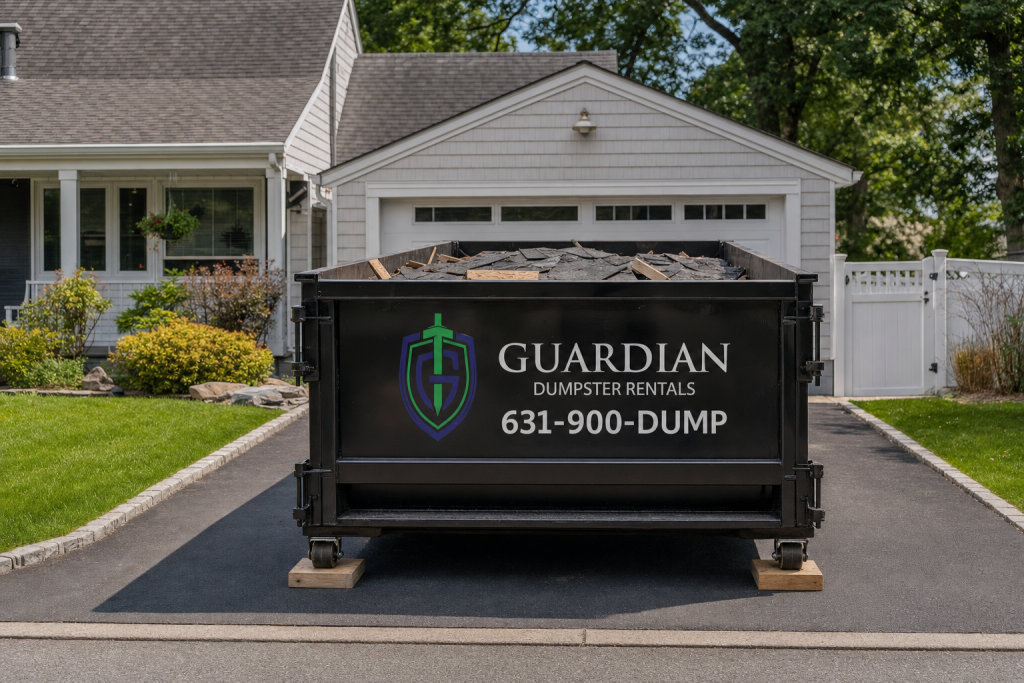
Our standard rental period covers the typical residential roofing timeline with room to spare. Most tear-offs in Islip take one to three days, and our included rental window comfortably handles that plus weather delays. You don’t need to rush your crew or schedule pickup for the exact day the last shingle goes in the box.
If your project runs long — rain pushes the schedule, your roofer finds rotted decking that needs replacing, or materials get delayed — just call before your scheduled pickup. Extending by a few days is simple, and daily extension rates are modest compared to the cost of returning the container and re-delivering a new one. We’d much rather keep your 10, 20, or 30 yard box on site a little longer than have you scrambling.
Long Island weather is a real factor here. Spring nor’easters and summer thunderstorms routinely stall roofing work across Suffolk County, so we build flexibility into how we schedule pickups. If your roofer calls a rain delay, let us know and we’ll adjust.
When the job wraps up, call or text for pickup and we’ll typically remove the container within one to two business days. Before the truck arrives, make sure nothing is loaded above the top rail — drivers can’t legally haul an overfilled box on Islip roads — and confirm the load is roofing debris only, with no brick, concrete, dirt, or yard waste mixed in. A clean, level load means a quick, hassle-free pickup and your driveway back the same day.
Do I Need To Be Home For Roofing Dumpster Rental Islip NY Delivery And Pickup?
No, you don’t need to be on site for either delivery or pickup, and most of our Islip customers aren’t. When you book Roofing Dumpster Rental Islip NY with Guardian Dumpster Rental, we’ll confirm your placement instructions the day before — which side of the driveway, how far from the garage, door orientation toward the house or the street. As long as the spot is clear of vehicles, our driver handles the rest.
That said, a clear path matters. Our roll-off trucks need roughly 60 feet of straight approach and about 11 feet of overhead clearance, so trim any low-hanging branches on older Islip streets before delivery day. If a car is blocking the drop zone when we arrive, we may have to reschedule, and a dry-run fee can apply.
Many homeowners leave a simple marker — a trash can or a chalk outline — showing exactly where the 10, 20, or 30 yard container should sit. We recommend placing it as close to the tear-off side of the roof as possible so your crew isn’t carrying shingles across the yard.
For pickup, just make sure nothing is loaded above the top rail and no vehicles are parked behind the container. If you want to be present, we’re happy to give you a delivery window, but texting photos of the placement works just as well. Most of our Suffolk County drivers have been delivering to Islip, East Islip, and Bay Shore driveways for years and know the tight spots.
How Does Rain Or Wet Shingles Affect The Weight Of My Roofing Dumpster In Islip?
This catches a lot of homeowners off guard: asphalt shingles are porous, and a heavy Long Island rainstorm can add several hundred pounds of water weight to a loaded container. Since roll-off rentals are weighed at the transfer station, soaked debris can push you past your included tonnage and trigger overage charges.
The fix is simple. If rain is in the forecast during your tear-off — common with the coastal weather we get here in Islip, especially in spring and fall — cover the container with a tarp overnight and between work sessions. A basic poly tarp and a few bungee cords from any hardware store on Main Street or Sunrise Highway will do the job.
Timing also helps. If your roofer finishes the tear-off in one day, call us for pickup right away rather than letting the loaded box sit through a weekend storm. We run pickup routes throughout Suffolk County most weekdays and can usually pull a container within a day or two of your call.
One more tip specific to roofing jobs: load shingles flat rather than in tangled piles. Flat loading means less air space for water to pool in, better use of your 10, 20, or 30 yard container’s capacity, and a load that stays below the rail so we can tarp it legally for transport. If a storm does hit before pickup, let us know — in some cases we can note the conditions when we weigh out.
Which Islip Neighborhoods And Nearby Hamlets Does Guardian Dumpster Rental Deliver To?
We deliver roofing containers throughout the Town of Islip and the surrounding Suffolk County hamlets. That includes Islip proper, East Islip, West Islip, Central Islip, Islip Terrace, Bay Shore, Brightwaters, Great River, Oakdale, Sayville, Bohemia, Hauppauge, and Brentwood. If you’re near the edges of the town — say Ronkonkoma or West Sayville — call us and we’ll confirm delivery, because we service most of central and western Suffolk.
Local delivery matters more than people realize for a roofing project. Because our trucks are already running routes along Sunrise Highway, Montauk Highway, and the Southern State corridor, we can usually get a 10, 20, or 30 yard container to your driveway within one to two business days — often next-morning if you call before noon.
It also means our drivers know the quirks of each area. The older streets near Islip’s waterfront and in Brightwaters tend to be narrow with mature trees, so we often recommend a 10 or 20 yard box there for easier placement. Newer developments in Central Islip and Hauppauge generally have wider driveways that handle a 30 yard container without trouble.
Shingle debris from every job goes to licensed Suffolk County transfer stations, so your tear-off waste is handled in compliance with New York State disposal regulations. If you’re a roofing contractor working multiple jobs across these hamlets, ask about scheduling containers at more than one address — we coordinate multi-site drops for local crews all season long.
Can A Roofing Contractor Arrange Roofing Dumpster Rental Islip NY On My Behalf, Or Should I Book It Myself?
Either works, and there are real pros and cons to each. Many Suffolk County roofers bundle the container into their quote and handle everything — they call us, schedule the drop for tear-off morning, and the cost is folded into your contract. That’s the hands-off option, and we work with local roofing crews across Islip every week.
Booking it yourself often saves money, though. When a contractor arranges Roofing Dumpster Rental Islip NY for you, they typically add a markup — sometimes 20 to 40 percent — on top of the rental price. If you order directly from Guardian Dumpster Rental, you pay our rate, you control the rental window, and you can use leftover days to toss other household debris after the roof is done, as long as it’s an allowed material.
If you do book it yourself, coordinate three details with your roofer before calling us. First, the tear-off date, so the container arrives the morning the work starts. Second, the roof size in squares, so we can match you to the right 10, 20, or 30 yard container. Third, where the crew wants the box placed — most roofers want it directly below the eave they’re stripping so shingles can be tossed straight in.
One thing to confirm either way: whoever books is responsible for how the box is loaded. Make sure your crew knows our containers can’t take brick, concrete, dirt, or yard waste — roofing debris and general materials only.
How Should I Load The Dumpster During My Islip Tear-Off To Make The Most Of The Space?
Shingles are dense, so smart loading matters more than it does with bulky household junk. Start by distributing the debris evenly across the floor of the container rather than piling everything at one end. An uneven load can exceed the axle limits on our trucks and delay pickup.
If your crew is tossing shingles directly off the roof, position the container as close to the eave as safely possible and aim for the center. Many Islip roofers lay a sheet of plywood against the far wall as a backstop so bundles slide down instead of bouncing out. Keep flashing, drip edge, and underlayment layered flat between shingle loads so nothing sticks up above the rim.
Stay below the fill line marked on the side of the container. Roofing debris that rises above the top rail cannot be legally transported on Long Island roads, and our drivers will ask you to level the load before hauling, which costs you time on tear-off day.
For a typical single-layer asphalt tear-off, a 10 yard container handles smaller Islip capes, a 20 yard suits most colonials and split-levels, and a 30 yard is the right call for larger homes or double-layer removals. Whichever size you choose, loading flat and even means you fit every square of shingles you paid to haul, and pickup happens without a hitch.
If you are unsure how your crew plans to load, mention it when you book and we will position the container to match their workflow.
Where Do The Old Shingles From Roofing Dumpster Rental Islip NY Actually Go After Pickup?
Once our driver picks up your loaded container, the debris is hauled to licensed transfer and processing facilities here in Suffolk County NY. Nothing is dumped illegally or left sitting on a truck for days, which matters in a town like Islip where disposal is tightly regulated.
Asphalt shingles are one of the more recyclable construction materials on Long Island. Where facility capacity allows, torn-off shingles are ground down and the asphalt content is reclaimed, often ending up in paving mix. Clean loads recycle more efficiently, which is one reason we ask customers to keep roofing debris separated from random junk.
Metal components from your roof, like aluminum drip edge, flashing, and old vents, are typically pulled and recycled as scrap at the processing stage. Underlayment, felt paper, and ice-and-water shield travel with the shingle load and are handled at the same facilities.
Keep in mind that certain materials are never accepted in our containers, including brick, concrete, dirt, and yard waste. Mixing those into a roofing load contaminates it, can trigger rejection fees at the facility, and slows down your pickup.
If responsible disposal matters to you, choosing a local hauler with established relationships at Suffolk County facilities is the practical way to ensure your tear-off debris is handled correctly. We are happy to tell you exactly where a given load is headed when you book your 10, 20, or 30 yard container.
How Much Room Does The Delivery Truck Need To Drop A Roll-Off At My Islip Home?
Our roll-off trucks need roughly 60 feet of straight clearance in front of the drop spot, because the container slides off the back of the truck bed as the driver pulls forward. Vertically, plan on about 20 to 25 feet of overhead clearance to account for the raised bed, so flag any low branches, wires, or carport roofs before delivery day.
Width is rarely a problem in Islip. A 10 yard, 20 yard, or 30 yard container is all roughly 8 feet wide, which fits a standard residential driveway. Length is the bigger variable: a 10 yard runs about 12 to 14 feet long, a 20 yard about 22 feet, and a 30 yard about 22 feet with taller walls. Measure your driveway before choosing a size if space is tight.
Many South Shore properties have narrow side yards, mature oaks over the driveway, or overhead service lines running from the street to the house. Snap a photo of your driveway and send it to us when booking, and we will confirm whether your preferred size fits or suggest an alternative placement.
On delivery day, clear vehicles from the driveway and mark your preferred spot with a cone or a piece of chalk. Our drivers deliver across Islip daily and are experienced with tight suburban lots, but a clear, premeasured target makes the drop fast and precise so your roofers can start the tear-off on schedule.
Can I Throw Household Junk In With My Roofing Debris, Or Does The Container Have To Be Shingles Only?
With Roofing Dumpster Rental Islip NY, mixing in some general household debris is usually fine, but there are two important caveats: weight and prohibited items.
First, weight. Shingles are extremely heavy for their volume, and every rental includes a weight allowance tied to the container size. If you fill the remaining space in a 20 yard or 30 yard container with furniture, boxes, and general junk on top of a full tear-off load, you can push past the included tonnage and trigger overage charges. If you have a lot of non-roofing cleanout to do, a separate 10 yard container for the household material is often cheaper than paying overweight fees on a combined load.
Second, prohibited materials. Regardless of what else goes in, we never accept brick, concrete, dirt, or yard waste in any of our containers. Those materials contaminate the load at the processing facility and can result in rejection fees passed back to you. Also leave out the usual hazardous items: paint cans with liquid paint, propane tanks, tires, batteries, and appliances containing refrigerant.
What is fine to mix in: old gutters, wood trim pulled during the roof job, broken furniture, and bagged household junk, as long as everything stays below the fill line.
If you are planning a roof replacement and a garage cleanout at the same time, tell us when you book. We will size the order honestly so you are not paying for tonnage you do not need.
Local Relevance
Islip sits on Long Island’s South Shore, where salt air off the Great South Bay, nor’easters, and summer humidity are hard on asphalt shingles. Add winter freeze-thaw cycles and roofs here often age faster than the shingle warranty suggests, which is why tear-offs are such a steady part of local home maintenance.
Much of Islip’s housing stock dates to the mid-twentieth century — capes, ranches, and split-levels — and many of these roofs have been layered over at least once. A second layer roughly doubles the debris weight, so sizing the container correctly matters more here than in newer developments.
Guardian serves the whole surrounding area as well, including Roofing Dumpster Rental in West Islip and general Dumpster Rental in Babylon New York, so our trucks are already working your corner of Suffolk County most days of the week.
Many Islip-area homes built in the postwar decades carry two layers of asphalt shingle, and coastal storms tend to force tear-offs before homeowners planned for them — so when you call for a roofing container here, mention the layer count up front, because a double-layer tear-off often moves the job from a 20 yard to a 30 yard box.
Tearing Off A Roof In Islip? Get Your Container Scheduled Today
Tell Guardian Dumpster Rental your roof size and layer count, and we will quote the right 10, 20, or 30 yard roll off with honest tonnage included — delivered before your crew arrives and hauled away the day you are done.
Call us: (631) 206-5588
Helpful Resources
- EPA guidance on construction and demolition materials — Federal overview of handling and recycling tear-off debris
- OSHA fall protection standards for roofing work — Safety requirements for crews working on roofs
Serving Islip · Suffolk County NY
Last updated: October 27, 2026