
20 Yard Dumpster Driveway Myths: Will It Fit in NY?
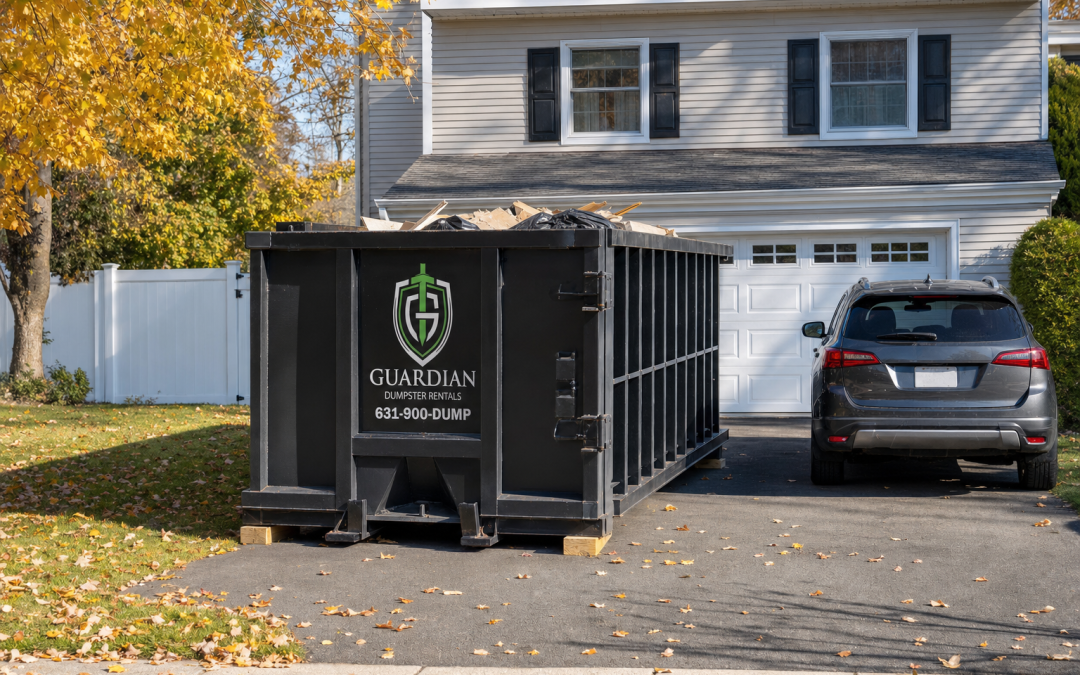
Quick Answer: Yes, a 20 Yard Dumpster Fits Most NY Driveways
The 20 yard dumpster driveway myth is just that — a myth, because a 20 yard container measures roughly 22 feet long by 8 feet wide, while a standard New York single-car driveway runs about 9 to 12 feet wide and 18 to 20+ feet deep, leaving room to spare in most residential setups.
Key takeaways
- A 20 yard dumpster typically measures about 22 feet long by 8 feet wide, so it fits comfortably in most standard NY driveways, which are usually 9 to 12 feet wide and 18 to 25 feet long.
- Delivery trucks need roughly 60 feet of straight-line clearance and about 14 to 23 feet of overhead clearance to safely roll off a 20 yard dumpster.
- Driveway protection boards or plywood under the dumpster's steel wheels are a simple, standard way to prevent scuffing on asphalt or paver driveways.
- If a 20 yard container is too long for your driveway, a 10 yard dumpster offers a shorter footprint, while a 30 yard adds capacity without a wider base.
- Measuring your driveway's length, width, and overhead obstructions before ordering is the single best way to avoid a failed delivery fee.
If you’ve been told you need a parking lot or a sprawling commercial property to host a 20 yard container, you can relax. The numbers simply don’t support the myth. Most homeowners across Long Island place 20 yard dumpsters on their driveways every single week without blocking the garage, damaging the pavement, or spilling over onto the street. Companies that handle a 20 yard dumpster rental in West Islip NY deliver to tight residential driveways routinely — it’s the most common placement, not the exception.
The Math at a Glance
- 20 yard dumpster footprint: approximately 22 feet long, 8 feet wide, and 4 to 5 feet tall
- Typical NY single-car driveway: 9 to 12 feet wide and 18 to 20+ feet deep
- Typical NY double-car driveway: 20 to 24 feet wide, giving you room for the dumpster and a parked vehicle
Notice that the container is narrower than almost every driveway in the state. Length is the only dimension that occasionally gets tight on very short driveways, and even then, a slight overhang toward the apron usually solves it. For comparison, a 10 yard dumpster runs shorter and lower-profile, while a 30 yard container is longer and taller — yet even 30 yard deliveries fit many standard driveways. Providers offering dumpster rental in Lindenhurst New York and surrounding towns place all three sizes on residential properties daily.
What the Rest of This Article Covers
The quick answer settles the “will it fit” question, but there’s more to a smooth delivery than the footprint alone. Here’s what we’ll walk through:
- Real dimensions: exactly how big a 20 yard dumpster is, including height and walk-in door clearance
- Where the myth comes from: why so many homeowners overestimate container size
- Truck clearance: the overhead and approach space the delivery truck needs — often the real constraint, not the dumpster
- Fall prep: how to get your driveway ready before the truck arrives
- Size selection: how to choose between a 10, 20, or 30 yard container for your remodeling project
By the end, you’ll know whether your specific driveway works, what to clear out beforehand, and which size actually matches your project — so you order once and get it right.
How Big Is a 20 Yard Dumpster, Really? The True 20 Yard Dumpster Driveway Footprint
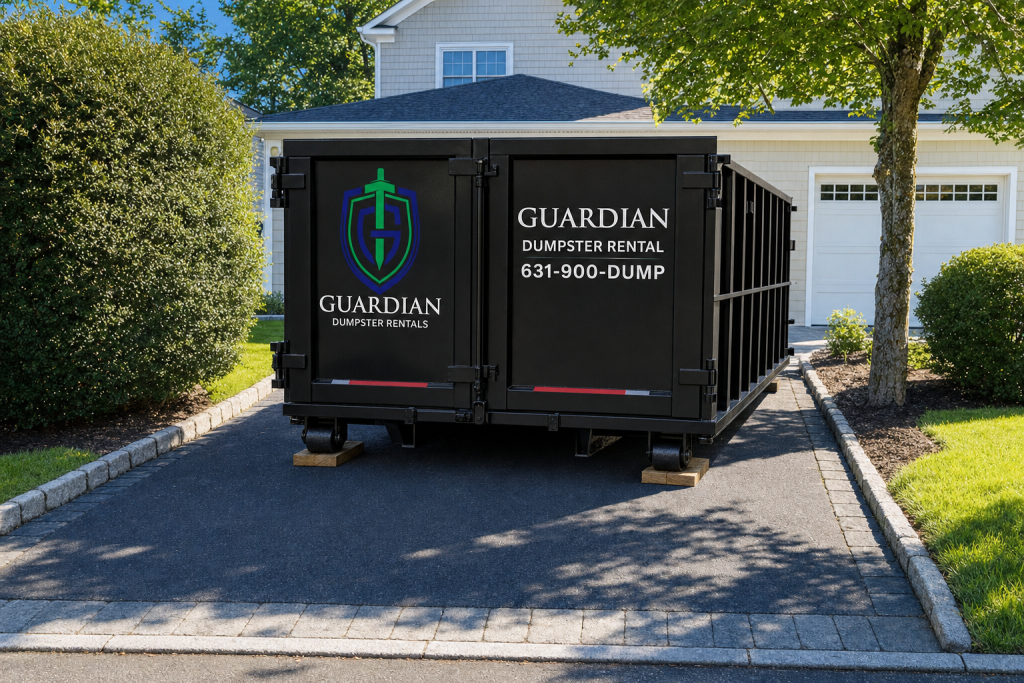
A 20 yard dumpster typically measures about 22 feet long, 7.5 to 8 feet wide, and 4 to 4.5 feet tall. That footprint is roughly the size of two parked cars end to end, which means it fits comfortably on the vast majority of standard suburban New York driveways.
Hearing “20 cubic yards” makes a lot of homeowners picture something enormous. In reality, the cubic yard number describes volume, not ground space. The 20 yard dumpster driveway footprint is long but narrow — it occupies about one lane of a driveway, leaving room to walk around it on most properties. The 4-foot-ish sidewalls are also low enough that most people can toss debris over the side without a ladder.
Side-by-Side: 10, 20, and 30 Yard Dimensions
Here’s how the three most common residential sizes compare. Exact dimensions vary slightly by manufacturer, but these ranges are typical:
- 10 yard dumpster: roughly 12–14 ft long, 7.5–8 ft wide, 3.5 ft tall — about the length of a single parked car
- 20 yard dumpster: roughly 22 ft long, 7.5–8 ft wide, 4–4.5 ft tall — about two car lengths
- 30 yard dumpster: roughly 22 ft long, 8 ft wide, 6 ft tall — same footprint as the 20, just with taller walls
Notice the key detail: the 20 and 30 yard containers take up nearly identical ground space. The 30 simply goes up, not out. So if a 20 fits on your driveway, a 30 almost always does too. Homeowners booking a 20 yard dumpster rental in West Islip are often surprised to see it tucks neatly onto one side of a two-car driveway.
How That Stacks Up Against Typical NY Driveways
Most suburban driveways on Long Island and across New York follow fairly standard dimensions:
- Single-car driveway: usually 9–12 ft wide and 18–25 ft long
- Two-car driveway: usually 18–24 ft wide and 20–25 ft long
At 8 feet wide, a 20 yard container fits within a single-car driveway’s width with room to spare, and its 22-foot length fits most driveway lengths. On a two-car driveway, it occupies one side while leaving the other open for a vehicle. If your driveway is unusually short — say, a compact pad under 20 feet — a smaller container like a 10 yard dumpster rental in Bay Shore may be the better match, since its 12–14 foot length fits almost anywhere.
The bottom line: measure your driveway’s length and width before you book, but don’t assume the 20 won’t fit. For most New York homes, it does — easily.
What’s Behind the 20 Yard Dumpster Driveway Myth?
The myth that a 20 yard dumpster won’t fit in a driveway comes from homeowners confusing the dumpster’s footprint with the delivery truck’s full length, plus horror stories from dense city lots that don’t apply to most of New York. Outside of tight urban cores, the typical suburban driveway handles a 20 yard container with room to spare.
Confusing the Truck with the Container
A roll-off delivery truck is noticeably longer than the dumpster it carries, and people often hear the truck’s length quoted and assume that’s the space the container will occupy permanently. In reality, the truck only needs extra room temporarily while it tilts and rolls the box off. Once the driver pulls away, the 20 yard dumpster itself sits in a footprint comparable to a parked pickup truck with a small trailer — well within the dimensions of a standard two-car driveway.
City Horror Stories That Don’t Apply to the Suburbs
Plenty of the scary anecdotes floating around come from New York City boroughs, where narrow lots, shared alleys, and street-permit requirements genuinely complicate placement. Homeowners in Suffolk and Nassau County hear those stories and assume the same rules apply to them. They usually don’t. Suburban Long Island properties typically have private driveways, wider streets, and no need for the special permitting that drives those urban headaches. Providers handling dumpster rental in Islip New York place 20 yard containers on residential driveways routinely without issue.
Outdated Assumptions About Dumpster Design
Some of the myth is simply old information. People picture the massive commercial containers behind shopping centers, or remember a neighbor’s oversized box from decades ago, and assume all dumpsters are that bulky. Modern residential roll-offs are designed with driveways in mind:
- Walk-in rear doors mean you load from ground level instead of needing clearance to toss debris over tall sides.
- Standardized widths keep 10, 20, and 30 yard containers roughly the same width — it’s mainly length and wall height that change between sizes.
- Driveway-friendly delivery practices, like placing boards under the rails, protect the surface during drop-off and pickup.
When Caution Is Actually Warranted
To be fair, the myth isn’t entirely baseless. Steeply sloped driveways, very short parking pads, low-hanging branches, or overhead wires can genuinely limit placement. But in those cases the answer usually isn’t “no dumpster” — it’s a smaller container or an adjusted drop spot. A compact option like a 10 yard dumpster rental in Bay Shore works well when a driveway truly is on the short side. For the vast majority of New York homes outside the five boroughs, though, the 20 yard dumpster driveway concern evaporates the moment the container is actually delivered and sitting comfortably on the pavement.
How Much Clearance Does the Delivery Truck Need for a 20 Yard Dumpster Driveway Placement?
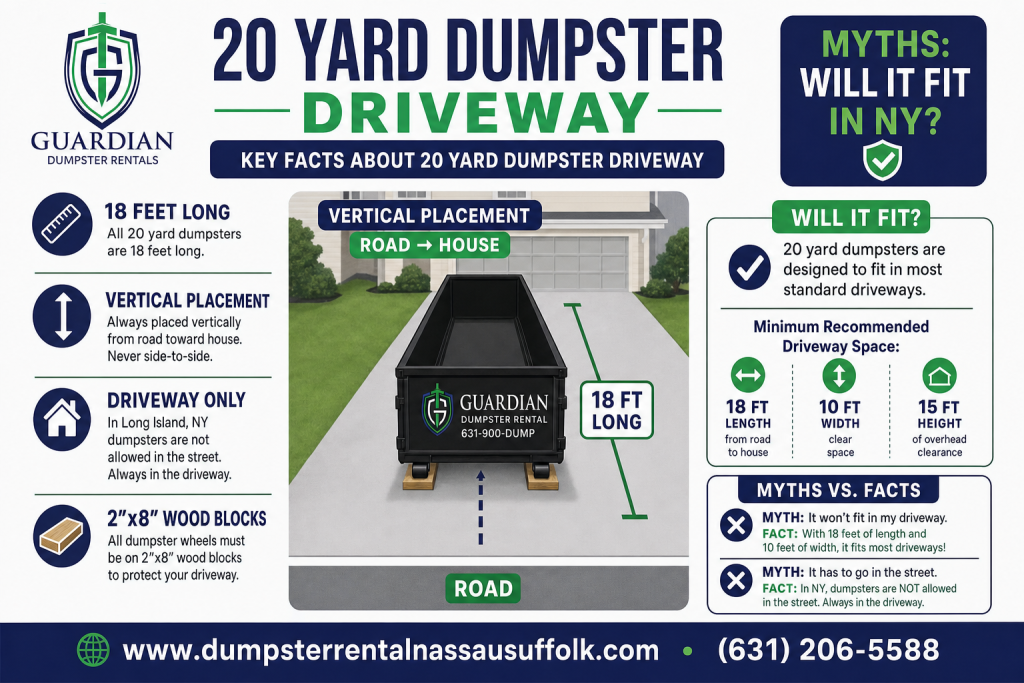
A roll-off delivery truck needs roughly 60 feet of straight-line approach, 10 to 12 feet of width, and 20 to 25 feet of overhead clearance to tilt its bed and slide the container into place. If your driveway and the street in front of it offer that much room, a 20 yard dumpster driveway delivery is usually straightforward.
Those numbers sound big until you break them down. The 60 feet isn’t all on your property — it’s the combined distance the truck uses to back in and line up, and much of it can be the street itself. The width requirement is about the truck’s mirrors and the container’s footprint, and the overhead clearance matters because the bed tilts up at a steep angle before the dumpster rolls off the back.
The Three Clearances, Explained
- Straight-line approach (about 60 feet): The driver backs the truck in roughly in line with where the dumpster will sit. Sharp curves, parked cars, or a tight cul-de-sac can complicate this more than the driveway itself.
- Width (10 to 12 feet): The container itself is around 8 feet wide, but the truck needs a little extra room on each side for mirrors and maneuvering. Most two-car driveways clear this easily; single-car driveways often do too, as long as nothing is parked alongside.
- Overhead clearance (20 to 25 feet): This is the one homeowners forget. When the bed tilts up to unload, the raised rails reach well above the height of the truck cab. Anything hanging over the driveway at that height is a problem.
What to Check Before Delivery Day
Walk your driveway and look up as well as around. On Long Island properties with mature trees and older utility lines, overhead obstructions are the most common reason a driver can’t place a container exactly where you wanted it. Teams that handle 20 yard dumpster rental in Babylon deal with tree-lined streets like these every week, and a quick heads-up about tight spots helps the driver plan the drop.
- Low wires: Note any electric, cable, or phone lines crossing the driveway. Service drops to the house are often lower than street lines.
- Tree limbs: Branches that brush a car roof will absolutely interfere with a tilted bed. Trimming anything below about 25 feet over the placement spot is smart.
- Gates and fences: Measure gate openings — a gate narrower than 10 feet usually means the dumpster goes outside it. Remove or swing gates fully open before the truck arrives.
- Parked vehicles: Clear cars from the driveway and, if possible, the curb directly in front of it.
If you’re unsure whether your property qualifies, a local provider can often tell you from your address and a couple of photos. Companies offering dumpster rental in Bay Shore New York and surrounding Suffolk County towns know the typical driveway layouts in each neighborhood and can flag problems before the truck ever leaves the yard.
How Should You Prep Your 20 Yard Dumpster Driveway Spot for a Fall Delivery?
Before an autumn delivery in New York, rake wet leaves off the driveway so the driver can see the surface, move vehicles out of the way before an early freeze locks them in place, lay plywood sheets where the container will sit, and mark the drop spot clearly before daylight fades in the late afternoon.
Fall on Long Island brings a specific set of conditions that can complicate an otherwise simple drop-off. A few minutes of prep the night before keeps the delivery smooth and protects your pavement at the same time.
Clear Wet Leaves From the Drop Zone
A layer of soggy leaves hides cracks, drain grates, and the edges of your driveway. Drivers position a roll-off by reading the surface, so sweep or blow the landing area clean before the truck arrives. Keep in mind that leaves and other yard waste are not allowed inside the container itself, so bag them separately for your regular municipal pickup. Homeowners arranging a 20 yard dumpster rental in Babylon often find that a cleared, visible surface lets the driver place the box exactly where they want it on the first try.
Move Vehicles Before the Cold Snap Hits
Early fall cold snaps can arrive overnight in New York. A car parked where the container needs to go becomes a real problem if a hard frost freezes the door locks or an icy windshield delays you at 7 a.m. when the truck pulls up. Relocate vehicles to the street or a neighbor’s driveway the evening before your scheduled delivery window.
Lay Plywood to Protect Softened Asphalt
Autumn temperature swings — warm afternoons followed by near-freezing nights — leave asphalt in a softened, flexible state. Set down sheets of three-quarter-inch plywood where the container rails and rear rollers will rest. The boards spread the weight and prevent the loaded box from pressing dents or scuffs into your 20 yard dumpster driveway spot as debris piles up over the rental period.
Mark the Spot Before Daylight Fades
Shorter fall days mean many deliveries happen in dim morning or early-evening light. Make the target obvious:
- Set out bright cones or flags at the corners of the intended footprint.
- Chalk an outline on the pavement if the surface is dry.
- Turn on exterior lights if the drop is scheduled near dawn or dusk.
- Leave a note or text the dispatcher with any special placement instructions.
These same steps apply across Suffolk County neighborhoods with mature trees and sloped drives. If you’re planning a project further north, the team handling dumpster rental in Commack New York sees the same fall challenges and can advise on placement when you book. A prepared driveway means the driver spends less time maneuvering and your pavement comes through the season unscathed.
Which Dumpster Size Fits Your Remodeling Project?
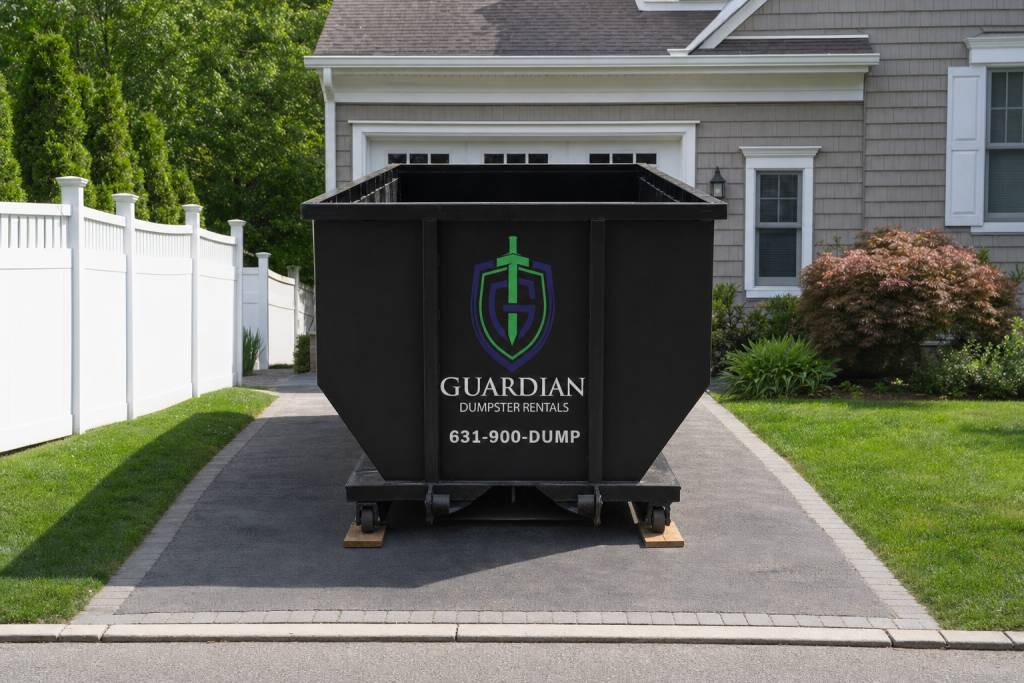
A 10 yard dumpster suits a single bathroom gut, a 20 yard container handles a full kitchen remodel or multi-room project, and a 30 yard dumpster is built for whole-home renovations. All three fit on a standard residential driveway, so your choice comes down to debris volume, not space.
Matching the container to the job matters more than most homeowners realize. Go too small and you pay for a second haul; go too big and you’re paying for air. Here’s how the three residential sizes compare:
Container Sizes at a Glance
| Size | Approximate Footprint | Capacity | Ideal Remodeling Use |
|---|---|---|---|
| 10 Yard | About 12 ft long x 8 ft wide x 3.5 ft tall | Roughly 3–4 pickup truck loads | Bathroom gut, small closet or hallway demo, flooring removal from one or two rooms |
| 20 Yard | About 22 ft long x 8 ft wide x 4.5 ft tall | Roughly 6–8 pickup truck loads | Full kitchen remodel, basement finishing, roofing tear-off, multi-room renovation |
| 30 Yard | About 22 ft long x 8 ft wide x 6 ft tall | Roughly 9–12 pickup truck loads | Whole-home renovation, large addition, major cleanout combined with demo work |
Matching the Size to Your Project
- Bathroom gut: Old vanities, tile, drywall, and fixtures add up slower than you’d think. A compact 10 yard dumpster rental in Amityville handles a typical bathroom demo with room to spare.
- Kitchen remodel: Cabinets, countertops, old appliances, and wall material are bulky. The 20 yard is the sweet spot — big enough for the whole job, and a 20 yard dumpster driveway placement still leaves room to park a vehicle beside it in most cases.
- Whole-home renovation: When you’re tearing out multiple rooms, flooring throughout, and old finishes everywhere, step up to a 30 yard dumpster rental in Lindenhurst NY. The taller walls swallow long, awkward debris like trim, doors, and cabinet runs.
One Important Rule: Keep Heavy Materials Out
No matter which size you choose, brick, concrete, dirt, and yard waste are not allowed in any container. These materials are extremely dense and can push a container past safe road-weight limits, and they often require separate handling under local disposal rules. If your remodel involves masonry or excavation, talk to your hauler about the right disposal path before loading day. The EPA’s guidance on construction and demolition materials is a helpful resource for understanding how renovation debris should be managed and what can often be recycled instead of landfilled.
When in doubt between two sizes, most contractors recommend sizing up — the price difference is usually smaller than the cost of a second container if you underestimate your debris.
~22 ft long x 8 ft wide
Typical 20 Yard Footprint
9-12 ft (single car)
Standard NY Driveway Width
~60 ft straight approach
Truck Clearance Needed
~14-23 ft during drop-off
Overhead Clearance
20 Yard Dumpster Driveway Fit: Comparing 10, 20, and 30 Yard Containers
| Container Size | Typical Footprint (L x W) | Approx. Height | Driveway Fit Notes |
|---|---|---|---|
| 10 Yard Dumpster | ~14 ft x 8 ft | ~3.5 ft | Fits nearly any standard driveway; ideal for short or narrow driveways |
| 20 Yard Dumpster | ~22 ft x 8 ft | ~4.5 ft | Fits most standard NY driveways; confirm at least 22-25 ft of usable length |
| 30 Yard Dumpster | ~22 ft x 8 ft | ~6 ft | Same footprint as a 20 yard but taller; watch for low branches and wires |
Illustrative Example: A Queens Kitchen Remodel (Hypothetical)
Illustrative example
Consider a hypothetical homeowner in Queens planning a full kitchen gut renovation who assumed a 20 yard dumpster would never fit their single-car driveway. After measuring, they found roughly 24 feet of usable length and 10 feet of width — more than enough for the container's 22-by-8-foot footprint. The driver used plywood boards under the wheels to protect the asphalt and placed the dumpster with the swing door facing the garage for easy loading. The homeowner filled it with cabinets, drywall, and general remodeling debris over a week, avoiding multiple trips with a smaller 10 yard container. This composite scenario reflects a common outcome: measuring first usually proves the 'won't fit' myth wrong.
Frequently asked questions
Will a 20 yard dumpster driveway placement actually fit in a typical New York driveway?
In most cases, yes. A 20 yard dumpster is typically about 22 feet long and 7.5 to 8 feet wide, while a standard single-car driveway runs roughly 10 to 12 feet wide and 20-plus feet long. The tight spot is usually length and overhead clearance for the delivery truck, not the container itself. Measure your driveway's length and check for low branches or wires before booking.
How much overhead clearance does the delivery truck need to drop a 20 yard dumpster?
The truck raises its bed or hook-lift arm to slide the dumpster off, so you generally need significantly more vertical clearance than the container's height alone—often around 20 feet or more at the drop point. Walk your driveway and look up for power lines, tree limbs, gutters, and carport roofs. If anything hangs low, flag it when you order so the driver can plan or suggest another spot.
What goes wrong most often with driveway dumpster deliveries?
The most common problems are cars blocking the driveway on delivery day, low-hanging wires or branches the homeowner never noticed, and gates or fences too narrow for the truck. Another frequent mistake is loading prohibited material—brick, concrete, dirt, and yard waste are not allowed in the dumpster—which can lead to extra charges or a refused pickup. Clearing the space and confirming what's accepted beforehand prevents nearly all of these issues.
Should I get a 10 yard dumpster instead if my driveway is small?
If your driveway is short or you only have a modest cleanout, a 10 yard dumpster is a smart choice—it's several feet shorter than a 20 yard and easier to place. But for a full kitchen or bathroom remodel, a 20 yard usually fits standard driveways fine and avoids paying for a second haul. Measure your usable length first, then size to the project, not just the space.
Will a 20 yard dumpster damage my driveway?
It can scuff or crack asphalt if precautions are skipped, since the loaded container concentrates a lot of weight. The simple fix: lay plywood or wooden boards where the dumpster's rails and wheels will sit. Most reputable haulers will place it on boards you provide. Avoid overloading one end, and never fill it with heavy prohibited materials like concrete, brick, or dirt, which aren't allowed anyway.
How long can I keep a dumpster in my driveway during a remodel?
Rental periods vary by company, but most standard rentals run several days to about two weeks, with the option to extend for a daily fee. For a typical remodeling project, plan your demolition days to fall early in the rental window so you're not paying for idle days. Ask your hauler about extension costs upfront—it's usually cheaper to extend than to schedule a second delivery.
Do I need a permit to put a dumpster in my own driveway in NY?
Generally no—placing a dumpster on your own private driveway doesn't require a street-use permit in most New York municipalities. Permits typically come into play only when the container sits on a public street or sidewalk. Rules vary by town and some HOAs have their own restrictions, so a quick call to your local code office or HOA is worth making before delivery day.
What should I do to prepare my driveway before the dumpster arrives?
Move all vehicles out of the driveway the night before, since delivery windows can be early. Clear bikes, trash cans, and basketball hoops from the path. Lay plywood where the container will rest to protect the surface. Check overhead for wires and branches, and decide exactly where you want it—close enough to the house for easy loading but leaving room to open the rear door.
Is it worth going up to a 30 yard dumpster for a whole-house remodel?
If you're gutting multiple rooms or doing a whole-house renovation, a 30 yard dumpster often costs less than renting two smaller containers back to back. The tradeoff is size: a 30 yard is longer and taller than a 20 yard, so it needs a longer driveway and more truck clearance. If your driveway comfortably fits two cars end to end, a 30 yard is usually feasible; otherwise stick with the 20.
Can the driver place the dumpster so I can still use my garage?
Often yes, if your driveway is long enough. Tell the company exactly where you want the container when you book, and mark the spot with cones or chalk. Drivers can usually position it to one side or set it back from the garage door, but they need a straight approach path. Keep in mind the rear swing door needs a few feet of clearance to open for walk-in loading.
10 yard dumpster rental help near you
Related local pages
- Dumpster Rental Greenlawn New York
- Dumpster Rental West Babylon New York
- Dumpster Rental Amityville New York
Ready to start your fall remodel? Call us today for a free quote and we'll confirm your driveway placement before you book — no surprises on delivery day. Get in touch.
Last updated: October 23, 2026
Recent Comments