
Roofing Dumpster Rental: Why Shingles Need Their Own Box
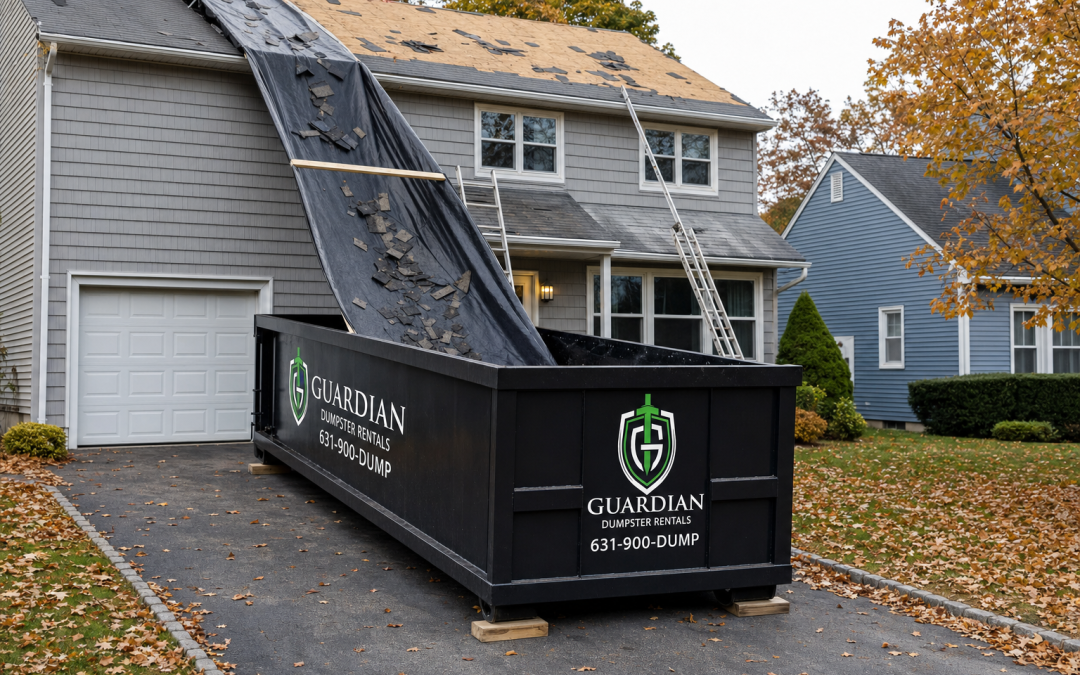
Why Shingle Tear-Off Debris Deserves Its Own Dumpster
A dedicated roofing dumpster rental keeps heavy shingle tear-off debris out of your remodel container, which prevents overweight fees, keeps both crews working without waiting on each other, and stops shingles from eating up space your remodel waste needs. During a busy fall roofing season in New York, that separation can save you both money and days on the schedule.
Key takeaways
- Shingle tear-off debris is dense and heavy, so mixing it into your remodel container can push the box over its weight limit and trigger overage fees.
- A dedicated roofing dumpster rental keeps shingles separate, which often qualifies the load for shingle-specific disposal or recycling pricing.
- For most NY re-roofing projects, a 10 yard or 20 yard dumpster handles shingle tear-off, while the whole-house remodel debris goes in its own 20 or 30 yard container.
- Keeping nails, underlayment, and shingles out of the remodel box reduces jobsite hazards and keeps both contractors' crews moving without sorting delays.
- Remember that brick, concrete, dirt, and yard waste are not allowed in the dumpsters, so plan separate handling for any masonry or landscaping debris.
Asphalt shingles are deceptively heavy. A full tear-off from an average home produces a dense, compact pile that weighs far more than its size suggests. Toss that into a container that’s also collecting drywall, old cabinets, and flooring, and you create three problems at once — all of them avoidable with a second box dedicated to the roof.
Problem 1: Shingles Blow Past Weight Limits Fast
Every dumpster comes with a weight allowance, and mixed loads topped with shingles are one of the most common ways homeowners exceed it. Because shingle weight stacks up so quickly, a roofing crew can push a 20 yard remodel container over its limit before the box even looks full. Haulers who handle a roofing dumpster rental in Lindenhurst NY plan for that density from the start, so the container size and weight allowance actually match the job.
Problem 2: Two Crews, One Box, Constant Bottlenecks
When roofers and remodelers share a single container, someone is always waiting. Roofing crews work fast — shingles come off in hours, not days — and they need clear access to throw debris directly from the roof into the box. If the interior crew has the dumpster parked near the garage, or it’s already half full of demolition waste, the tear-off slows down. In fall, when roofers are racing to dry-in homes before New York’s first cold snaps, a lost day can push your project into weather delays.
Problem 3: Shingles Steal Your Remodel Capacity
Shingle debris is dense and settles into every gap, which means it fills the bottom of a container and leaves far less usable volume for bulky remodel items. The common result is an unplanned swap-out — another delivery fee, another wait. Keeping the roof debris in its own 10 yard or 20 yard container means your remodel box holds exactly what you planned for.
The Simple Fix: One Box Per Job
- Roofing container: typically a 10 yard or 20 yard box, placed close to the house for direct tear-off loading.
- Remodel container: a 20 yard or 30 yard box positioned for interior crew access.
- Separate pickups: the roofing box leaves as soon as the tear-off wraps, clearing your driveway sooner.
If your project is a whole-house renovation on Long Island, coordinating both containers through one provider — like a local dumpster rental in Amityville New York — makes scheduling the two deliveries and pickups far simpler. The sections below break down sizing, timing, and whether the second box truly pays for itself.
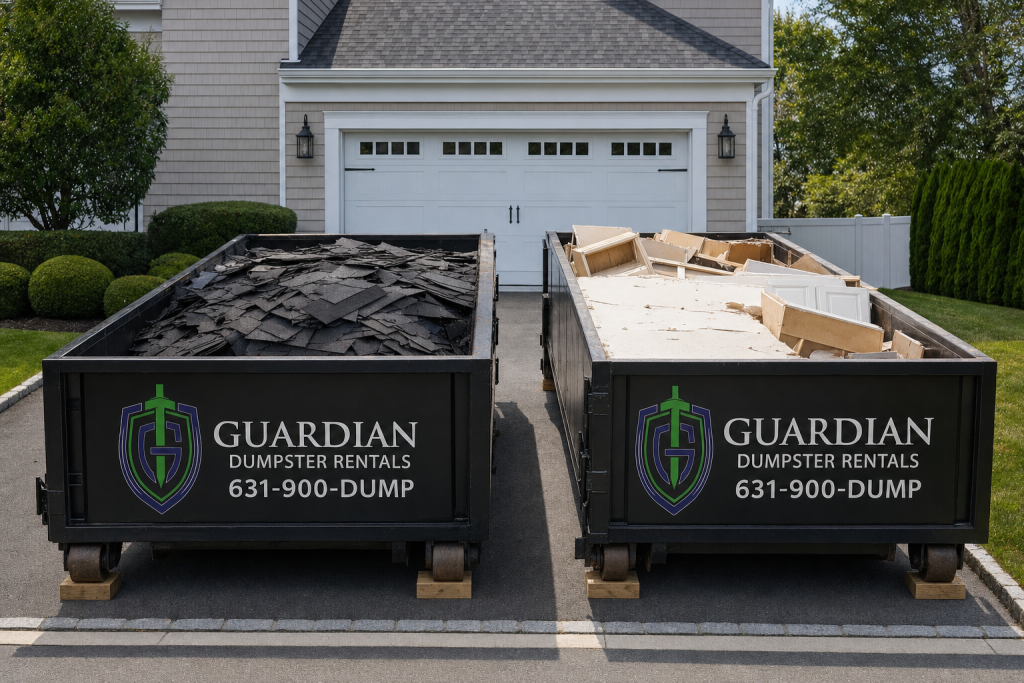
Why Do Roof Shingles Need a Separate Dumpster From Remodel Debris?
Roof shingles need their own dumpster because asphalt is dramatically heavier per cubic foot than drywall, cabinetry, and trim. Mixing the two fills a container by weight before it fills by volume, triggering overage charges, uneven loads, and timing conflicts between your roofing crew and interior demo crew.
Think of it this way: a remodel dumpster fills up with bulky-but-light material, while a roofing dumpster fills up with dense, compact material. Those are two completely different loading profiles, and trying to serve both with one box almost always works against you.
The Weight Problem With Asphalt Shingles
Asphalt shingles are essentially fiberglass mats saturated with asphalt and coated in mineral granules — they’re built to be dense and weather-resistant, which also makes them one of the heaviest common debris types. Torn-off shingles come down with nails, felt paper, and often an older second layer underneath, so the pile adds up fast. Drywall, cabinets, and trim, by contrast, take up lots of space but weigh comparatively little.
When you combine the two in one container, you get the worst of both worlds:
- Overage charges: Dumpsters come with a weight allowance. A layer of shingles at the bottom can eat most of that allowance before the interior debris even goes in.
- Uneven fills: Heavy shingles dumped on one end create an unbalanced load that’s harder — and sometimes unsafe — to haul.
- Wasted volume: Bulky cabinetry and framing lumber trap air pockets over the shingles, so you pay for space you can’t actually use.
Scheduling Conflicts Between Crews
There’s also a practical jobsite issue. Roofers work fast — most residential tear-offs happen in a day or two — and they need the box positioned close to the roofline so debris slides straight in. Interior demo crews need the same container near a door or window chute, often for a week or more. If both crews share one dumpster, someone is always walking debris across the yard, and when the box fills early, both trades stall while they wait on a swap-out. A dedicated roofing dumpster rental in Bay Shore NY lets the tear-off crew load, finish, and get the heavy box hauled off without touching the remodel timeline.
Cleaner Loads Keep Everything Simpler
Shingle-only loads are also easier for haulers to weigh, process, and price accurately, which means fewer surprises on your invoice. Whether you’re planning a straightforward re-roof or coordinating it alongside a larger renovation, a dedicated roofing dumpster rental in Dix Hills keeps the heavy material in its own box where it belongs. In a 10, 20, or 30 yard container filled only with shingles, the hauler knows exactly what to expect — and so do you.
What Size Roofing Dumpster Rental Do I Need for a Tear-Off in NY?
For most New York tear-offs, a 10 yard dumpster handles a small roof or single-layer job of roughly 20–25 squares, a 20 yard suits the average single-family home at around 30–40 squares, and a 30 yard covers large homes or double-layer tear-offs. When in doubt, size up — shingles are heavy and bulky.
Roofers measure in “squares” (one square equals 100 square feet of roof surface). Before you book a roofing dumpster rental, ask your contractor for the total square count and whether the roof has one layer of shingles or two. A second layer effectively doubles the debris, which is the most common reason homeowners end up needing a second haul.
Container Sizes Table
| Dumpster Size | Approx. Shingle Capacity (Single Layer) | Best For |
|---|---|---|
| 10 Yard | Roughly 20–25 squares | Small capes, ranches, garages, or partial tear-offs |
| 20 Yard | Roughly 30–40 squares | Typical NY colonials and split-levels with one shingle layer |
| 30 Yard | Roughly 50+ squares | Large homes, steep or complex rooflines, double-layer tear-offs |
Single-Layer vs. Double-Layer Tear-Offs
Many older Long Island homes were re-roofed directly over the original shingles, so a “one roof” job can produce two roofs’ worth of debris. Keep these rules of thumb in mind:
- Single layer: Match the dumpster to your square count using the table above.
- Double layer: Move up at least one container size — a home that would normally need a 10 yard typically needs a 20 yard, and a 20 yard job often requires a 30 yard.
- Weight matters: Shingles are dense, so even a box that looks half full can approach its weight allowance. Confirm the included tonnage when you order.
Matching the Box to Typical NY Home Footprints
A modest cape or ranch in the 1,000–1,500 square foot range usually generates a roof in the 15–25 square neighborhood, which fits a 10 yard container if there’s only one layer. Mid-size colonials common across Suffolk County often land in 20 yard territory, which is the size we deliver most for roofing dumpster rental in Dix Hills and similar neighborhoods with larger lots and bigger rooflines.
Sprawling two-story homes, houses with multiple dormers, or any double-layer tear-off generally call for a 30 yard box. If you’re unsure where your home falls, a quick call with your roof’s square footage is all it takes — homeowners arranging a roofing dumpster rental in Commack NY can get a size recommendation based on the square count and layer count before the crew ever shows up.
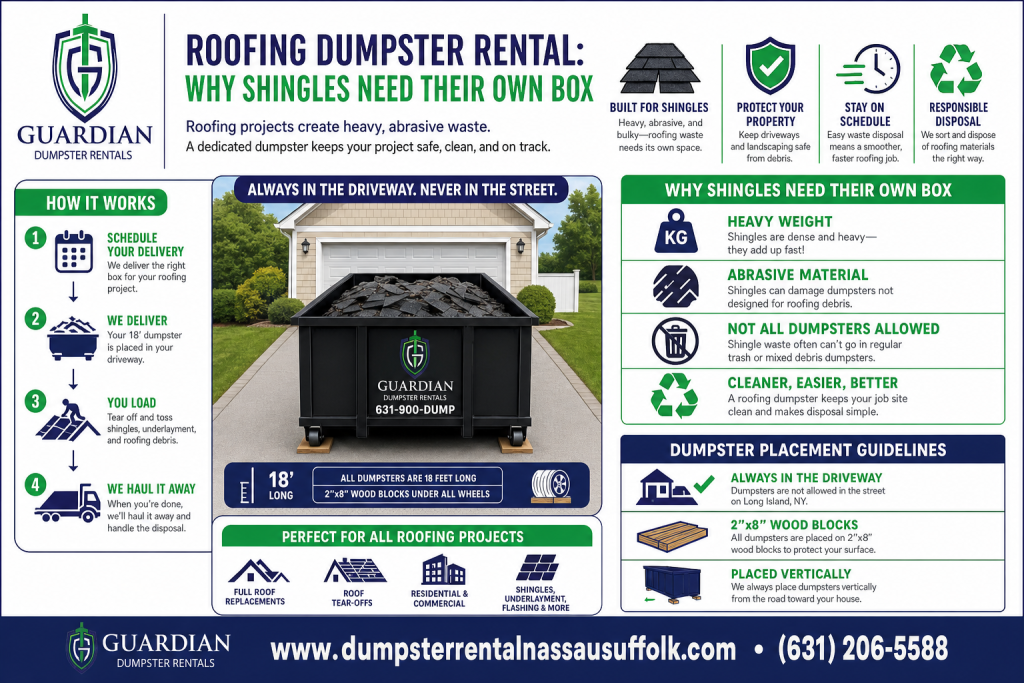
How Should I Schedule Two Dumpsters During a Whole-House Remodel?
Order the roofing dumpster to arrive the day before your roofer starts, placed directly under the eave where shingles come down. Keep the remodel container near the driveway entrance for the duration of interior work. Stagger the deliveries so trucks never compete for driveway access, and book swap-outs a few days ahead.
Running a roof tear-off and an interior remodel at the same time is common, but it only works smoothly when the two containers have clearly separate jobs and clearly separate parking spots. A little planning before the first truck arrives saves you from a blocked driveway and a crew standing around.
Placement: Keep Each Container Where Its Debris Falls
- Roofing dumpster: Stage it as close to the drop zone as possible, ideally alongside the house under the section being stripped first. Roofers want to slide shingles straight off the roof into the box, not wheelbarrow them across the yard.
- Remodel dumpster: Position it near the main entry or garage, where drywall, cabinetry, and flooring will be carried out. A 20 yard container is a common pick here, while a 30 yard box often handles a heavy tear-off plus full interior gut better than two trips.
- Leave a truck lane: The roll-off truck needs a straight approach to lift each box. If the two containers box each other in, your swap-out stalls.
If you’re coordinating both boxes on a tight suburban driveway, a local provider who knows the streets helps. Homeowners arranging a roofing dumpster rental in Babylon NY, for example, can get placement guidance based on the actual lot and driveway layout.
Sequencing Around the Roofer’s Start Date
Roofing crews move fast — many residential tear-offs are stripped in a single day. Schedule the roofing container to land the afternoon before the crew arrives, and arrange pickup for the day after the tear-off wraps so the box isn’t sitting full and blocking the next phase. The remodel container, by contrast, usually stays on site for the full project window, so deliver it first and let it anchor its spot.
Confirm your roofer’s start date before locking in delivery, and ask how many squares they expect to strip. That number determines whether a 10 yard, 20 yard, or 30 yard box goes in the roofing position — and whether you’ll need a mid-project swap.
Why Fall Timing in NY Demands Tighter Scheduling
Autumn is peak roofing season on Long Island, but shorter daylight hours shrink the working window, and an early cold snap can push asphalt shingles below their ideal installation temperature. If a full roofing container sits for days waiting on a pickup, your roofer may lose the weather window entirely. Book your swap-out in advance rather than calling when the box is already full — fall demand means same-day pickups aren’t guaranteed. Working with a nearby hauler, such as one serving roll off dumpster rental in Greenlawn, makes those quick turnarounds far more realistic.
What Can and Can’t Go in a Roofing Dumpster?
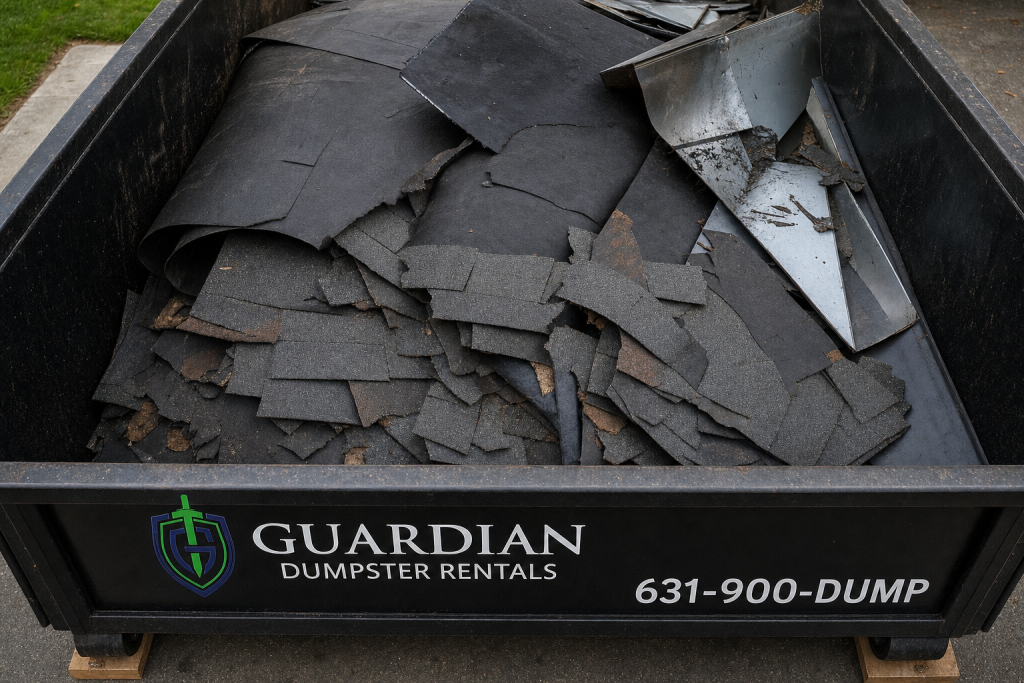
A roofing dumpster can take asphalt shingles, underlayment, roofing felt, flashing, drip edge, and the nails that come off with them. It cannot take brick, concrete, dirt, or yard waste — including the leaves and branches that often land on tarps during a fall tear-off. Keep it strictly roofing debris.
That short list sounds simple, but tear-off sites get messy fast, and the wrong item in the box can complicate your haul-away. Here’s a closer breakdown of what belongs in the container and what needs to stay out.
Accepted Roofing Debris
Everything that comes off the roof as part of the shingle system is fair game:
- Asphalt shingles — whole, torn, or broken, including ridge caps and starter strips
- Underlayment and roofing felt — tar paper and synthetic underlayment alike
- Flashing and drip edge — the metal pieces pulled from valleys, chimneys, and roof edges
- Nails and staples — loose fasteners swept off tarps can go right in with the shingles
- Ice and water shield scraps — the membrane material stripped from eaves and valleys
If your crew is tearing off in Suffolk County, a roll off dumpster rental in Greenlawn loaded with only these materials will be weighed and hauled without any sorting headaches on your end.
Prohibited Items — No Exceptions
These materials are not allowed in a roofing dumpster:
- No brick — even a few loose bricks from an old chimney repair need to go elsewhere
- No concrete — chunks of walkway or patio can’t ride along with shingles
- No dirt — soil from landscaping or excavation stays out of the box
- No yard waste — leaves, branches, grass clippings, and brush are all prohibited
Watch the Tarps During Autumn Tear-Offs
The yard waste rule trips up more homeowners than any other, especially in October and November. Crews lay tarps around the house to catch falling shingles, and those same tarps collect leaves, twigs, and small branches all day. When the tarps get dumped into the container at cleanup time, that organic debris goes with them — and now you have a contaminated load.
The fix is easy: shake the tarps out or rake them off before emptying them into the dumpster. A minute of attention keeps the load clean. Homeowners booking a 10 yard dumpster rental in West Islip for a smaller roof should be especially careful, since a compact container fills quickly and there’s less room to dig out stray debris if something prohibited slips in.
When in doubt about a specific item, ask before you toss it. A quick call beats finding out at pickup that your shingle load has a problem.
Is a Second Dumpster Really Cheaper Than One Big Mixed Load? The Roofing Dumpster Rental Math
Yes, in most cases a dedicated roofing dumpster rental costs less than cramming shingles into one shared container. Shingles are dense enough to trigger overweight fees on a mixed load, and contaminated-load charges can erase any savings from renting a single box. A separate 10 or 20 yard roofing dumpster keeps both loads clean, predictable, and flat-rate.
Where the “One Big Box” Plan Goes Wrong
Asphalt shingles are among the heaviest materials a homeowner will ever throw away. According to the EPA’s guidance on construction and demolition materials, roofing debris makes up a significant share of C&D waste, and its weight is what drives disposal cost. When shingles get layered on top of lighter remodel debris in a single 30 yard container, the box often hits its weight allowance long before it’s physically full. You end up paying overage fees on a dumpster that looks half empty.
- Overweight fees: Mixed loads with shingles routinely exceed the included tonnage, and per-ton overage charges add up fast.
- Contaminated-load charges: Shingles mixed into general debris can disqualify the load from cheaper shingle-specific disposal or recycling, meaning the entire container is billed at the higher mixed-waste rate.
- Wasted volume: Heavy shingles compress and bury lighter material, so you get less usable space out of the box you’re already paying for.
The Flat-Cost Advantage of a Dedicated Roofing Box
Adding a 10 yard dumpster for the tear-off — or a 20 yard for a larger roof — gives you a known, flat price up front. Clean shingle loads are easy for haulers to weigh, price, and in many areas recycle; the Asphalt Roofing Manufacturers Association notes that asphalt shingles can be processed into pavement material rather than landfilled, which is only possible when the load isn’t mixed. Homeowners comparing options for a roofing dumpster rental in Lindenhurst NY typically find the dedicated box pays for itself the moment it prevents a single overage bill.
The Schedule Factor: Beating Winter
Cost isn’t only measured in disposal fees. A dedicated roofing container gets filled in a day or two, hauled away, and your driveway is clear for the next phase — no waiting on the remodel crew to finish before the box can leave. That faster turnaround matters most in late fall, when roofers are racing to dry in the house before snow and ice arrive. Property owners arranging a roofing dumpster rental in Amityville often book the roofing box and the remodel box as separate, back-to-back deliveries for exactly this reason: each container arrives when its crew needs it and leaves the moment it’s full.
The bottom line: one oversized mixed container feels cheaper, but a clean 10 or 20 yard roofing box plus a separate remodel container almost always wins once weight, contamination risk, and schedule delays are counted.
Roughly 200-350+ lbs per square (one layer), so loads add up fast
Asphalt shingle weight
10 or 20 yard dumpster for most residential tear-offs
Common roofing box size
Overweight fees and lost recycling eligibility when shingles share a remodel box
Typical mixed-load risk
No brick, concrete, dirt, or yard waste in any dumpster
Prohibited materials
Roofing Dumpster Rental Sizes for Shingle Tear-Off vs. Remodel Debris
| Dumpster Size | Best Use on a Re-Roof + Remodel Job | Typical Shingle Capacity |
|---|---|---|
| 10 Yard | Dedicated shingle tear-off box for small to mid-size roofs | Roughly 20-30 squares of asphalt shingles, depending on layers |
| 20 Yard | Larger roofs or tear-offs with multiple shingle layers | Roughly 40-60 squares; confirm weight limits before loading |
| 30 Yard | Whole-house remodel debris (drywall, cabinets, flooring, fixtures) | Not recommended for shingles alone — too much weight capacity risk; use for bulky, lighter remodel debris |
Illustrative Example: A Two-Container Plan for a Long Island Remodel
Illustrative example
Consider a hypothetical homeowner in Suffolk County tackling a full interior remodel at the same time as a two-layer shingle tear-off. The general contractor initially planned to share one 30 yard dumpster, but the roofer flagged that the shingle weight alone could max out the container before the remodel debris was even loaded. Instead, they placed a 10 yard roofing dumpster at the driveway edge for shingles and underlayment, and kept a 30 yard box for drywall, cabinetry, and flooring. The roofing crew finished tear-off in a day without slowing the interior demo, and the clean shingle-only load avoided mixed-debris complications at disposal. This composite scenario reflects a common outcome when crews separate heavy roofing debris from general remodel waste.
Frequently asked questions
Why can't I just throw old shingles in the same dumpster as my remodeling debris?
Shingles are extremely heavy and dense, so mixing them with bulky remodel debris wastes space and can push the container over its weight limit fast, triggering overage fees. Many haulers also price roofing dumpsters differently because shingles are often recycled separately. Keeping tear-off debris in its own box protects your weight allowance, simplifies disposal, and keeps the remodel container free for drywall, cabinets, flooring, and other lighter materials.
What size roofing dumpster rental do I need for a shingle tear-off?
Most residential tear-offs fit in a 10 yard or 20 yard dumpster, depending on roof size and the number of shingle layers being removed. A 10 yard works well for smaller roofs with a single layer, while a 20 yard suits larger homes or multi-layer tear-offs. A 30 yard is rarely needed for shingles alone because weight limits are usually reached before the container fills, so bigger isn't automatically better.
How much does it cost to rent a dumpster for roof shingles?
Pricing varies by region, container size, rental length, and included weight allowance, so get a quote based on your zip code and roof details. In general, a 10 yard roofing dumpster costs less than a 20 yard, but the biggest cost driver is weight. Ask your hauler how many tons are included and what the per-ton overage charge is, since shingles hit weight limits quickly.
How long does a roofing dumpster need to stay on site during a remodel?
Most shingle tear-offs take one to a few days, so a short rental often works if the roofer's schedule is firm. Standard rental periods typically run about a week, which gives buffer for weather delays. Coordinate delivery for the day before tear-off starts and schedule pickup promptly after loading, since a shingle-filled container sitting in the driveway blocks space your remodel crew needs.
What happens if my roofing dumpster goes over the weight limit?
The hauler weighs the container at the disposal facility, and anything above your included tonnage is billed per ton as an overage fee. Shingles are one of the easiest materials to overload because they're so dense. To avoid surprises, tell your rental company upfront that the box is for shingle tear-off, ask what tonnage is included, and don't top off the container with other heavy debris.
Can I put anything else in the roofing dumpster besides shingles?
Typically yes—related roofing debris like underlayment, felt paper, flashing, nails, and damaged wood decking can usually go in with shingles. Avoid adding general remodel debris, since mixed loads can change how the container is priced and processed. Never add prohibited materials; for example, brick, concrete, dirt, and yard waste are not allowed in the dumpsters. Confirm your hauler's accepted-materials list before loading.
Where should the roofing dumpster be placed during a whole-house remodel?
Position it as close to the roof edge as safely possible so crews can toss debris directly in, reducing labor and scattered nails. On a remodel site, coordinate placement so it doesn't block the remodel container, material deliveries, or driveway access. Use plywood under the container to protect the driveway, and confirm whether your street placement requires a permit from your municipality before delivery.
Do I need a permit for a roofing dumpster in NY?
If the dumpster sits entirely on your private property, such as a driveway, you generally don't need a placement permit. If it must go on a public street or sidewalk, most New York municipalities require a street-occupancy permit. Rules and fees vary by city and town, so check with your local building or transportation department—or ask your rental company, since many handle permits or advise on local requirements.
What's the biggest mistake homeowners make when ordering a dumpster for a re-roof?
Sizing by volume instead of weight. Homeowners often order a 30 yard thinking bigger is safer, then hit the weight cap with the container half empty—paying for space they couldn't use. The second common mistake is letting the roofing crew toss shingles into the remodel container, causing overages and contaminated loads. Order a dedicated 10 or 20 yard roofing box and brief all crews on which container is theirs.
Should the roofer provide the dumpster or should I rent it myself?
Either works, but clarify it in writing before tear-off begins. Many roofers include a dumpster in their bid, which is convenient but may carry a markup. Renting it yourself can save money and gives you control over size, placement, and pickup timing—important when a remodel crew is sharing the site. If you rent it, confirm the roofer's start date so the container arrives the day before.
Roofing Dumpster Rental help near you
- Roofing Dumpster Rental Lindenhurst NY
- Roofing Dumpster Rental Commack NY
- Roofing Dumpster Rental Bay Shore NY
Related local pages
- Dumpster Rental Greenlawn New York
- Dumpster Rental West Islip New York
- Dumpster Rental Deer Park New York
Tackling a re-roof and remodel at the same time? Call us today to reserve a dedicated roofing dumpster alongside your remodel container — fast NY delivery before the first winter storms hit. Get in touch.
Last updated: October 14, 2026
Recent Comments