
Roofing Dumpster Placement: Tear-Off Day Done Right
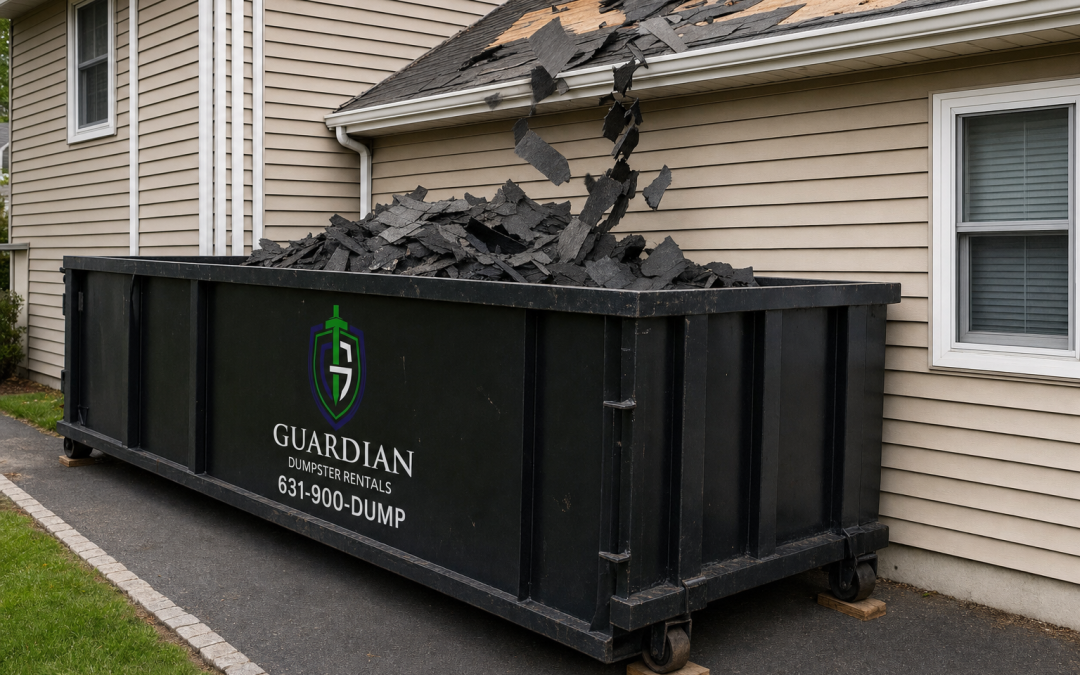
Why Roofing Dumpster Placement Makes or Breaks Tear-Off Day
Smart roofing dumpster placement — staging the container directly under the roof’s drip line, protecting the driveway underneath it, and choosing the right 10, 20, or 30 yard size — can shave hours off a New York tear-off. Get those three decisions right before the crew arrives, and the whole day runs faster, cleaner, and safer.
Key takeaways
- Place the roofing dumpster directly under the roof's drip line so tear-off debris drops straight in, cutting ground cleanup dramatically.
- Protect your NY driveway by laying plywood sheets under the dumpster's contact points before delivery to prevent scratches and cracking.
- A 20 yard dumpster handles most single-family roof tear-offs, while larger or multi-layer roofs typically call for a 30 yard container.
- Confirm placement with your roofer before delivery day — repositioning a loaded dumpster mid-job is costly and often impossible.
- Keep prohibited materials like brick, concrete, dirt, and yard waste out of the roofing dumpster to avoid overage or contamination fees.
A roof tear-off is one of the messiest jobs a home ever goes through. Thousands of pounds of old shingles, underlayment, and nails come raining down in a matter of hours, and every piece of debris that misses the dumpster has to be picked up by hand. That’s why experienced roofers treat dumpster placement as the first task of the day, not an afterthought. When the container sits where debris naturally falls, shingles go from roof to dumpster in one motion instead of hitting the lawn, the flower beds, or a tarp that has to be dragged and dumped over and over.
The Three Decisions That Set Up a Smooth Tear-Off
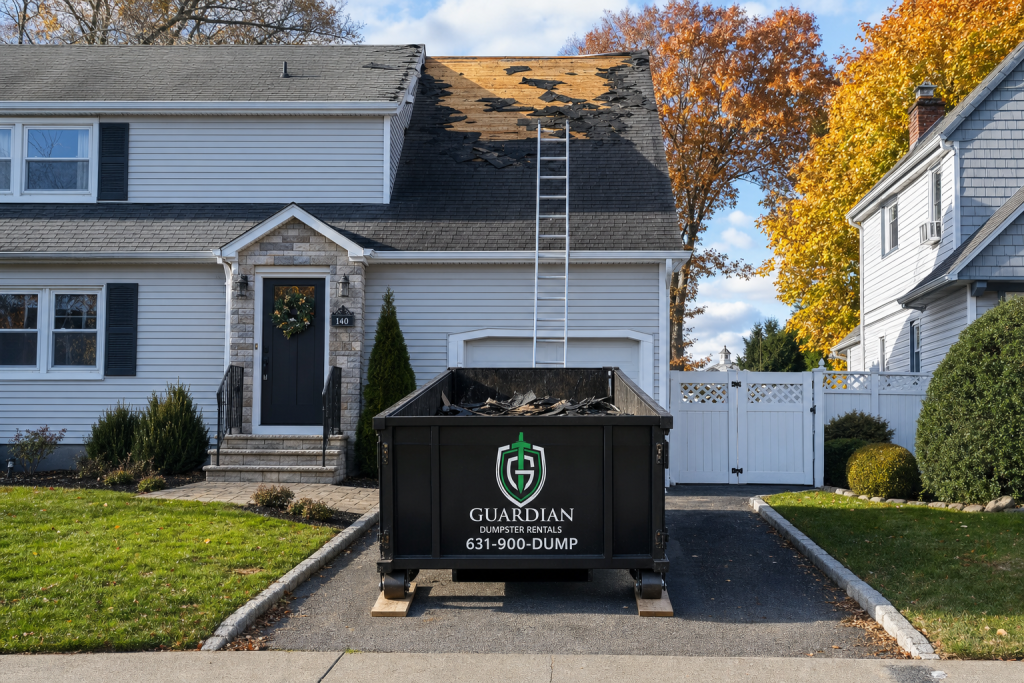
- Position under the drip line. Placing the dumpster tight to the house, below the roof edge where the crew is stripping, lets workers toss debris straight in. Less carrying means less fatigue, fewer stray nails, and a faster job.
- Protect the driveway. A loaded roofing dumpster is heavy. Plywood under the wheels or rails spreads that weight and keeps asphalt and concrete from cracking or scuffing — a small step that prevents an expensive repair.
- Size it right the first time. A 10 yard container suits a small roof, a 20 yard handles most single-family homes, and a 30 yard covers large or multi-layer tear-offs. An undersized dumpster stops work mid-job while everyone waits on a swap.
Why Timing Matters More in the Fall
In New York, fall is peak roofing season — but it’s also when daylight shrinks fast and early cold snaps can shut a job down. A crew that loses an hour repositioning a badly placed container, or stands idle waiting for a second dumpster, may not finish before dark. If you’re planning a project on the South Shore, arranging a roll off dumpster rental in West Islip a few days ahead gives you time to confirm delivery placement with your roofer.
The good news: none of this is complicated. It just has to happen before the first shingle comes off. Homeowners who coordinate a dumpster rental in Deer Park New York or a nearby town with their roofing contractor — agreeing on the exact spot, the protection plan, and the container size — consistently see faster tear-offs and cleaner yards. The sections below walk through each decision step by step.

Where Should I Put the Dumpster for a Roof Tear-Off? Roofing Dumpster Placement Basics
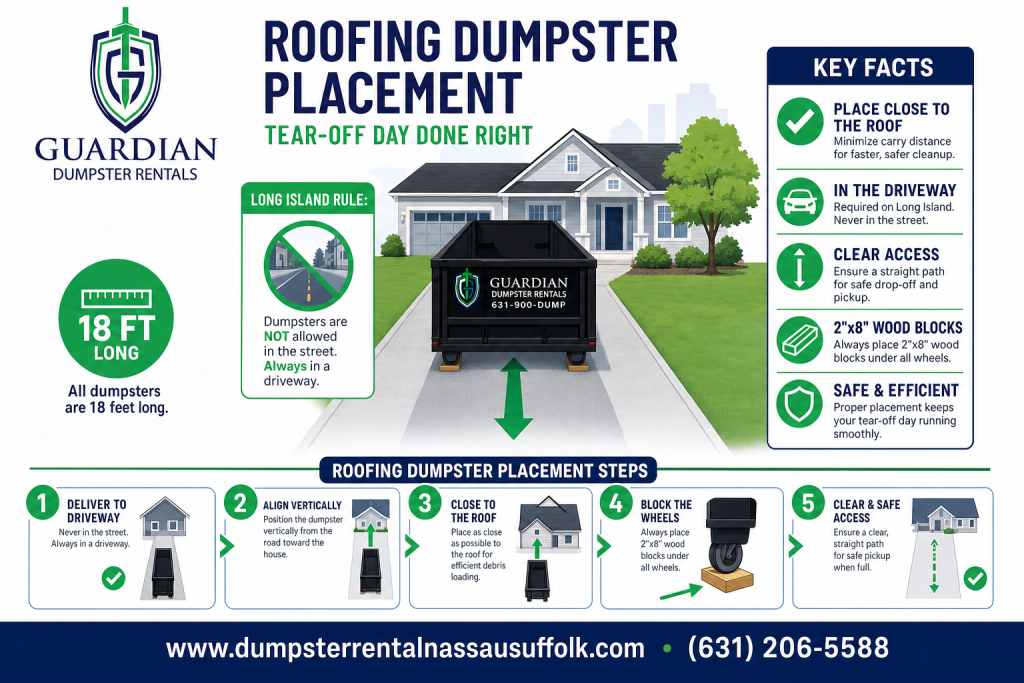
Place the dumpster as close to the eave (drip line) as safely possible, ideally on the driveway alongside the house, so crews can toss torn-off shingles straight from the roof into the container. Keep clear of power lines and overhangs, and if the dumpster must sit on the street, check whether your town requires a permit first.
Get It Under the Working Edge of the Roof
The single biggest time-saver on tear-off day is putting the container where debris naturally falls. Walk the property with your roofer before delivery and identify which side of the house the crew will strip first. A dumpster staged along that eave means shingles go from roof to container in one motion instead of being piled on tarps and carried across the yard. If you’re comparing options for a roll off dumpster rental in Commack, tell the provider it’s for a roof tear-off so the driver knows to position it tight to the house where you’ve marked.
Clearance Rules to Check Before Delivery
- Overhead power lines: Delivery trucks raise their beds high to roll the container off. Never place a dumpster under or near service lines running to the house.
- Tree limbs and gutters: Low branches and overhanging gutters can block the truck or get damaged during drop-off and pickup.
- Truck access: The driver typically needs a long, straight approach and room to back in. Tight side yards, fences, and parked cars can force a less ideal spot, so clear the path in advance.
- Ground conditions: A loaded roofing dumpster is heavy. Soft lawns and unpaved areas can rut or trap the container, so paved surfaces are strongly preferred.
Driveway vs. Curb: The Trade-Off
The driveway is usually the winner: it’s private property (no permit needed in most cases), it’s closer to the roofline, and it keeps debris off the street. The curb becomes the fallback when the driveway is too short, too steep, or needed for vehicles during the job. Curbside placement puts the container farther from the eave, which means more hand-carrying of debris and more stray nails near the road. Homeowners arranging a dumpster rental in West Islip New York or elsewhere on Long Island should measure the driveway length before booking so the hauler can confirm the container will fit with room for the truck.
NY Street Permits: Ask Before It Arrives
If the dumpster must sit in the street or right-of-way, many New York towns and villages require a temporary street occupancy permit, and some also require reflective markings or cones. Rules vary by municipality, so call your town or village clerk (or ask your rental company, since local haulers deal with these requirements constantly) before scheduling delivery. Getting caught without a permit can mean fines or an order to move the container mid-job, exactly what you don’t want with an open roof.
Why Does Placement Under the Drip Line Save Hours of Cleanup?
Placing the dumpster directly under the roof’s drip line lets the crew toss shingles straight off the edge into the container. That eliminates wheelbarrow relays, shrinks the debris field on your lawn, cuts down on stray nails, and can shave hours of tarp-hauling and magnet-sweeping off tear-off day.
Think about what happens when the container sits even twenty feet from the eave. Every scoop of shingles that misses the box has to be picked up twice: once off the tarp or grass, and again when it’s carried to the dumpster. Multiply that by an entire roof’s worth of material and you’re paying for hours of double-handling, whether that cost shows up on the contractor’s invoice or in your own weekend.
Direct-Drop Loading vs. the Wheelbarrow Relay
With direct-drop loading, the roofer strips a section, slides the debris to the edge, and it lands in the container in one motion. With a relay setup, the same debris hits a ground tarp, gets shoveled into a wheelbarrow, gets pushed across the yard, and gets lifted over the dumpster wall. That’s three or four extra touches per load. A taller container like a 20 yard dumpster rental in West Babylon positioned tight to the drip line turns most of those touches into zero.
The Nail Problem Nobody Talks About
Old roofing nails are the real cleanup headache. When shingles drop straight into the container, most of those nails go with them. When shingles hit a tarp or bounce off the lawn, nails scatter, and they’re small enough to slip through grass blades and hide in mulch beds. Crews then have to run a magnetic sweeper over the whole yard, and even a careful sweep misses some. Fewer stray nails means:
- Less time spent on multiple magnet passes around the house
- Lower risk of a flat tire in the driveway weeks later
- Safer footing for kids and pets once the crew leaves
- Faster crew cycles, since roofers strip and drop instead of stopping to police the ground
Why Fall Tear-Offs Raise the Stakes
On Long Island, a lot of roof replacements happen in autumn, right when leaves start blanketing lawns. A layer of leaves hides shingle fragments, felt scraps, and nails almost perfectly. Debris that would be obvious on a green summer lawn simply disappears until you rake in November and find it the hard way. Homeowners arranging a dumpster rental in Commack, New York for a fall project should treat drip-line placement as non-negotiable: the less material that ever touches the ground, the less a leaf cover can conceal.
The takeaway is simple. Good roofing dumpster placement isn’t just about convenience for the delivery driver — it’s the single biggest factor in how clean your property is when the last shingle comes off.
How Do I Protect My NY Driveway from a Roofing Dumpster?
Protect your driveway by laying plywood sheets or 2×10 boards under the container’s rails before delivery, and ask the driver to set the can down gently rather than dragging it. Avoid placing the dumpster on freshly sealed asphalt, and be extra cautious in cooler fall weather, when asphalt hardens and becomes more prone to scraping and cracking.
Boards Under the Rails Are Non-Negotiable
A loaded roofing dumpster concentrates thousands of pounds onto two narrow steel rails. Without a buffer, those rails can dig into asphalt, leave rust stains on concrete, or gouge pavers. The fix is simple and cheap:
- Plywood sheets (3/4 inch): Lay them where the rails will land to spread the weight over a wider footprint.
- 2×10 or 2×12 lumber: Run boards lengthwise under each rail — this is the standard method most roofing crews use.
- Cover the roll-off path too: When the truck tilts the container down and later winches it back up, the rails travel along the driveway. Boards should cover that path, not just the final resting spot.
Have the boards in place before the truck arrives. A good driver will position the container right on top of them, and experienced local providers who handle roofing dumpster rental in Amityville and surrounding areas do this routinely on residential tear-offs.
Why Fall Weather Raises the Risk
Asphalt is flexible in summer heat, but as New York temperatures drop in October and November, the surface stiffens and turns brittle. A brittle driveway doesn’t flex under the rails — it scrapes, chips, or cracks instead. If your tear-off is scheduled for the cooler months, treat board protection as mandatory, not optional. Concrete driveways handle cold better but can still spall at the edges under a hard set-down, so boards are smart there too.
Skip Freshly Sealed Driveways Entirely
If your asphalt was sealcoated within the last few weeks, do not place a container on it. Fresh sealant stays soft longer than most homeowners expect, and the rails will imprint or peel it even with boards down. Either wait until the sealant has fully cured or choose an alternate placement spot on the street (with any required permit) or a gravel area.
How Drivers Set the Can Down Gently
Ask your rental company about their delivery approach when you book. A careful driver will:
- Lower the container slowly with the winch cable rather than letting it slide free
- Ease the rails onto your boards instead of dropping the box the last few inches
- Line up the placement on the first pass to avoid repositioning drags
Smaller containers are naturally easier on driveways as well — for a modest tear-off, a compact option like a 10 yard dumpster rental in Dix Hills puts far less weight on the pavement than a larger box, which matters on older or thinner asphalt.
What Size Dumpster Do I Need for a Roof Tear-Off?
Most single-layer roof tear-offs on average homes fit in a 20 yard dumpster, which handles roughly 25 to 30 squares of shingles. Smaller roofs or partial tear-offs suit a 10 yard container, while large homes or double-layer removals typically need a 30 yard dumpster to avoid overage fees or a second haul.
Roofers measure in “squares” — one square equals 100 square feet of roof surface. Before you order, ask your contractor for the roof’s square count and how many shingle layers are coming off. A second layer nearly doubles your debris volume and weight, which changes the right container size fast.
Container Sizes Table for Roof Tear-Offs
- 10 Yard Dumpster: Handles roughly 10 to 15 squares of single-layer shingles. A good fit for small capes, ranches, garages, or partial repairs. Compact footprint also makes roofing dumpster placement easier on short driveways.
- 20 Yard Dumpster: Handles roughly 25 to 30 squares of single-layer shingles, or about 15 squares if you’re tearing off two layers. The most common choice for typical two-story colonials and split-levels across Long Island.
- 30 Yard Dumpster: Handles roughly 40+ squares single-layer, or larger homes with multiple shingle layers. Best for big colonials, homes with attached garages and dormers, or full tear-offs where plywood decking is also being replaced.
If you’re working on a smaller roof section or a detached garage, a compact container like a 10 yard dumpster rental in Dix Hills keeps costs down while still leaving room for underlayment, flashing, and nails.
Don’t Forget the Weight Limit
Shingles are deceptively heavy. A single square of standard three-tab shingles weighs around 200 to 250 pounds, while heavy architectural shingles can run 300 to 450 pounds per square. That means a large tear-off can hit several tons before the container looks anywhere near full. Every dumpster size comes with a weight allowance, and exceeding it triggers per-ton overage charges — so with architectural shingles, it’s often smarter to size up or ask your rental company about the included tonnage before booking.
When in Doubt, Size Up
The price gap between container sizes is usually modest compared to the cost of a swap-out mid-job. If your roofer says you’re borderline between two sizes, the larger box almost always wins — especially if there’s any chance of rotted decking or an unexpected second shingle layer hiding underneath. A dedicated roofing dumpster rental in Amityville can be matched to your square count and shingle type so the crew isn’t stuck waiting on a second container while debris piles up on your lawn.
What Can and Can’t Go in a Roofing Dumpster?
A roofing dumpster can take shingles, underlayment, flashing, nails, and rotten decking wood — everything a tear-off produces. It cannot take brick, concrete, dirt, or yard waste, including fall leaves and branches. Mixing prohibited materials with roofing debris can lead to overage charges or an outright rejected load at the disposal facility.
The reason is simple: roofing debris is typically hauled to facilities that process construction and demolition materials, and the load is weighed and inspected. When the wrong materials show up, the hauler either pays a penalty at the scale or gets turned away — and that cost lands on the customer. The U.S. Environmental Protection Agency classifies roofing shingles as construction and demolition debris, which is why they follow different disposal rules than household or yard waste.
Materials That Belong in the Dumpster
- Asphalt shingles — old three-tab or architectural shingles, including multiple torn-off layers
- Underlayment — felt paper, synthetic underlayment, and ice-and-water shield
- Flashing — step flashing, drip edge, valley metal, and pipe boots
- Nails and fasteners — they’re expected in a roofing load, so don’t stress over stray nails
- Rotten or damaged decking — plywood and plank sheathing pulled during the tear-off
Materials That Must Stay Out
- Brick — even chimney brick removed during the roof job needs separate handling
- Concrete — chunks of walkway or old footings will overload and contaminate the container
- Dirt — soil is far heavier than it looks and isn’t accepted with roofing debris
- Yard waste — leaves, branches, brush, and grass clippings, no exceptions
Resist the Fall Cleanup Temptation
Most Long Island tear-offs happen in fall, right when leaves are piling up. An open dumpster in the driveway looks like a convenient solution, but tossing bags of leaves or trimmed branches on top of shingles contaminates the load. New York State regulates how construction debris is handled — the NYS Department of Environmental Conservation outlines those requirements — and yard waste follows an entirely separate stream, often municipal composting.
If you’re booking a container specifically for a tear-off, a roofing dumpster rental in Amityville comes with clear guidance on accepted materials, so there’s no guesswork on delivery day.
And if the roofing job uncovers a smaller side project — say, hauling out old decking or garage clutter — a separate 10 yard dumpster rental in Islip keeps those materials out of the roofing load and keeps both containers compliant. Keeping loads clean is the cheapest insurance you can buy on tear-off day.
20 yard dumpster
Most common tear-off size
Plywood sheets under contact points
Driveway protection
Roughly 60 ft of straight access and overhead room
Typical clearance needed for delivery
Often hours of ground pickup avoided
Cleanup time saved with drip-line placement
Roofing Dumpster Placement & Size Guide: 10, 20, and 30 Yard Options
| Dumpster Size | Typical Roofing Job | Best Placement Strategy |
|---|---|---|
| 10 Yard | Small roof sections, garage roofs, or partial repairs | Tight against the driveway edge nearest the work area, under the drip line if possible |
| 20 Yard | Most single-family home tear-offs (single layer) | Centered under the primary drip line on plywood-protected driveway |
| 30 Yard | Large homes, multi-layer tear-offs, or steep complex roofs | Positioned under the longest roof edge with clear overhead access for tossing debris |
Illustrative Example: A Smooth Tear-Off in a Suburban NY Driveway
Illustrative example
Consider a hypothetical homeowner in Westchester County planning a full shingle tear-off on a two-story colonial. Working with their roofer, they ordered a 20 yard dumpster and had it placed on plywood directly beneath the longest drip line of the roof. Crews were able to toss shingles straight from the roof edge into the container, so end-of-day ground cleanup took minutes instead of hours. The plywood protected the asphalt driveway from gouges, and the driveway was left in the same condition as before delivery. This composite scenario reflects a typical outcome when roofing dumpster placement is planned before tear-off day.
Frequently asked questions
What is the best roofing dumpster placement for a tear-off?
The ideal spot is on the driveway, as close to the roof's drip line as safely possible so crews can toss shingles directly into the container. Keep the dumpster clear of overhead power lines, low branches, and the garage door swing. Position the rear door away from the house so the driver has room to hook and lift, and leave enough clearance for the truck to back in straight.
Will a roofing dumpster crack my driveway?
A loaded dumpster can mar or crack asphalt and stain concrete, especially in hot New York summers when asphalt softens. Protect the surface by laying plywood sheets or dunnage boards under the dumpster's contact points and wheels before delivery. Ask the driver to place the container on the boards, and avoid overfilling, since excess weight concentrated on small contact points is what causes most damage.
What size dumpster do I need for a roof tear-off?
It depends on your roof's square footage and how many layers of shingles are coming off. A 10 yard dumpster handles small roofs or single-layer tear-offs, a 20 yard dumpster suits most average homes, and a 30 yard dumpster covers large houses or multi-layer removals. Your roofer can estimate the number of roofing squares, which is the most reliable way to choose between the three sizes.
Why does placing the dumpster under the drip line save time?
When the dumpster sits directly under the roof edge, crews can slide debris straight off the roof into the container instead of carrying it across the yard by hand or wheelbarrow. That eliminates hundreds of trips, keeps shingles and nails off the lawn, and can cut cleanup time from hours to minutes. It also reduces the number of stray nails left behind for magnet sweeps to catch.
How long can I keep a roofing dumpster in my driveway?
Most rentals include a standard period of several days to a week, which comfortably covers a typical one- to two-day tear-off plus cleanup. Confirm the included rental days and any per-day extension fees before delivery. Schedule the dumpster to arrive the morning of tear-off or the day before, and call for pickup as soon as the crew finishes so you are not paying for idle days.
Do I need a permit to put a roofing dumpster on the street in NY?
If the dumpster sits entirely on your private driveway, you generally do not need a permit. If it must go on a public street or right-of-way, most New York municipalities require a street occupancy permit, and rules vary by town and city. Check with your local building or highway department before delivery, since fines and forced relocation are common consequences of skipping the permit.
What can't I throw in a roofing dumpster?
Roofing dumpsters are meant for shingles, underlayment, felt, flashing, nails, and general tear-off debris. Brick, concrete, dirt, and yard waste are not allowed in the dumpster. Hazardous materials like paint, chemicals, and propane tanks are also prohibited, and older roofs with asbestos-containing materials require special handling. Ask your rental company for their full prohibited items list before loading anything questionable.
What are the biggest mistakes people make with dumpster placement on roofing jobs?
Common mistakes include parking the dumpster too far from the roof edge, forgetting to move vehicles out of the garage before delivery blocks them in, placing it under power lines, skipping plywood protection on the driveway, and overfilling past the rim so the hauler refuses pickup. Another frequent error is ordering a 10 yard dumpster when the tear-off really needs a 20 or 30 yard container.
What happens if the dumpster fills up before the tear-off is done?
Call the rental company right away and request a swap-out, where the full container is hauled off and an empty one is delivered. This adds cost and can stall the crew, so it is usually cheaper to size up front, choosing a 20 yard over a 10 yard, or a 30 yard for multi-layer tear-offs. Never pile debris above the rim, since overloaded dumpsters cannot legally be transported.
Should the roofing dumpster arrive before the crew or on tear-off day?
Having it delivered the afternoon or evening before tear-off is usually the safer choice. It guarantees the container is positioned exactly where you want it before crews arrive, lets you inspect placement and driveway protection, and prevents a late delivery truck from stalling the whole job. Same-morning delivery works too, but only if the hauler can commit to an early window before the crew starts stripping shingles.
Related local pages
- Dumpster Rental Lindenhurst New York
- Dumpster Rental Deer Park New York
- Dumpster Rental Islip New York
Ready for tear-off day? Reserve your 10, 20, or 30 yard roofing dumpster now and we'll help you pick the perfect placement spot before the crew arrives. Get in touch.
Last updated: September 24, 2026
Recent Comments