
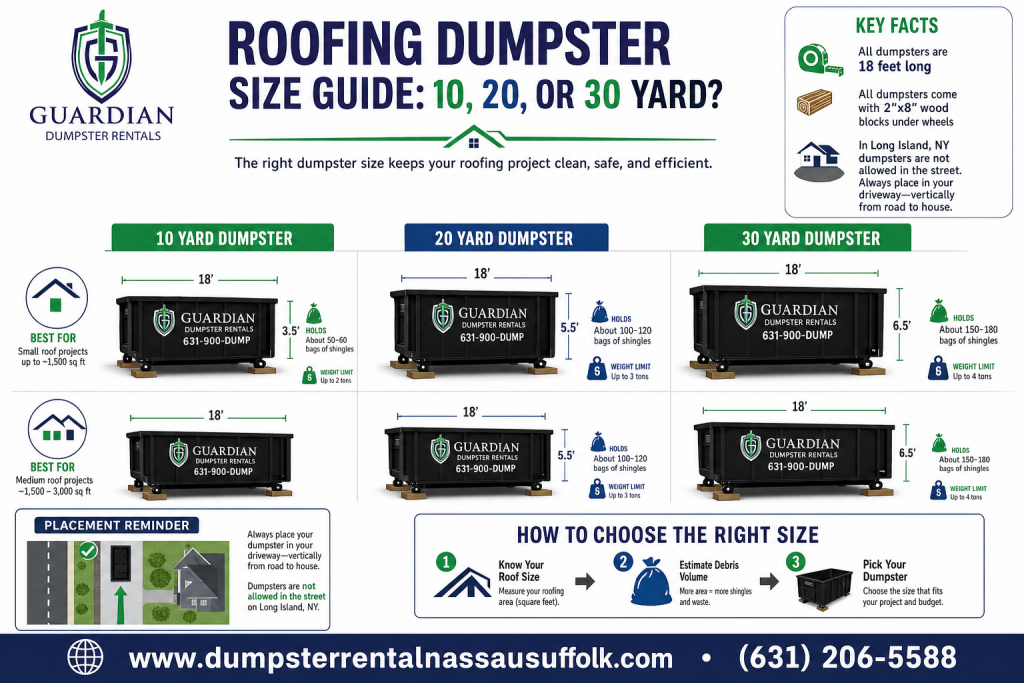
Roofing Dumpster Size Guide: 10, 20, or 30 Yard?
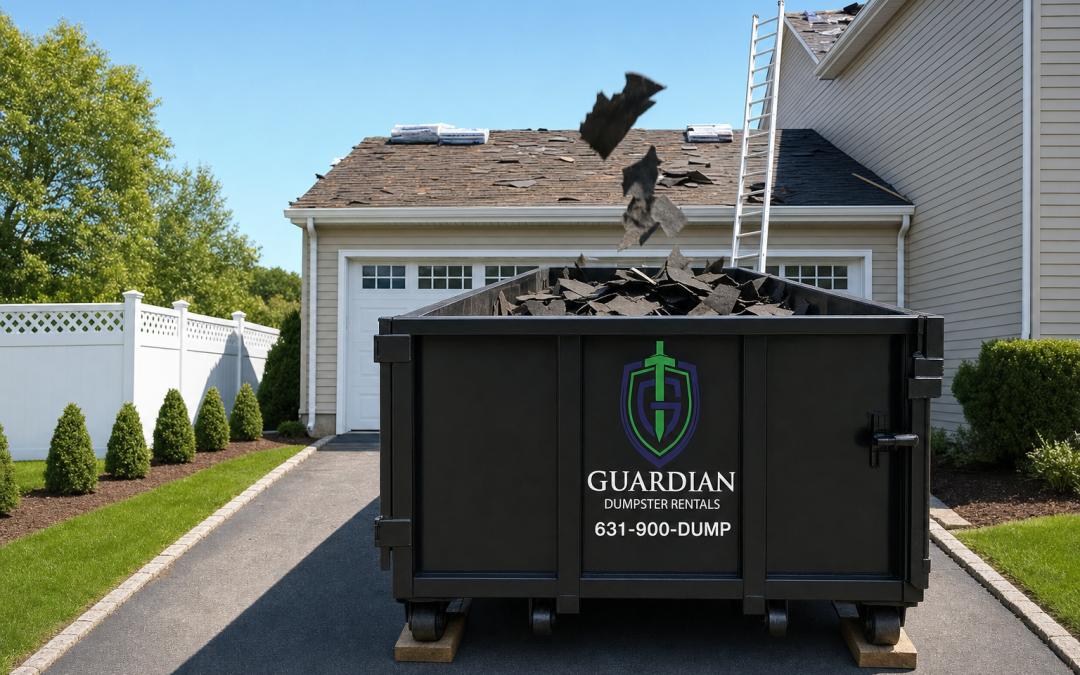
Quick Answer: Which Roofing Dumpster Size Fits Your Tear-Off?
The right roofing dumpster size depends on how many squares of shingles you’re tearing off: a 10 yard dumpster handles roughly 25–30 squares of 3-tab shingles, a 20 yard holds about 50–60 squares, and a 30 yard fits 80 or more. Most single-family roof tear-offs land squarely in 10 or 20 yard territory.
Key takeaways
- One roofing square equals 100 square feet of roof area, and a single layer of asphalt shingles weighs roughly 200-350 pounds per square.
- As a rule of thumb, a 10 yard dumpster handles small roofs of roughly 20-25 squares, a 20 yard handles about 30-40 squares, and a 30 yard suits large roofs of 50+ squares (single layer).
- Weight limits, not volume, are usually the deciding factor for shingle debris, so always confirm the tonnage cap with your hauler before ordering.
- Multiple shingle layers effectively double or triple your debris, so a two-layer tear-off often bumps you up a full dumpster size.
- When in doubt, size up: one larger dumpster is almost always cheaper than a second haul or overage fees.
If you only remember one thing from this guide, make it this chart. Match your roof’s square count (one square equals 100 square feet of roof surface) to the container that covers it with a little breathing room, and you’ll avoid both an overflowing dumpster and paying for space you never use.
Roofing Dumpster Size Chart at a Glance
- 10 yard dumpster: roughly 25–30 squares of 3-tab shingles — a good fit for smaller ranch homes, garages, and single-layer tear-offs
- 20 yard dumpster: roughly 50–60 squares — the most common choice for average two-story homes and roofs with a second layer of shingles
- 30 yard dumpster: 80+ squares — best for large homes, steep or complex roofs, multi-layer tear-offs, or jobs that include decking and other debris
Keep in mind these figures assume standard 3-tab asphalt shingles. Architectural (dimensional) shingles are noticeably heavier and bulkier, so the same dumpster holds fewer squares of them. If your roof has architectural shingles or more than one layer, lean toward the larger size in any borderline situation.
Why Weight Matters as Much as Volume
Shingles are one of the densest materials homeowners ever throw in a dumpster. A container can look half empty and still be at its weight limit, because asphalt shingles pack down heavy — a single square of tear-off debris can weigh a few hundred pounds. That’s why roofing dumpsters come with weight allowances, not just cubic-yard capacities.
- Volume tells you if it fits; weight tells you if the truck can legally haul it.
- Overage fees apply when you exceed the included tonnage, so an underestimated load can cost more than simply renting the next size up.
- Multiple layers multiply weight fast — a two-layer tear-off can double your debris without changing your roof’s footprint.
For the typical Long Island home, a 20 yard dumpster rental in Babylon hits the sweet spot: enough capacity for most single-family tear-offs, a weight allowance suited to shingle debris, and a footprint that still fits comfortably in a standard driveway.
Not sure how many squares your roof actually has? The next two sections walk you through the math and the situations where sizing up from a 10 to a 20 or 30 yard container is the smarter — and often cheaper — call.
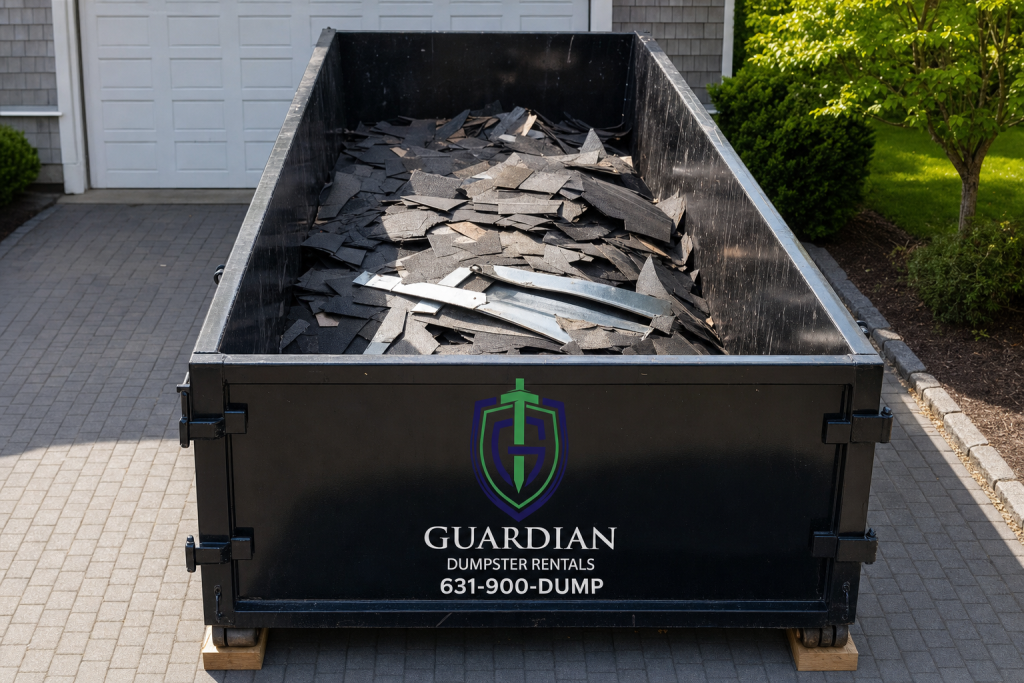
How Many Squares of Shingles Fit in a 10, 20, or 30 Yard Dumpster? A Roofing Dumpster Size Breakdown
As a general rule, a 10 yard dumpster holds roughly 20–25 squares of single-layer 3-tab shingles, a 20 yard handles about 35–40 squares, and a 30 yard fits 50–60 squares. Heavier architectural shingles and double-layer tear-offs reduce those numbers, because weight limits fill up before the container does.
Shingles are dense, so the right roofing dumpster size is usually determined by weight, not volume. A square of 3-tab shingles typically weighs around 200–250 pounds, while architectural (dimensional) shingles often run 350–450 pounds per square. That difference matters a lot when your hauler’s weight allowance is measured in tons.
10 Yard Dumpster
- 3-tab shingles (single layer): roughly 20–25 squares
- Architectural shingles (single layer): roughly 15–20 squares
- Double-layer tear-off: plan for about half the square count above
- Typical weight limit: around 2–3 tons, depending on the hauler
- Footprint: roughly 12–14 feet long by 8 feet wide with low sidewalls, so it fits on most standard driveways with room to spare
20 Yard Dumpster
- 3-tab shingles (single layer): roughly 35–40 squares
- Architectural shingles (single layer): roughly 25–30 squares
- Double-layer tear-off: comfortable for many average-size homes where a 10 yard would max out on weight
- Typical weight limit: around 3–4 tons
- Footprint: roughly 22 feet long by 8 feet wide with 4-foot-plus walls — still driveway-friendly, but measure your parking pad first
The 20 yard is the workhorse of residential roofing, which is why crews handling a full tear-off often default to a 20 yard dumpster rental in Babylon and similar Long Island neighborhoods where lot sizes and roof areas fall in that middle range.
30 Yard Dumpster
- 3-tab shingles (single layer): roughly 50–60 squares
- Architectural shingles (single layer): roughly 40–45 squares
- Double-layer tear-off: the safest pick for large homes, steep multi-plane roofs, or jobs with plywood decking coming off too
- Typical weight limit: often 4–5 tons, though roofing loads may be capped lower — always confirm with your provider
- Footprint: similar length to a 20 yard (around 22 feet) but with taller 6-foot walls, so the driveway space needed is nearly the same
One caveat worth flagging: exact weight allowances and overage fees vary between companies and local landfills. Before you book, tell your provider the shingle type, number of layers, and approximate square count — they can confirm whether the roofing dumpster size you have in mind will stay under the weight cap.
How Do I Figure Out How Many Squares My Roof Has?
To estimate your roof’s size in squares, measure your home’s footprint (length x width), multiply by a pitch factor to account for the slope, then divide the result by 100. One roofing square equals 100 square feet. Finally, check how many shingle layers are on the roof, since each layer adds to your debris total.
Step 1: Measure Your Home’s Footprint
Walk the perimeter of your house at ground level and measure the length and width, including any attached garages, porches, or additions with roofs that will be torn off. Multiply length by width to get the footprint in square feet. For an L-shaped or complex home, break it into rectangles, calculate each one, and add them together.
Step 2: Apply a Pitch Multiplier
Your roof is bigger than your footprint because it slopes. A pitch multiplier converts flat footprint area into actual roof surface area. Roof pitch is expressed as rise over run — for example, a 6/12 pitch rises 6 inches for every 12 inches of horizontal distance. Common multipliers look like this:
- Low pitch (roughly 3/12 to 4/12): multiply by about 1.05 to 1.06
- Medium pitch (roughly 5/12 to 7/12): multiply by about 1.08 to 1.16
- Steep pitch (roughly 8/12 to 12/12): multiply by about 1.2 to 1.4
If you’re not sure of your pitch, you can eyeball it from the ground — most suburban homes fall in the medium range — or hold a level and tape measure against a rafter in the attic to measure the rise over a 12-inch run.
Step 3: Convert Square Footage to Roofing Squares
Divide your adjusted roof area by 100. For example, a 1,500-square-foot footprint with a medium 6/12 pitch works out to roughly 1,500 x 1.12 = 1,680 square feet of roof surface, or about 17 squares. When in doubt, round up — it’s the safer direction when choosing a roofing dumpster size.
Step 4: Check for Extra Shingle Layers
This step catches more homeowners off guard than any other. Many older roofs were re-shingled directly over the original layer, so a tear-off produces double (or occasionally triple) the debris you’d expect from the surface area alone. To check:
- Look at the roof edge along the eaves or a gable — multiple layers show a visibly thick, stacked edge.
- Lift a shingle at the edge and count the layers underneath.
- Ask your roofer during the estimate; they’ll confirm layer count before quoting the job.
Once you know your total squares and layer count, you have the two numbers that matter most for ordering the right container — and you’ll avoid the mid-project scramble of a dumpster that fills up halfway through the tear-off.
Should I Size Up for a Roof Tear-Off? When a 20 or 30 Yard Beats a 10
Yes — size up whenever your tear-off involves multiple shingle layers, a steep pitch, or anything larger than a small ranch roof. One right-sized 20 or 30 yard dumpster almost always costs less than an overloaded 10 yard hit with overage fees, or a second dumpster and a second haul fee.
Roofing debris is deceptive. Shingles are dense, and dumpsters for tear-offs usually hit their weight limit before they look full. That’s why the “just squeeze it into a 10” plan backfires on so many New York homes — especially older houses carrying two or three layers of asphalt.
NY Home Scenarios: Cape vs. Colonial vs. Ranch
- Small ranch, single layer: A modest single-story ranch with one layer of architectural shingles is the classic 10 yard job. If that’s you, a 10 usually works fine.
- Cape Cod with dormers: Capes common across Long Island and the Hudson Valley have steeper pitches and dormers, which add surface area and cut-up waste. Even a mid-size cape often pushes past a 10 yard’s weight limit, making a 20 the safer call.
- Two-story colonial: A typical colonial roof, especially with a second shingle layer, generates enough tonnage that a 20 yard is the floor — and a 30 makes sense for larger footprints or triple-layer tear-offs.
- Multi-layer tear-offs: Every extra layer roughly multiplies your debris. Two layers on a colonial can weigh what a much larger single-layer roof would.
The Overage Fee Math That Bites Homeowners
Most dumpster rentals include a weight allowance. Go over it, and you pay a per-ton overage charge on top of your rental. Because shingle debris is so heavy, an overloaded 10 yard can rack up enough overage tonnage that you’d have paid less renting the 20 yard from the start. Worse, if debris is heaped above the rim, many haulers legally can’t transport it — meaning you’re shoveling material back out or paying a trip fee for a failed pickup.
The Second-Haul Trap
The other common mistake is finishing a tear-off, filling the 10, and then needing a swap-out for the last third of the roof. Now you’re paying two rental fees, two delivery-and-pickup trips, and your crew is standing around waiting on the second can. Roofers charge for their time whether they’re tearing off shingles or watching the driveway.
The Simple Rule of Thumb
If you’re on the fence between two roofing dumpster sizes, take the larger one. The price gap between a 10 and a 20, or a 20 and a 30, is typically small compared to overage fees or a second haul — and unused space costs you nothing.
What Can and Can’t Go in a Roofing Dumpster?
A roofing dumpster accepts asphalt shingles, underlayment, felt paper, nails, flashing, drip edge, and damaged plywood decking. Prohibited items include brick, concrete, dirt, and yard waste — these heavy or mixed materials violate rental terms and can trigger extra fees. Load flat, distribute weight evenly, and stay under the posted weight limit.
Most rental companies price roofing dumpsters with tear-off debris in mind, but they still expect the load to stay within a defined material list and weight allowance. Knowing exactly what belongs in the container — and what doesn’t — keeps your project on budget and avoids a rejected pickup.
Materials That Are Fine to Toss
- Asphalt shingles — the bulk of any tear-off, including old three-tab and architectural shingles
- Underlayment and felt paper — synthetic or traditional felt comes off with the shingles and goes right in
- Nails and fasteners — no need to separate them; loose roofing nails are expected in tear-off debris
- Flashing and drip edge — metal step flashing, valley flashing, and drip edge are all acceptable
- Damaged plywood or OSB decking — rotted or delaminated sheathing that gets replaced during the job
- Ridge caps, vents, and pipe boots — the miscellaneous components that come off with the roof
Materials That Are Prohibited
- Brick and concrete — masonry is far denser than shingles and will blow past the weight limit fast; it also requires a separate heavy-debris container
- Dirt and soil — even a few wheelbarrow loads add serious weight and contaminate the load
- Yard waste — branches, leaves, and grass clippings are typically processed separately and shouldn’t be mixed with construction debris
- Hazardous materials — anything flammable, chemical, or containing asbestos requires special handling; if your home is older and you suspect asbestos in old roofing layers, have it tested before demolition
If you’re tempted to sneak in leftover landscaping debris or a broken patio slab “since the dumpster’s already here,” don’t. Mixed loads often get flagged at the disposal facility, and the overage or contamination fee usually costs more than renting the right container for that material.
Loading Tips to Stay Under the Weight Limit
Shingles are deceptively heavy, which is why picking the right roofing dumpster size matters as much as loading it well. A few habits make a real difference:
- Load flat and even. Lay shingle bundles and sheets of decking horizontally rather than tossing them in at angles — you’ll fit more debris in less space.
- Distribute weight across the container. Piling everything at one end makes the dumpster unsafe to haul and can delay pickup.
- Never fill past the top rail. Drivers legally can’t transport an overfilled container, and debris above the fill line means you’ll be pulling material back out.
- Break down bulky decking. Snap or cut damaged plywood into smaller pieces so it nests flat instead of creating air gaps.
Follow the material list, load smart, and your dumpster gets picked up on schedule with no surprise charges.
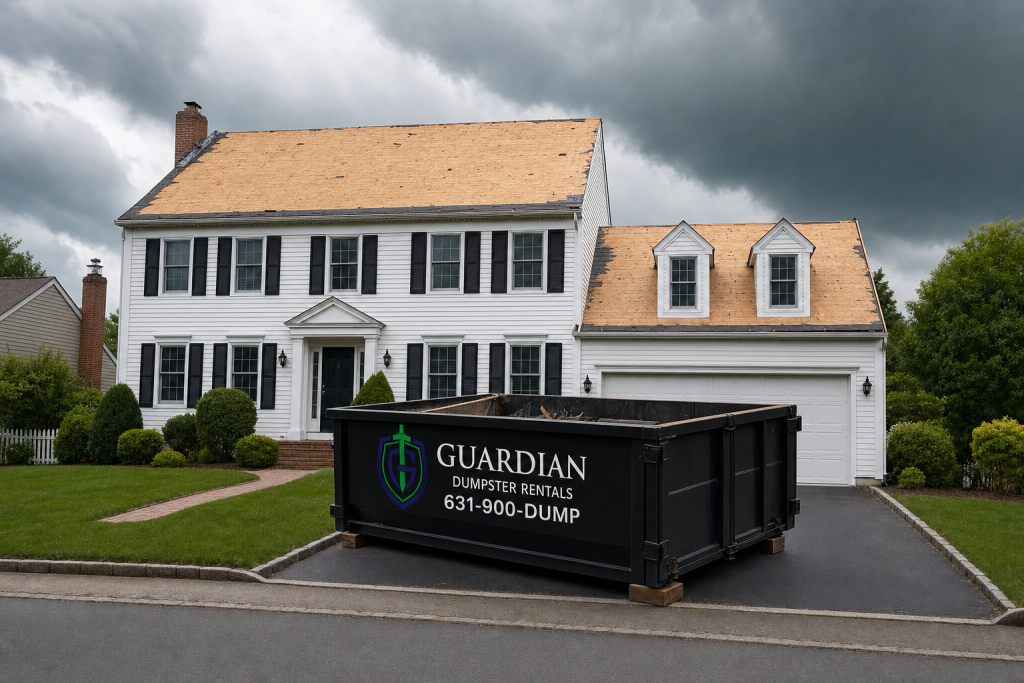
Why Summer Storm Season Is the Time to Book Your Roof Dumpster in NY
Summer thunderstorms and Atlantic tropical-storm season drive a surge in roof tear-offs across New York, which means dumpsters and roofing crews get booked fast. Reserving your dumpster before your roofer arrives prevents costly delays with an exposed deck, and tarping the loaded container protects heavy, wet debris from sudden downpours.
Storm Season Creates a Demand Crunch
From June through November, the Atlantic hurricane season overlaps with New York’s most active thunderstorm months. According to the National Hurricane Center, this is when tropical systems and their remnants are most likely to push heavy rain and damaging wind into the Northeast. Every hailstorm or wind event that sweeps across the state sends a wave of homeowners calling roofers at the same time — and every one of those tear-offs needs a container. When demand spikes:
- Popular container sizes (especially 20-yarders) sell out first in storm-hit ZIP codes.
- Delivery windows stretch from next-day to several days out.
- Roofers may bump your job if debris removal isn’t lined up when they arrive.
Book the Dumpster Before the Roofer Shows Up
A tear-off crew works fast — a typical residential roof can be stripped in a day. If the dumpster isn’t on-site when they start, you face two bad options: piles of shingles sitting on your lawn and driveway, or a crew that pauses the job with your deck partially exposed. In summer, an exposed deck plus a pop-up thunderstorm can mean water damage to sheathing, insulation, and interior ceilings. The fix is simple:
- Confirm your roofing dumpster size and delivery date at least a few days ahead, ideally as soon as your roofer gives you a start date.
- Schedule delivery for the day before tear-off begins, so weather or traffic delays don’t stall the crew.
- Ask your roofer where they want it placed — close to the eave they’ll strip first saves hours of wheelbarrow trips.
Tarp Your Load Against Sudden Downpours
Asphalt shingles are heavy when dry and dramatically heavier when soaked — and most rentals bill overage by the ton. Since summer storms in New York can build with little warning, check the daily forecast at the National Weather Service during your project and follow a few habits:
- Cover the open container with a heavy-duty tarp each evening and before any forecast rain.
- Weight the tarp edges with scrap lumber or bungee it to the container’s side hooks so gusts don’t strip it off.
- Slope the tarp toward one end so rainwater sheds instead of pooling and leaking through.
- Schedule pickup promptly after the job wraps — every extra day outside is another chance for the load to absorb water weight.
Bottom line: in a New York summer, the dumpster is not an afterthought — it’s the first thing to lock in. Reserve early, place it smart, and keep it covered.
100 sq ft of roof area
1 Roofing Square
~200-350 lbs (single layer, asphalt)
Shingle Weight Per Square
20 yard for typical single-family tear-offs
Most Common Choice
Each extra shingle layer roughly doubles debris weight
Multi-Layer Rule
Roofing Dumpster Size Comparison: Which Roofing Dumpster Size Fits Your Tear-Off?
| Dumpster Size | Typical Shingle Capacity (Single Layer) | Best For | Watch Out For |
|---|---|---|---|
| 10 Yard | Roughly 20-25 squares | Small homes, garages, partial re-roofs | Weight caps are reached quickly with heavy architectural shingles |
| 20 Yard | Roughly 30-40 squares | Average single-family roof tear-offs | Two-layer tear-offs may exceed capacity |
| 30 Yard | Roughly 50-60+ squares | Large or steep roofs, multi-layer tear-offs | May exceed driveway space; check placement footprint |
Illustrative Example: Sizing for a Two-Layer Tear-Off
Illustrative example
Consider a hypothetical homeowner planning a tear-off on a 24-square ranch roof, which on paper fits comfortably in a 10 yard dumpster. During the estimate, the contractor discovers a second layer of older shingles beneath the top layer, effectively doubling the debris to the equivalent of nearly 50 squares. Instead of risking overage fees or a second haul with the smaller container, they order a single 20 yard dumpster with a confirmed tonnage allowance. The job wraps in one haul, illustrating why verifying layer count before choosing a roofing dumpster size can save both money and schedule headaches.
Frequently asked questions
What roofing dumpster size do I need if I don't know my roof's square footage?
A quick estimate: measure your home's footprint (length x width) and multiply by 1.3 to 1.5 to account for roof pitch, then divide by 100 to get roofing squares. If you're between sizes, go up one. Shingle debris is heavy, and the price difference between sizes is usually small compared to the cost of ordering a second dumpster mid-project.
How much does it cost to rent a dumpster for a roof tear-off?
Prices vary widely by region, dumpster size, rental length, and local landfill fees, so get quotes from two or three local haulers. Ask specifically about the included weight allowance and the per-ton overage fee, because shingles are dense and overage charges are where roofing rentals get expensive. A flat-rate quote with a clear tonnage limit is easiest to budget.
How heavy are shingles compared to regular household junk?
Much heavier. A single square of asphalt shingles (100 square feet) typically weighs a couple hundred pounds or more, and architectural shingles weigh more than three-tab. That's why roofing dumpsters hit their weight limit long before they look full. Always size by weight capacity and tonnage allowance, not just by how much volume the container appears to have.
What happens if I overload a roofing dumpster?
Two things can go wrong: you'll be charged per-ton overage fees, or the driver may refuse to haul it if it exceeds legal road weight limits or debris sticks above the rim. If that happens, you'll have to remove material before pickup. Avoid this by filling only to the fill line, spreading debris evenly, and confirming the tonnage allowance before ordering.
Should I get one big dumpster or two smaller ones for a large roof?
For most large tear-offs, two smaller dumpsters swapped out mid-job often work better than one oversized container. Shingles are so heavy that a large dumpster filled with them can exceed hauling weight limits anyway. Two swaps also keep the driveway clearer and let the crew keep working while the first load is hauled. Ask your hauler which approach costs less in your area.
How long can I keep a dumpster during a roofing project?
Most rentals include a set period, commonly around a week, which is plenty since typical residential tear-offs take one to three days. If weather delays the job, call the hauler before your rental ends—daily extension fees are usually modest if arranged in advance. Schedule delivery for the day before tear-off begins so it's not sitting unused and racking up rental days.
Can I throw old underlayment, nails, and flashing in the roofing dumpster?
Yes—felt paper, synthetic underlayment, nails, drip edge, flashing, and wood decking are all standard roofing debris and accepted in most roll-off dumpsters. Ask before adding anything unusual, though. Some landfills restrict or surcharge certain materials, and hazardous items are never allowed. If your old roof might contain asbestos (common in some older homes), stop and get it tested before disposal.
Will a roofing dumpster damage my driveway?
It can if precautions aren't taken. A loaded roofing dumpster weighs several tons concentrated on steel rails or wheels, which can crack concrete or dent asphalt, especially in hot weather. Ask the hauler to place plywood or boards under the contact points, and avoid placing it on soft ground or over a septic system. Most reputable companies do this routinely if you request it.
What's the biggest mistake people make when ordering a roofing dumpster?
Choosing by volume alone and ignoring weight. A 30-yard dumpster sounds like plenty of room, but shingles can max out its tonnage allowance when it's only partly full, triggering overage fees. The second most common mistake is undersizing to save money, then paying for a second delivery. Estimate your squares, ask the hauler what they recommend for that amount, and confirm the weight limit in writing.
Do roofing contractors usually provide the dumpster, or do I rent it myself?
Most professional roofers include debris disposal in their quote and arrange the dumpster themselves—confirm this in writing before signing. If you're doing a DIY tear-off or your contractor's disposal fee seems high, you can rent one yourself, sometimes for less. Just make sure you handle placement, permits (if it goes on the street), and weight limits, since those become your responsibility.
Related local pages
- Dumpster Rental Babylon New York
- Dumpster Rental Bay Shore New York
- Dumpster Rental Commack New York
Ready to schedule your roof tear-off? Call us today for a fast quote and same-week delivery of a 10, 20, or 30 yard dumpster anywhere in NY. Get in touch.
Last updated: August 22, 2026
Recent Comments