
30 Yard Dumpster Rental: Gut a Whole Floor in One Go
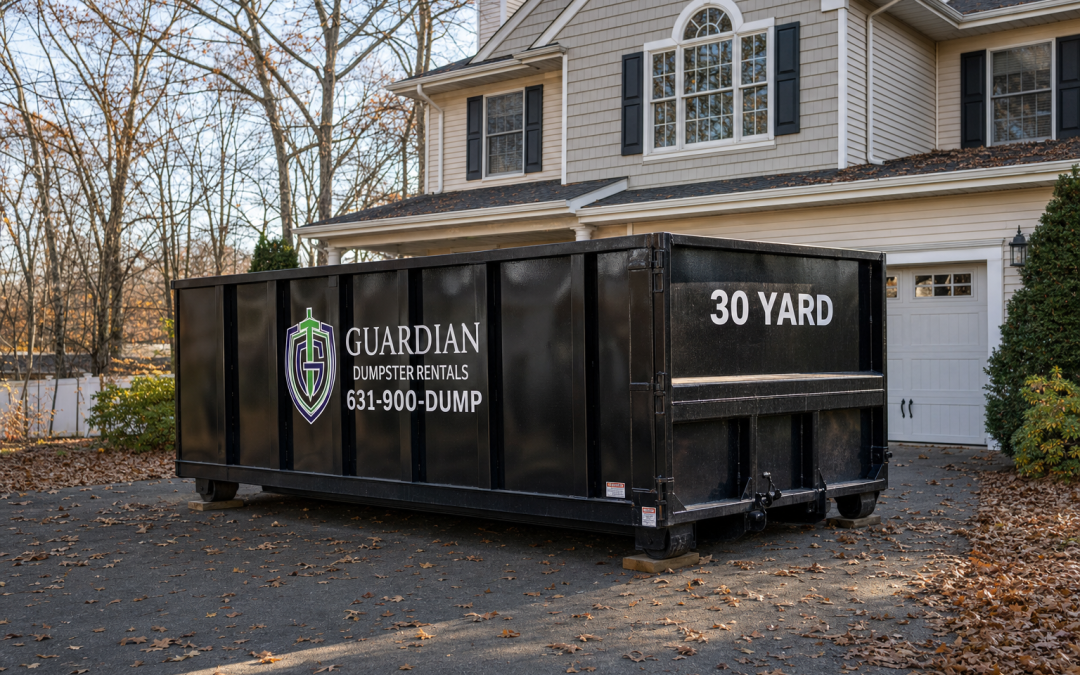
One Dumpster, One Demo: Why Whole-Floor Gut Jobs Need a 30 Yard Dumpster Rental
A 30 yard dumpster rental is typically the right size to hold an entire floor’s worth of gut-job debris — drywall, flooring, trim, cabinets, and fixtures — in a single container. That means one delivery, one pickup, and no mid-project swap-outs that stall your crew and add haul fees to your remodel budget.
Key takeaways
- A 30 yard dumpster typically holds the debris from a full-floor gut job, so most multi-room remodels avoid mid-project swap-outs entirely.
- Choosing one 30 yard container over two smaller hauls usually saves both money and the one-to-three-day wait a swap-out can add to your timeline.
- Keep heavy materials like plaster, tile, and concrete distributed evenly and below the fill line to stay within weight limits and avoid overage fees.
- In New York, confirm whether the dumpster sits on your property or the street — street placement often requires a municipal permit arranged before delivery.
- Load strategically: break down cabinetry and doors flat, place bulky items first, and fill gaps with smaller debris to maximize every cubic yard.
When you gut a whole floor, the debris pile grows faster than most homeowners expect. Tearing out a single room feels manageable, but multiply that by three or four rooms plus a hallway and you’re suddenly staring at a mountain of broken drywall, ripped-up subfloor, old carpet, and demolished cabinetry. Undersize the container and the demo grinds to a halt while you wait for an empty box to arrive.
The Real Cost of Running Out of Room
A full dumpster in the middle of demolition doesn’t just pause the work — it creates a chain reaction of delays:
- Idle labor: Your crew (or your weekend helpers) stand around while debris piles up on tarps and in the yard.
- Extra haul fees: Every swap-out means another trip charge, and two smaller containers usually cost more combined than one 30 yarder.
- Scheduling gaps: Swap-outs depend on the hauler’s route availability, which can push your timeline back a day or more.
- Double handling: Debris staged on the ground has to be picked up and loaded twice — slow, messy work nobody enjoys.
Homeowners planning full-floor tear-outs often start by comparing container sizes, and it’s worth talking through the scope of your project before booking. A provider handling residential dumpster rental in Dix Hills and similar Long Island neighborhoods can help you match the box to the square footage you’re gutting.
Why Fall Makes Sizing Up Even Smarter
In New York, autumn renovation schedules are unforgiving. Daylight shrinks week by week, and an early cold snap can complicate everything from adhesive cure times to open-wall work. Every day lost to a dumpster swap is a day closer to winter conditions. Loading one big container straight through — demo Friday, done by Sunday — keeps the project inside the weather window instead of fighting it.
Driveway space is the one thing to check before committing to the larger size. A 30 yard container has a bigger footprint than its smaller siblings, so measure your placement area and confirm clearance for the delivery truck. If you’re weighing logistics for a project further west on the Island, a company offering roll off dumpster rental in West Babylon can walk you through placement requirements before drop-off day.
The bottom line: for a whole-floor gut, one bigger box beats two smaller ones on cost, timeline, and sanity. The sections below break down exactly what fits, how to load it, and when a smaller container genuinely makes more sense.
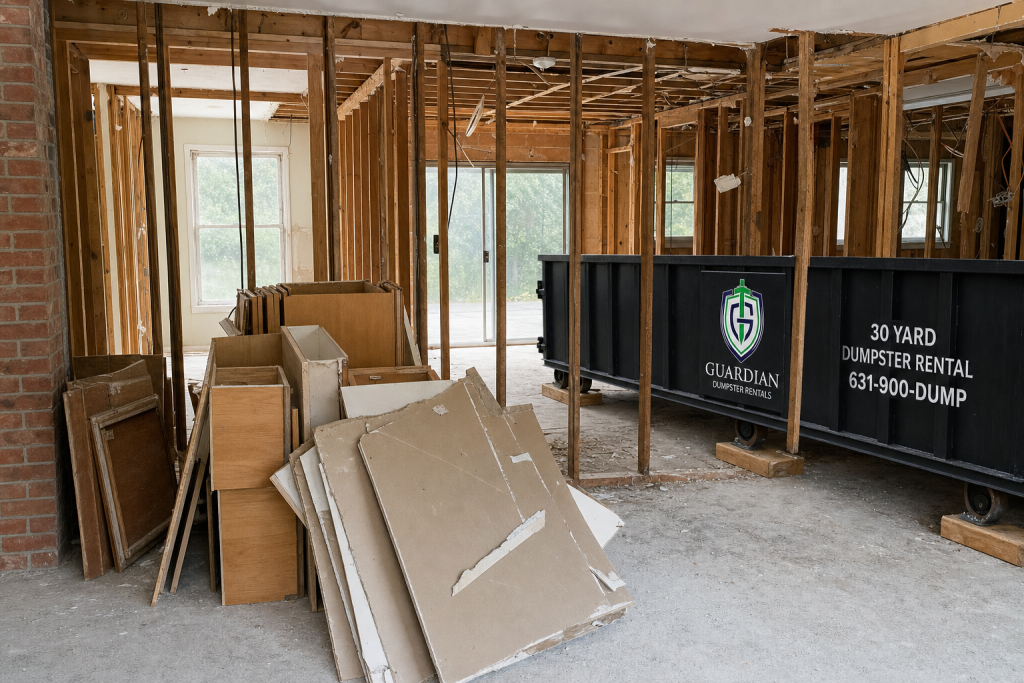
Will a 30 Yard Dumpster Rental Really Hold a Whole-Floor Gut Job?
Yes — for most homes, a 30 yard dumpster rental holds an entire floor’s worth of demo debris in a single container. With roughly 9 to 12 pickup truck loads of capacity, it can swallow a full kitchen tear-out, a gutted bathroom, drywall, flooring, trim, doors, and old furniture without spilling over the rim.
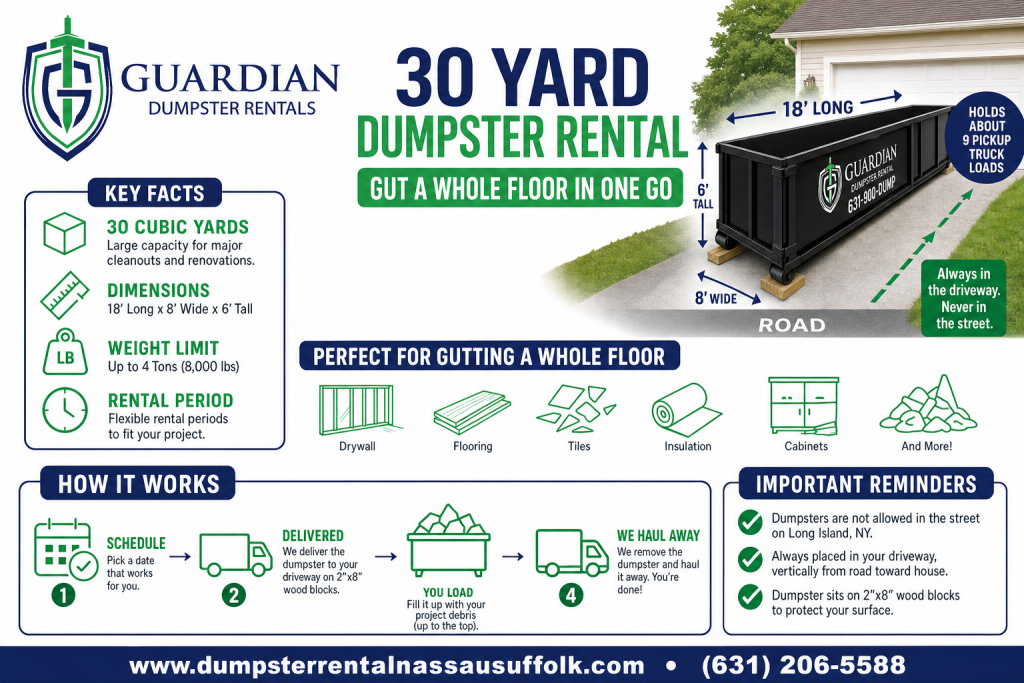
To picture the size, a typical 30 yard roll off runs about 22 feet long, 8 feet wide, and 6 feet tall. That six-foot wall height is the real difference-maker on a gut job: bulky, awkward items like cabinet boxes, vanities, and mattresses that would eat up a smaller container simply stack inside a 30 yarder with room to spare.
The Debris Math for a Typical Multi-Room Demo
Here’s how the pieces of a whole-floor gut in a typical New York home add up:
- Kitchen cabinets and countertops: A full set of uppers, lowers, and counters usually takes up 3 to 5 cubic yards, even when the boxes are knocked flat.
- Bathroom fixtures: A tub, toilet, vanity, and tile tear-out typically adds another 2 to 3 cubic yards — and tile is heavy, so it belongs low in the container.
- Drywall: Stripping walls and ceilings across several rooms can generate 5 to 8 cubic yards of broken sheetrock, depending on square footage.
- Flooring: Ripped-up carpet, padding, hardwood, or laminate from a whole floor commonly fills 3 to 5 cubic yards.
- Trim, doors, and framing scraps: Baseboard, casing, interior doors, and stray lumber add roughly 2 to 3 cubic yards.
- Old furniture and cleanout items: A couch, a couple of dressers, and miscellaneous junk can easily claim another 3 to 4 cubic yards.
Run the totals and a full-floor gut lands in the 18 to 28 cubic yard range — right in the sweet spot for a 30 yarder. You fill the box, but you’re not fighting the fill line or paying for a second haul. Homeowners tackling this kind of project often start with a roll off dumpster rental in Commack sized for the whole demo rather than guessing small and hoping.
One Caution: Weight, Not Just Volume
Volume is rarely the problem on a gut job — weight can be. If your demo includes plaster walls, ceramic tile, or a concrete hearth, the container may hit its tonnage allowance before it looks full. Mixing heavy material evenly with lighter debris keeps you inside the limit, which is a standard consideration for construction debris removal in Babylon and anywhere else on Long Island. When in doubt, tell your rental company what you’re tearing out; they’ll flag anything that might push you over.
Why Do Mid-Project Dumpster Swap-Outs Slow Down a Remodel?
Mid-project swap-outs slow a remodel because you wait a day or more for the haul-and-return, pay a second delivery fee, and force your crew to stand idle or stack debris inside the house. In fall, wind-scattered debris and wet or frozen driveways make the second placement even harder than the first.
When homeowners undersize a container for a whole-floor gut, the problem rarely shows up on day one. It shows up on day two or three, when the box is heaped past the fill line and the demo is only two-thirds done. At that point, everything downstream of the dumpster grinds to a halt.
The Hidden Costs Nobody Puts on the Estimate
- Haul-and-return lag. The hauler has to fit your pickup into an existing route, empty the container, and bring it back. Depending on scheduling, that can mean a full day or more with no place to throw anything.
- A second delivery fee. Every trip the truck makes costs money. Two hauls of a smaller box almost always cost more than one haul of the right-sized container.
- Idle labor. If you’ve hired a demo crew, they’re on the clock whether debris is moving or not. Crews either stand around, get sent home, or start piling plaster, flooring, and cabinetry in rooms you were about to work in.
- Double handling. Debris stacked indoors has to be carried twice — once into a holding pile, then again into the returned dumpster. That’s wasted hours and extra wear on your floors and doorways.
Contractors who handle construction debris removal in Babylon and similar gut jobs will tell you the same thing: the cheapest schedule is the one where the container never has to leave until the demo is finished.
Fall Makes a Second Placement Riskier
Autumn adds problems that don’t exist in July. Lightweight debris — insulation, drywall dust, torn vapor barrier, cardboard — sits in that interior holding pile or an uncovered heap, and gusty fall winds can scatter it across your yard and your neighbor’s. Meanwhile, the driveway itself changes between deliveries. Wet leaves reduce traction for the roll-off truck, and an early freeze can leave the driver working on a slick or hardened surface where the container can’t be spotted as precisely as the first drop.
A properly sized roll off dumpster rental in Dix Hills or anywhere else on Long Island sidesteps all of it: one delivery on clean pavement, one continuous demo push, one pickup when you’re done. For a whole-floor gut, that single-container rhythm is usually worth far more than the modest price difference between a mid-size box and a 30 yard dumpster rental.
What Can and Can’t Go in a 30 Yard Dumpster Rental?
A 30 yard dumpster rental accepts nearly all interior gut-job debris: drywall, lumber, cabinetry, flooring, doors, trim, fixtures, insulation, and furniture. It does not accept brick, concrete, dirt, or yard waste — heavy masonry and organic material require separate disposal, and mixing them in can trigger overage fees or a refused pickup.
The good news for anyone tearing out a full floor is that almost everything a sledgehammer and pry bar produce belongs in this box. The container is built for the light-but-bulky mix that interior demolition generates, which is exactly why it pairs so well with a whole-floor gut.
Gut-Job Debris That’s Welcome
- Drywall and plaster — full sheets, broken chunks, and the dust-caked scraps that pile up fast
- Lumber and framing — studs, subfloor sheeting, plywood, and trim boards, nails and all
- Cabinetry and countertops — kitchen and bathroom cabinets, vanities, and laminate counters
- Flooring — carpet, padding, hardwood, laminate, vinyl, and tile pulled from wood subfloors
- Doors, windows, and trim — interior doors, casings, baseboards, and crown molding
- Fixtures — sinks, toilets, tubs, light fixtures, and towel bars
- Insulation — fiberglass batts and blown-in material bagged to keep it contained
- Furniture — couches, mattresses, dressers, and anything else cleared out before demo day
If your tear-out is producing a heavy mix of renovation waste, a service focused on construction debris removal in Bay Shore can confirm exactly what your local hauler will take before the first hammer swings.
What Stays Out of the Container
- Brick and block — masonry from a fireplace or wall tear-out is far too heavy for a mixed-debris load
- Concrete — slab pieces, footings, and mortar rubble need a dedicated heavy-debris container
- Dirt and soil — even a few wheelbarrows of fill dirt can push the load past weight limits
- Yard waste — leaves, branches, sod, and stumps are handled through separate green-waste channels
The weight issue is the real driver here. A 30 yard container is sized for volume, not density, and dense material like concrete concentrates enormous weight in very little space. Tossing masonry or a fall’s worth of bagged leaves on top of your demo debris is the fastest way to blow past the included tonnage — and haulers weigh every load at the scale, so it never goes unnoticed.
Hazardous items are also off-limits: paint cans with liquid paint, solvents, refrigerants, tires, and batteries all need special handling. If you’re unsure whether a specific item qualifies, providers offering roll off dumpster rental in Dix Hills and surrounding areas can walk you through the accepted-materials list when you book. A two-minute phone call beats a surprise fee on the final invoice.
How Should I Load a 30 Yard Dumpster to Use Every Cubic Yard?
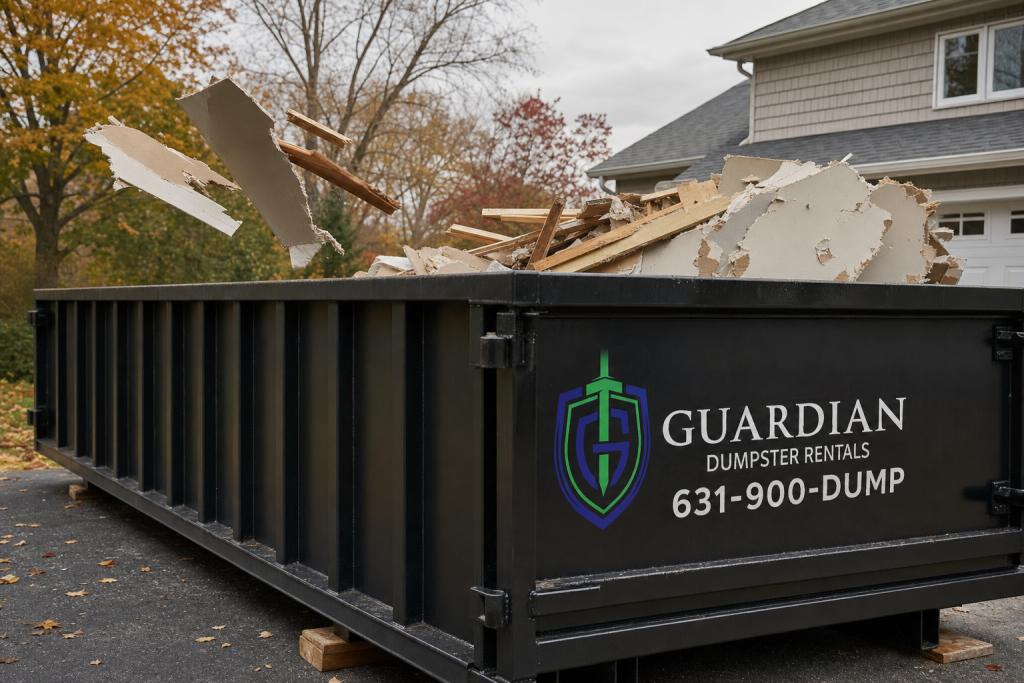
Load heavy, dense debris first and keep it low, break down cabinets and stack drywall flat instead of tossing pieces in whole, fill gaps with smaller debris as you go, and keep everything level with the top rail. Stage your demo room-by-room so the crew loads continuously rather than double-handling piles.
A 30 yard container gives you a lot of space, but sloppy loading can waste a third of it. Air pockets, tangled framing lumber, and cabinets thrown in whole all eat cubic yards you paid for. A little strategy turns one container into enough capacity for the entire floor.
Break It Down Before It Goes In
Whole cabinets, vanities, and doors trap huge amounts of dead air. Knock cabinet boxes flat with a few hammer blows, pull doors off hinges, and snap or cut long trim and framing into manageable lengths. Drywall should be stacked flat in layers like plywood sheets — it packs far tighter than jagged chunks tossed at random. Homeowners who plan their 30 yard dumpster rental in Babylon around this kind of flat-stacking routinely fit a full gut job that would otherwise overflow.
Heavy First, Low and Even
- Start with the dense stuff: tile, plaster, subfloor, and countertops go in first, spread evenly across the floor of the container rather than piled at one end.
- Layer lighter material on top: drywall, lumber, and insulation stack above the heavy base.
- Fill the voids: as each layer goes in, tuck smaller debris — broken trim, tile shards, bagged dust and sweepings — into gaps between larger pieces.
- Stay level with the top rail: hauliers can’t legally transport an overfilled container, so a mounded load means shoveling debris back out before pickup.
Stage the Demo So You Load As You Go
The biggest time-waster on a multi-room gut is double-handling: piling debris in the hallway, then moving it all again to the container. Instead, work one room at a time and run debris straight out the door as it comes off the walls. Use the walk-in door on the container for wheelbarrow loads of heavy tile and plaster, and save your throwing energy for light, bulky items. Keeping a clean path from the work area to the container matters as much as the container itself — efficient construction debris removal in Bay Shore projects follow the same room-by-room rhythm.
Done right, this approach means the last room’s debris slides neatly into the last few cubic yards — no second container, no overage, no pile left sitting in the driveway.
When Is a 20 Yard or 10 Yard Dumpster the Smarter Pick?
A 20 yard dumpster is the smarter pick when you’re remodeling a large kitchen plus a bathroom, or doing a partial demo on a single level. A 10 yard dumpster fits a one-room refresh — a bathroom tear-out, small deck removal, or a garage cleanout. If your project stops short of a full-floor gut, sizing down usually saves money.
A 30 yard dumpster rental is the right tool for whole-floor demolition, but renting more container than your debris requires means paying for air. The honest answer is that plenty of Long Island projects fit comfortably in a smaller box — the trick is matching the container to the actual scope of the tear-out, not to how ambitious the project feels.
When a 20 Yard Dumpster Makes Sense
A 20 yard container holds roughly 20 cubic yards of debris — enough for a kitchen-and-bath combo remodel, a single-level partial demo, or flooring removal across several rooms. It’s also a good fit when driveway space is tight, since it takes up noticeably less room than a 30. Homeowners planning a project in that middle range can look at a 20 yard dumpster rental in Bay Shore as the balanced option: real capacity without the footprint of a full-size roll-off.
- Good for: kitchen plus bathroom remodels, partial single-level demo, roofing tear-offs on average homes, multi-room flooring removal
- Not enough for: a true whole-floor gut, whole-house cleanouts with furniture, projects generating heavy plaster and framing throughout a level
When a 10 Yard Dumpster Is Enough
For a single-room refresh — one bathroom demo, a small kitchen update, a shed teardown, or a concentrated cleanout — 10 yards is often plenty. It fits in almost any driveway and is the most budget-friendly way to keep debris off your lawn. If that sounds like your project, a 10 yard dumpster rental near Commack covers the typical one-room job without wasted capacity.
A Simple Decision Framework
- One room, cosmetic or light demo: 10 yard
- Two rooms or one large room with structural debris (cabinets, tile, subfloor): 20 yard
- An entire floor down to the studs, or multiple heavy rooms at once: 30 yard
- On the fence between two sizes? Size up. A second haul-away on an overflowing small dumpster typically costs more than the price gap between sizes.
Whatever size you choose, remember that construction and demolition debris is one of the largest waste streams in the country, and much of it — clean wood, metal, cardboard — can be recycled. The EPA’s guidance on managing construction and demolition materials is a useful reference if you want to divert reusable material before it ever hits the container. Right-sizing your dumpster and sorting what you can keeps the project cheaper and the landfill load lighter.
Roughly 9-12 pickup truck loads of debris
Typical 30 yard capacity
7-14 days included with most rentals
Common rental period
About 22 ft long x 8 ft wide x 6 ft tall
Container footprint
Often 1-3 days of waiting per exchange
Swap-out delay avoided
30 Yard Dumpster Rental vs. Smaller Containers for a Whole-Floor Gut
| Factor | 30 Yard Dumpster | Two 15 Yard Dumpsters | 20 Yard Dumpster |
|---|---|---|---|
| Capacity | About 9-12 pickup truck loads | Same total volume, split across two hauls | About 6-8 pickup truck loads |
| Swap-outs needed | Usually none for a single-floor gut | At least one, adding delivery wait time | Often one for larger gut jobs |
| Typical best fit | Multi-room or whole-floor demolition | Tight sites that can't fit a large container | Kitchen plus one or two rooms |
| Cost efficiency | Lowest cost per cubic yard in most markets | Higher total cost due to double delivery fees | Moderate; risk of overage if project grows |
| Footprint | Roughly 22 ft long; needs driveway or permit space | Smaller footprint per container | Roughly 16-19 ft long |
Illustrative Example: One Container, One Continuous Gut
Illustrative example
Consider a hypothetical homeowner in upstate New York gutting the entire second floor of a 1940s colonial — three bedrooms, a bathroom, and a hallway down to the studs. Rather than ordering a 20 yard container and gambling on a mid-project swap, their contractor sized up to a single 30 yard dumpster rental placed in the driveway. The crew demoed room by room, breaking down doors and trim flat and layering plaster debris evenly to manage weight. The demolition wrapped in four days with one haul-away and no downtime waiting on an exchange. This composite scenario reflects a common pattern: for whole-floor guts, the larger container typically keeps the schedule intact.
Frequently asked questions
How much does a 30 yard dumpster rental cost for a whole-floor gut job?
Pricing varies by region, but in New York a 30 yard dumpster typically runs several hundred dollars for a standard rental period, with the exact quote depending on your town, debris type, and included weight allowance. Always ask what tonnage is included and the per-ton overage rate, since heavy demo debris like plaster and tile can push you past the base weight and add meaningfully to the final bill.
Will a 30 yard dumpster actually fit a whole floor's worth of demo debris?
Usually, yes. A 30 yard container holds roughly nine to twelve pickup truck loads, which covers most single-floor gut jobs involving drywall, flooring, cabinets, fixtures, and trim. Where people run short is with dense materials like plaster-and-lath walls or layered flooring, which eat volume and weight faster than expected. If your floor has old plaster construction, mention it when booking so the company can flag weight limits.
How long can I keep a 30 yard dumpster during a remodel?
Most companies include a set rental window, often around a week to ten days, with daily fees for extra time. For a whole-floor gut, plan your demo schedule before the dumpster arrives so you're loading it steadily rather than paying idle days. If the remodel will stretch over weeks, ask about extended rental rates upfront, they're usually cheaper than repeatedly extending day by day.
What can't I throw in a 30 yard dumpster in New York?
Standard exclusions include paint, solvents, chemicals, tires, batteries, appliances containing refrigerant, and anything suspected of containing asbestos, which is a real concern in older New York homes. Mattresses and electronics are restricted or surcharged by many haulers. If your gut job might disturb asbestos-era materials like old pipe insulation or certain floor tiles, get testing done first, contaminated loads can be rejected and become an expensive problem.
Do I need a permit to put a dumpster on the street in NY?
If the dumpster sits on your own driveway or private property, generally no. If it must go on a public street, most New York municipalities require a street occupancy or obstruction permit from the local buildings or transportation department. Rules and fees vary by town and borough, so check with your municipality before delivery day. Some rental companies will handle or advise on the permit process if you ask.
Should I get one 30 yard dumpster or two smaller ones for a multi-room remodel?
One 30 yard container is usually cheaper and simpler than two smaller swaps, since each haul involves its own delivery and pickup fees. Two smaller dumpsters only make sense if you lack space for a large container, or your demo happens in widely separated phases. The main risk with one big box is exceeding the weight cap with heavy debris, so match container size to material type, not just volume.
What happens if I overfill or overload the dumpster?
Debris piled above the rim can make the container illegal to transport, so drivers may refuse pickup or require you to offload the excess before hauling. Exceeding the weight limit triggers per-ton overage charges on your final invoice. Load heavy materials like tile and plaster first and spread them evenly, then fill gaps with lighter debris. Keep everything level with the top rail and you'll avoid both problems.
What's the biggest mistake people make renting a dumpster for a gut renovation?
Underestimating debris weight. Homeowners size the dumpster by volume, then discover plaster, tile, and layered subfloor blew past the tonnage allowance, resulting in surprise overage fees. The second most common mistake is bad placement, putting the container where the truck can't reach it for pickup or where it blocks material deliveries. Walk the site with the driver's access in mind and describe your debris honestly when getting quotes.
How far in advance should I schedule a 30 yard dumpster delivery?
Book at least several days to a week ahead in most markets, and earlier during spring and summer when demand peaks, since 30 yard containers are among the first sizes to sell out. Schedule delivery for the day before demo starts so the container is waiting, not the crew. Confirm the placement spot, driveway, street, protection boards for pavement, when you book to avoid delays at drop-off.
Where should the dumpster go so it doesn't slow down the renovation?
As close to the debris exit point as possible, ideally near the door or window crews will use to toss material, while leaving clear access for the roll-off truck, which needs substantial overhead and lengthwise clearance. Avoid blocking material deliveries, the garage, or neighbors' access. Lay plywood under the container's rails to protect a driveway. A few feet of walking distance per load adds up fast over a whole-floor gut.
Related local pages
- Dumpster Rental Islip New York
- Dumpster Rental West Islip New York
- Dumpster Rental West Babylon New York
Ready to gut that whole floor before winter sets in? Call us today to reserve your 30 yard dumpster and keep your NY remodel moving from demo day to done. Get in touch.
Last updated: September 1, 2026
Recent Comments