
Roofing Dumpster Size: How Many Squares Fit in Each Bin?
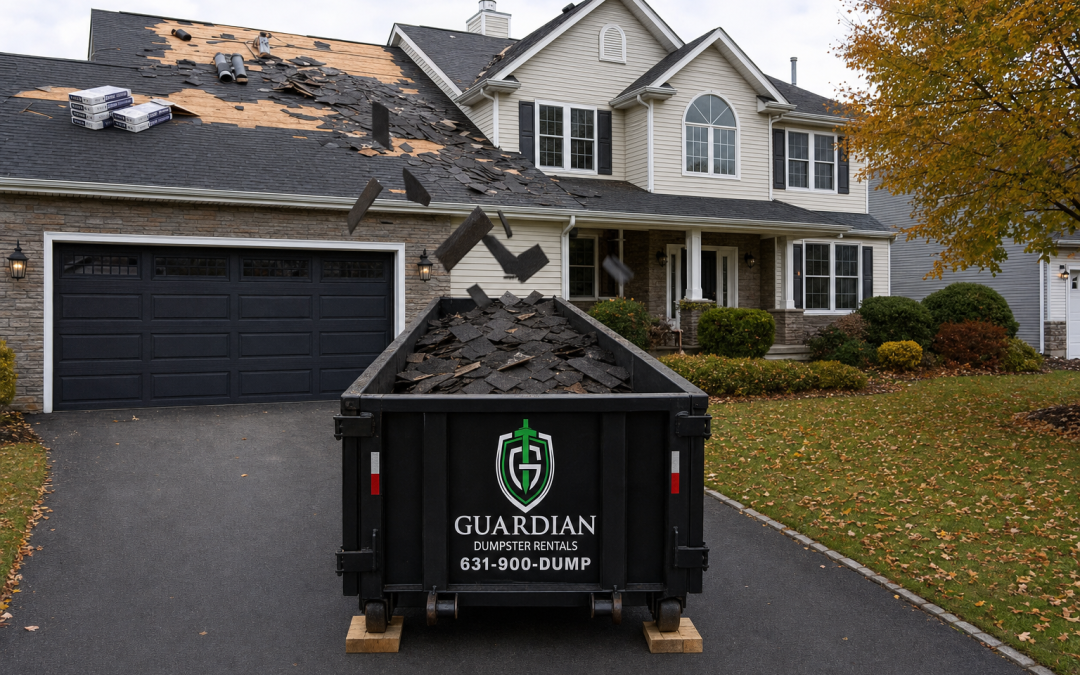
What Roofing Dumpster Size Do You Need for a Tear Off?
The right roofing dumpster size for a tear off is usually a 10 yard container for roofs up to about 20-25 squares, a 20 yard for roughly 25-45 squares, and a 30 yard for larger roofs or multi-layer tear-offs. Shingle weight, not volume, is typically the deciding factor.
Key takeaways
- A 10 yard roofing dumpster typically holds about 20-25 squares of single-layer asphalt shingle tear-off, making it a fit for smaller roofs.
- A 20 yard dumpster generally handles roughly 40-50 squares of shingles, covering most average-sized single-layer tear-offs.
- A 30 yard dumpster is the go-to for large roofs or multi-layer tear-offs, holding around 60 or more squares of shingles.
- Count your shingle layers before ordering — a two-layer tear-off roughly doubles your debris, so size up your dumpster accordingly.
- Keep brick, concrete, dirt, and yard waste out of the dumpster entirely — roofing bins are for shingles and roofing debris only.
Shingles are deceptively heavy. A single square (100 square feet) of architectural asphalt shingles can weigh a few hundred pounds, and that adds up fast once you factor in underlayment, nails, and any second layer hiding underneath. That’s why most roofing containers are sized around weight limits rather than how much physical space the debris takes up — a dumpster can look half empty and still be at its tonnage cap.
Quick Reference: Squares Per Dumpster
- 10 yard dumpster: Roughly 20-25 squares of a single-layer asphalt tear off. A good fit for smaller homes, garages, and partial roof replacements.
- 20 yard dumpster: Roughly 25-45 squares, or smaller roofs with two layers. This is the workhorse size for most average single-family tear-offs.
- 30 yard dumpster: Larger roofs, steep or complex rooflines, or multi-layer tear-offs where the debris count climbs quickly.
These are rule-of-thumb ranges, and your exact fit depends on shingle type, number of layers, and whether plywood decking is coming off too. Heavier materials like dense architectural or specialty shingles push you toward the larger bin even when the square count seems modest. If you’re planning a project in Suffolk County, a local provider of roofing dumpster rental in Amityville can help you match your square count to the right container before you commit.
Why Weight Beats Volume for Roofing Debris
Unlike household junk or renovation debris, shingles pack tightly and densely into a container. A 30 yard dumpster filled to the brim with torn-off shingles would often exceed safe hauling weights, which is why haulers set tonnage limits on each size. Ordering based on weight capacity — not just how big the box looks — keeps you from paying overage fees or needing a second haul. Keep in mind that roofing containers are for roofing debris only: no brick, no concrete, no dirt, and no yard waste should ever go in the bin.
Fall Is Crunch Time for New York Tear-Offs
In New York, autumn is the busiest stretch of the roofing calendar. Homeowners race to finish tear-offs before the first snow, because a compromised roof heading into winter invites ice dams and interior leaks. That demand means dumpsters book up faster in September through November, so reserving your container early matters. Homeowners arranging roofing dumpster rental in Lindenhurst NY during the fall rush will have an easier time locking in the size they actually need rather than settling for whatever is left.
How Many Squares of Shingles Fit in a 10, 20, or 30 Yard Dumpster?
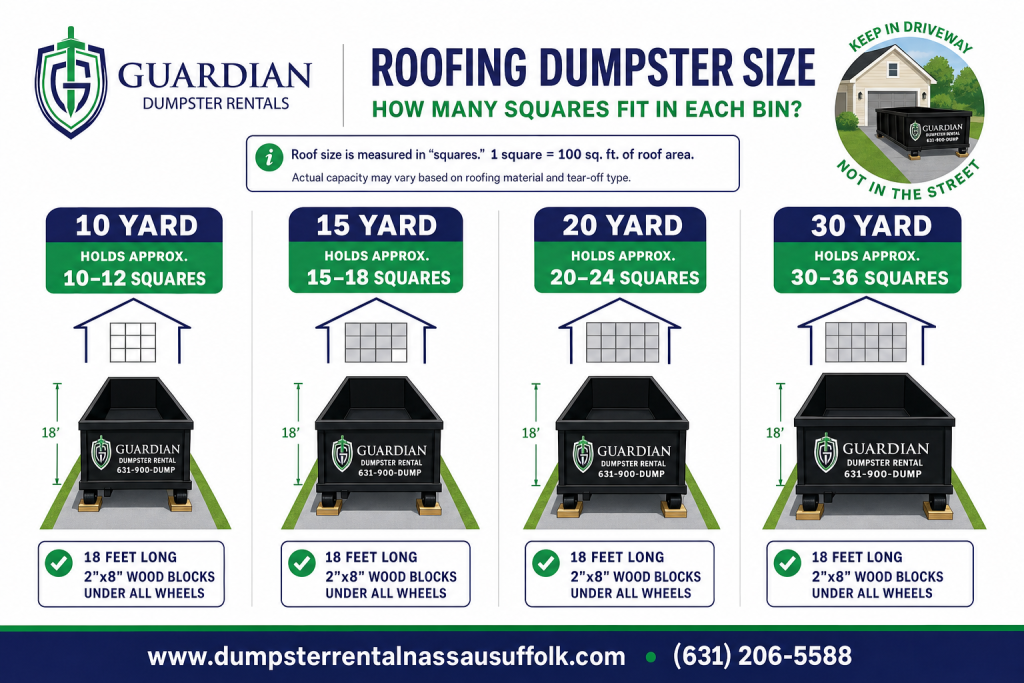
As a general rule, a 10 yard dumpster holds roughly 20–25 squares of shingles, a 20 yard holds roughly 40–50 squares, and a 30 yard holds roughly 60 squares or more. The real limit is usually weight, not space, because shingle debris is dense and every container has a tonnage cap.
Container Sizes Table: Roofing Dumpster Size vs. Shingle Squares
| Dumpster Size | Approx. Capacity (3-Tab) | Approx. Capacity (Architectural) | Best For |
|---|---|---|---|
| 10 Yard | About 20–25 squares | About 15–20 squares | Small homes, garages, single-layer tear offs |
| 20 Yard | About 40–50 squares | About 30–40 squares | Average single-family roofs, some double layers |
| 30 Yard | About 60+ squares | About 45–55 squares | Large homes, steep complex roofs, multi-layer tear offs |
Why Shingle Type Changes the Math
Not all shingles weigh the same, and that difference adds up fast across a whole roof:
- 3-tab shingles: roughly 200–250 lbs per square once torn off (including nails and felt debris)
- Architectural (dimensional) shingles: roughly 300–400 lbs per square, since they’re thicker and layered
That means 30 squares of architectural shingles can weigh as much as 40+ squares of 3-tab. If you’re not sure which type is on your roof, assume architectural and size up — most roofs installed in the last couple of decades use them. Homeowners planning a tear off can compare these numbers against local options for roofing dumpster rental in Islip NY to match the bin to the job.
How Tonnage Limits Cap What Actually Fits
Every rental comes with an included weight allowance, and shingles hit that ceiling before the container looks full. A 10 yard bin might physically hold 30 squares of debris, but if the included tonnage covers only 2–3 tons, you’ll pay overage fees once the load passes that mark. The same logic applies to 20 and 30 yard containers — the bigger bins come with higher allowances, which is why they’re the practical choice for heavy architectural tear offs even when the volume seems manageable.
Two quick tips to stay under the cap: spread the load evenly so the hauler can weigh and transport it safely, and never mix in other heavy debris. Shingles-only loads are easiest to price and haul, and keep in mind that brick, concrete, dirt, and yard waste aren’t allowed in these dumpsters anyway. If your project is near the South Shore, a provider offering dumpster rental in Bay Shore New York can confirm the exact tonnage included with each size before you book.
When your square count lands between two sizes, the safer move is almost always the larger roofing dumpster size — one bin with room to spare beats a second delivery fee.
How Do I Count the Layers on My Roof Before Ordering?
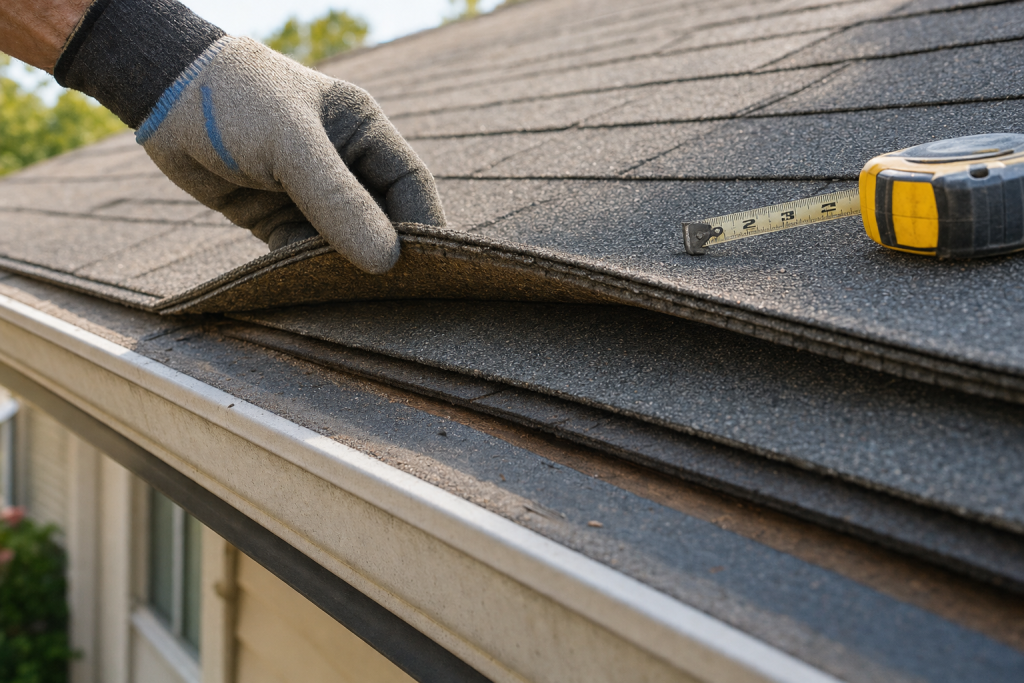
To count shingle layers, look at the roof’s edge along the drip line and count the stacked rows of shingle tabs, lift a corner of a shingle near the eave, or check the roof deck from inside the attic. Each extra layer roughly doubles your tear-off debris, which changes the roofing dumpster size you need.
Many older homes have a second layer of shingles installed right over the first — a practice called an overlay. If you order a bin based on one layer and your roofer discovers two, you could run out of room halfway through the job. A few minutes of checking before you book saves real headaches later.
Three Easy Ways to Spot Multiple Layers
- Check the roof edge or drip line. Stand on a ladder at the eave and look at the edge of the roof where the shingles meet the gutter. A single-layer roof shows one row of shingles over the drip edge. Two layers look noticeably thicker, with a visible stair-step of stacked shingle edges.
- Look inside a gable vent or attic. From the attic, examine the underside of the roof deck. Rows of nail points poking through in two distinct patterns often indicate a second layer was nailed over the first. You can sometimes see the edge of an older roof through a gable vent as well.
- Lift a shingle corner. Gently pry up the corner of a shingle near the bottom edge of the roof. If you see another full shingle directly underneath (not just underlayment or bare wood decking), you have at least two layers.
Why Layers Matter So Much for Your Dumpster
A two-layer tear-off doesn’t just add a little extra debris — it can effectively double both the volume and the weight coming off your roof. A roof that would comfortably fill a 10 yard dumpster with one layer may need a 20 yard container with two, and larger multi-layer roofs often call for a 30 yard bin. Weight is the bigger concern: asphalt shingles are dense, and haulers set weight limits for each container size. Homeowners who book a roofing dumpster rental in West Islip for a double-layer tear-off are usually steered toward a larger bin for exactly this reason.
Also keep in mind that New York building codes generally limit roofs to two layers of shingles, so if you already count two, your roofer will be required to strip everything down to the deck — meaning all of that material ends up in the bin. When you call to reserve a roofing dumpster rental in Bay Shore NY, mention the number of layers along with your roof’s square footage so the team can match you with the right 10, 20, or 30 yard container the first time.
How Do I Calculate My Roof’s Square Footage and Total Squares?
Measure your home’s footprint (length times width), multiply by a pitch factor to account for slope, then divide by 100 to get roofing squares. Finally, multiply that number by how many shingle layers are coming off. The result is your true debris total, which tells you which roofing dumpster size you actually need.
You don’t have to climb on the roof to get a workable estimate. Here’s the simple homeowner math, step by step.
Step 1: Measure Your Home’s Footprint
Walk the perimeter of your house at ground level and measure the length and width, including any attached garage or covered porch under the same roofline. Multiply length by width. A home measuring 40 feet by 30 feet has a 1,200 square foot footprint. For L-shaped homes, break the shape into rectangles, calculate each, and add them together.
Step 2: Apply a Pitch Multiplier
Your roof is bigger than your footprint because it slopes. Multiply your footprint by a pitch factor based on how steep the roof looks:
- Low pitch (4/12 or shallower): multiply by roughly 1.05 to 1.1
- Medium pitch (5/12 to 8/12), the most common on NY homes: multiply by roughly 1.15 to 1.25
- Steep pitch (9/12 and up), typical of colonials and capes with sharp gables: multiply by roughly 1.3 to 1.4
Using the 1,200 square foot example with a medium 1.2 multiplier, you get about 1,440 square feet of actual roof surface. When in doubt, round up — underestimating is what leaves debris piled on the lawn. Homeowners tackling a tear off often pair this math with a roofing dumpster rental in Dix Hills sized to the final number rather than the footprint alone.
Step 3: Convert to Roofing Squares
One roofing square equals 100 square feet. Divide your roof surface area by 100:
- 1,440 sq ft ÷ 100 = 14.4 squares (round up to 15)
Step 4: Multiply by the Number of Layers
This is the step most homeowners skip, and it’s the one that changes everything. If your roof has two layers of shingles, you’re tearing off double the material:
- 15 squares × 1 layer = 15 squares of debris
- 15 squares × 2 layers = 30 squares of debris
That difference can push you from a 20 yard container up to a 30 yard container, so run the full calculation before you book. If you’re planning a project nearby and want sizing guidance based on your numbers, a local provider offering roofing dumpster rental in Commack NY can confirm whether a 10, 20, or 30 yard bin matches your total squares. Remember to keep the load shingles-only — no brick, concrete, dirt, or yard waste in the container.
What Happens If I Order the Wrong Roofing Dumpster Size?
Order too small and you’ll pay for a mid-project swap-out, overage fees, or an overloaded bin the truck can’t legally haul. Order too large and you pay for space you never use. Getting the roofing dumpster size right the first time protects both your budget and your tear-off schedule.
Too Small: Overage Fees and Mid-Tear-Off Delays
Shingles are deceptively heavy, and every container comes with a weight limit written into your rental agreement. If your debris exceeds that limit, the hauler weighs the load at the scale and bills you per ton over the cap. On a shingle job, those overage charges add up fast because asphalt roofing is one of the densest materials homeowners ever throw away.
Running out of room is the other headache. If a 10 yard bin fills up halfway through the tear-off, your crew either stops working or starts piling shingles on your lawn while you wait for a swap-out. That means an extra haul fee, an extra delivery fee, and lost labor hours — often costing more than simply ordering a 20 yard or 30 yard container from the start. Companies that handle roofing dumpster rental in Commack NY see this scenario constantly: the homeowner saved a little on the smaller bin, then spent more fixing the shortfall.
Overloaded Bins the Truck Can’t Legally Haul
There’s a reason every roll-off has a fill line. A container loaded above the rim — or packed so heavy it exceeds road weight limits — can’t be legally transported. If the driver arrives and the bin is overfilled, you’ll typically be asked to remove material before pickup, and you may be charged a dry-run or trip fee for the wasted haul. That’s another day of a dumpster sitting in your driveway and another delay before your roofer can finish cleanup.
Wrong Materials: Shingles Only Means Shingles Only
A roofing dumpster is priced and weighed for roofing debris. Tossing in other materials can void your rate or get the load rejected entirely. Keep these out of the bin:
- Brick and concrete — not allowed, even in small amounts
- Dirt and soil — not allowed
- Yard waste — including those fall leaves you were tempted to rake in while the bin sat in the driveway
Mixing prohibited materials with shingles can mean contamination fees or a refused pickup. If you have a separate cleanup project, order a separate container for it rather than sneaking debris into the roofing bin. Providers offering roofing dumpster rental in Babylon NY can walk you through what’s acceptable before delivery so there are no surprises at pickup.
The bottom line: a few minutes spent measuring your roof and counting layers before you order is far cheaper than paying overage fees, swap-out charges, or a failed-haul fee after the shingles are already on the ground.
What Else Should NY Homeowners Know Before the Dumpster Arrives?
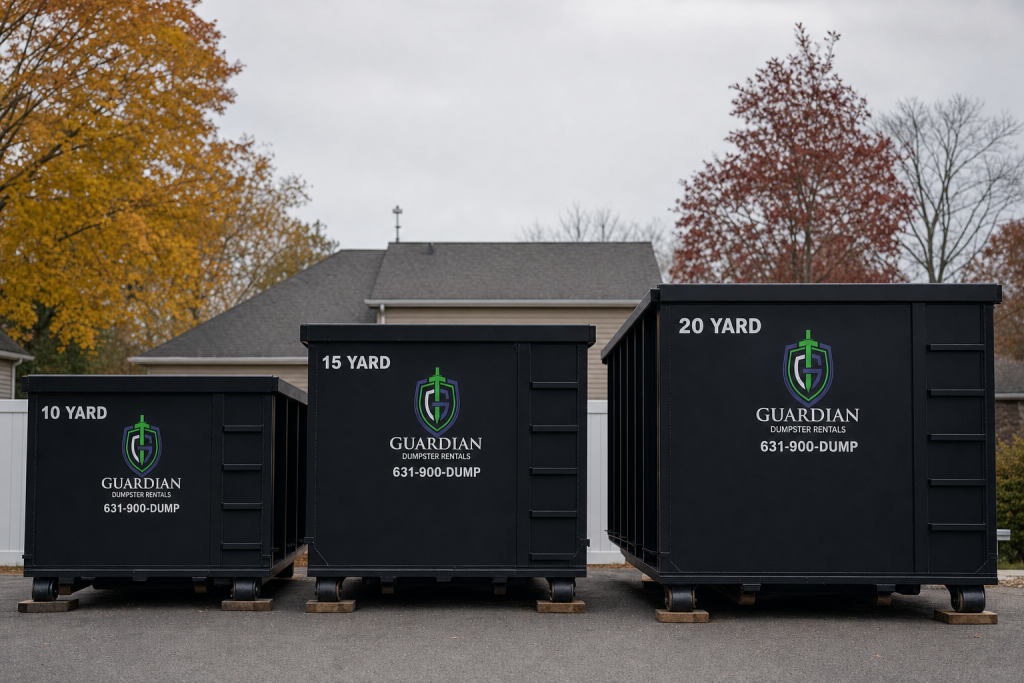
Before delivery, choose a flat driveway spot, lay plywood under the bin to protect pavement, plan to keep debris at or below the lid-level fill line (wet fall shingles are heavier), schedule around cold snaps and high winds, and check whether your town requires a permit for street placement. A little prep prevents delays and extra fees.
Pick the Spot and Protect Your Driveway
A loaded roofing dumpster is heavy, and the steel wheels and rails can scuff asphalt or crack pavers. Ask the driver to set the bin on sheets of plywood or dimensional lumber so the weight spreads out. Keep the container close to the roofline where the crew is tearing off, but leave room for the truck to approach in a straight line — most roll-off trucks need clear overhead space free of low branches and wires. Homeowners arranging roofing dumpster rental in Babylon NY often find the driveway apron works best, since it keeps the bin off the street entirely.
Mind the Fill Line — Especially After Autumn Rain
Shingles that sit in a bin through a fall rainstorm absorb water and gain real weight. That matters because haulers can only transport containers filled to the rim, never above it, and overweight loads can trigger overage charges. Practical habits that help:
- Load heavier, wetter debris first and spread it evenly across the floor of the bin.
- Stop loading at the lid-level line, even if there appears to be room to mound material higher.
- Cover the bin with a tarp overnight if rain is in the forecast to keep shingles drier and lighter.
If you are between two roofing dumpster sizes, the wet-weight issue in autumn is one more reason to go up a size rather than down.
Time Delivery Around Cold Snaps and Wind
Roofers generally avoid tear-offs during hard freezes and gusty days, since brittle shingles and wind-blown debris make the job slower and riskier. Check the National Weather Service forecast before locking in your delivery date, and build in a buffer day so the bin isn’t sitting empty — or sitting full and rain-soaked — longer than necessary.
Permits for Street Placement in New York Towns
If the dumpster must go on the street rather than your driveway, many Long Island villages and towns require a temporary placement or obstruction permit, and some require reflective markings or cones. Rules vary block by block, so call your town or village clerk before delivery day. Local providers handling roofing dumpster rental in Lindenhurst NY can usually tell you whether street placement is common in your area and what the municipality expects.
Finally, keep the load clean: shingles, underlayment, flashing, and nails only. Sorting out non-roofing material keeps your weight predictable and supports better disposal practices, as outlined in the EPA’s guidance on construction and demolition materials.
Typically 3 bundles of asphalt shingles equal 1 roofing square (100 sq ft)
Bundles per square
Roughly 200-350 lbs depending on shingle type and layers
Weight per square (tear-off)
Each extra shingle layer roughly doubles the debris volume
Layer rule of thumb
10, 20, and 30 yard containers
Available roofing dumpster sizes
Roofing Dumpster Size Comparison: Squares of Shingles by Container
| Roofing Dumpster Size | Approx. Single-Layer Squares | Best For |
|---|---|---|
| 10 Yard Dumpster | About 20-25 squares | Small roofs, garages, or partial tear-offs |
| 20 Yard Dumpster | About 40-50 squares | Average single-family homes with one shingle layer |
| 30 Yard Dumpster | About 60+ squares | Large roofs or two-layer tear-offs |
Hypothetical Example: Sizing a Bin for a Two-Layer Tear-Off in Upstate NY
Illustrative example
Consider a hypothetical NY homeowner planning a tear-off on a roof measuring about 24 squares. If the roof had a single shingle layer, a 10 yard dumpster might be a tight but workable fit, and a 20 yard would offer comfortable breathing room. During inspection, however, the contractor lifts a shingle edge and finds a second layer underneath — effectively doubling the debris to the equivalent of roughly 48 squares. In this composite scenario, the homeowner skips the 10 yard entirely and orders a 20 yard dumpster, with the contractor noting a 30 yard would be the safer call if any decking or underlayment also needed replacing. Checking layers before booking saved the hassle and cost of a second haul.
Frequently asked questions
What roofing dumpster size do I need for a typical house?
For most single-family homes with one layer of asphalt shingles, a 10 yard dumpster handles smaller roofs, a 20 yard covers the average tear-off, and a 30 yard suits large roofs or homes with multiple shingle layers. Count your roof's squares (one square equals 100 square feet) and your layers first — a two-layer tear-off produces roughly double the debris, which often bumps you up a full container size.
How do I figure out how many squares my roof is?
Measure the footprint of your house from the ground (length times width), then add extra for roof pitch and overhangs — steeper roofs have more surface area than the footprint suggests. Divide the total square footage by 100 to get squares. If math from the ground feels risky, your roofer's estimate will list the squares, or you can check your original roofing invoice or building permit for the figure.
How do I know how many layers of shingles are on my roof?
Look at the roof edge along the eave or a gable end — each layer shows as a distinct stack of shingle edges. You can also lift a shingle at the edge and count the layers underneath, or check your attic permit history. Many older homes have a second layer installed over the first, and some have three. Counting layers before ordering prevents the most common dumpster-sizing mistake.
Why do roofing dumpsters fill up faster than people expect?
Torn-off shingles don't lie flat — they come off in jagged, overlapping chunks mixed with felt paper, flashing, and nails, creating air gaps that eat up volume. Add a second shingle layer, rotted decking boards, or wet shingles after rain, and the pile grows fast. That's why experienced roofers size by squares and layers rather than guessing, and why many order one size up when anything about the roof is uncertain.
Is it cheaper to order a bigger dumpster or risk needing a second one?
Ordering a second dumpster almost always costs more than sizing up once, because you pay a second delivery and pickup fee on top of the container cost. The price gap between a 20 yard and a 30 yard is usually modest compared to a whole second rental. If your square count or layer count puts you near the top of a size's capacity, going one size up is the safer financial call.
What happens if I overload the dumpster with shingles?
Shingles are heavy, so dumpsters have weight limits — exceed them and you'll pay overage fees per ton, or the driver may refuse to haul the container until you remove debris. Loads piled above the rim can also be rejected because they can't be legally transported. Keep debris level with the top edge, and if you're tearing off multiple layers, size up rather than cramming everything into a smaller bin.
Can I put anything besides shingles in a roofing dumpster?
General roofing debris like old shingles, underlayment, flashing, and damaged wood decking typically goes in together. However, brick, concrete, dirt, and yard waste are not allowed in these dumpsters. Keep the load limited to roofing tear-off material, and confirm any questionable items with your rental company before tossing them in, since prohibited materials can trigger extra fees or a rejected pickup.
How long can I keep a roofing dumpster at my house?
Most rentals include a standard period — commonly about a week — which comfortably covers a typical tear-off, since most residential roof removals take one to three days. Extra days usually cost a daily fee. Schedule delivery for the day before or the morning of tear-off so you're not paying for a container sitting empty, and call for pickup as soon as loading is done.
Does a steeper or more complicated roof change which dumpster I should order?
Yes. Pitch increases actual roof surface area beyond your home's footprint, so a steep roof has more squares than the same-sized house with a low-slope roof. Complex roofs with dormers, valleys, and multiple planes also generate more flashing, underlayment, and cut waste. If your roof is steep or cut-up, calculate squares using the true surface area, not the footprint, and lean toward the larger of the 10, 20, or 30 yard options.
What's the biggest mistake homeowners make when ordering a dumpster for a roof tear-off?
Sizing off the house's square footage instead of the roof's, and forgetting to count shingle layers. A 1,500-square-foot house can easily have 20-plus squares of roof surface once pitch and overhangs are included, and a hidden second layer doubles the debris. Walk the eave, count the layers, calculate true squares, and only then choose between a 10, 20, or 30 yard container.
Roofing Dumpster Rental help near you
- Roofing Dumpster Rental West Babylon NY
- Roofing Dumpster Rental Islip NY
- Roofing Dumpster Rental West Islip
Related local pages
- Dumpster Rental Greenlawn New York
- Dumpster Rental Dix Hills New York
- Dumpster Rental Amityville New York
Tearing off a roof in New York this fall? Call us today for straight answers on roofing dumpster sizes and same-week delivery before winter weather hits. Get in touch.
Last updated: November 1, 2026
Recent Comments