
Basement Cleanout Season Long Island: Beat the Winter Rush
Why Is Summer the Best Time for a Basement Cleanout on Long Island?
Summer is the best time for a basement cleanout in New York because long daylight hours, dry driveways, and more flexible dumpster delivery windows make the whole job faster and safer. You can sort, stage, and load without fighting snow, ice, or early darkness — and you avoid the winter rush when weather delays pile up.
Key takeaways
- Schedule your basement cleanout for early-to-mid fall in NY, since dumpster demand and delivery delays spike once the first cold snap hits.
- Sort items into four zones — keep, donate, recycle, and dumpster — before your rental arrives so you’re not paying rental days just to make decisions.
- Stage heavy items like furniture and appliances closest to the dumpster path first, and load them on the bottom to maximize container space.
- A 10- to 20-yard dumpster handles most single-basement cleanouts; oversizing slightly beats paying overage fees on a container that’s too small.
- Check your hauler’s prohibited items list before loading — paint, propane tanks, and certain electronics typically can’t go in a residential dumpster in NY.
Anyone who has tried hauling boxes up basement stairs and across an icy walkway in January knows the difference a season makes. In winter, you’re working against frozen ground, slippery footing, salt-stained carpets, and a sun that sets before dinner. In summer, the same project becomes a straightforward weekend job. Here’s what’s actually working in your favor right now:
Three Conditions That Make Summer Cleanouts Easier
- Long daylight hours. With daylight stretching well into the evening, you can sort after work on weeknights and still have full weekend days for the heavy lifting. Winter cleanouts often stall simply because you run out of light.
- Dry, clear driveways. A roll-off dumpster needs a stable, accessible spot. In summer, your driveway is free of snowbanks and ice, so delivery is simpler, placement is more precise, and every trip from the basement door to the container is safer.
- Flexible scheduling. Snowstorms in NY can push dumpster deliveries and pickups back days at a time. Booking in summer means fewer weather-related delays and better odds of getting the exact delivery window that fits your plans. If you’re new to the process, this overview of renting a dumpster in NY walks through how scheduling and delivery typically work.
The Hidden Cost of Waiting Until Winter
Putting off a basement cleanout until the cold months doesn’t just make the work miserable — it makes it slower and riskier. Carrying awkward loads over icy steps invites injury, frozen ground complicates dumpster placement, and short days mean the project drags across multiple weekends instead of one or two. Basements also tend to accumulate more, not less, as holiday decorations, gifts, and off-season gear get shoved downstairs. The pile you’re avoiding in July will be bigger by December.
The System This Guide Teaches: Sort, Stage, Load
The rest of this article walks through a simple three-part approach that keeps a basement cleanout from becoming overwhelming:
- Sort — break the basement into zones and make keep/donate/toss decisions one category at a time, so you never face the whole mess at once.
- Stage — move outgoing items to a holding area near the exit before the dumpster arrives, so loading day is pure momentum.
- Load — fill the dumpster efficiently and safely, with strategies for working around summer heat and pop-up storms.
Follow that sequence, and you’ll finish while the weather is still on your side — instead of shoveling a path to the curb in February.
How Do I Sort a Basement Full of Stuff Without Getting Overwhelmed?
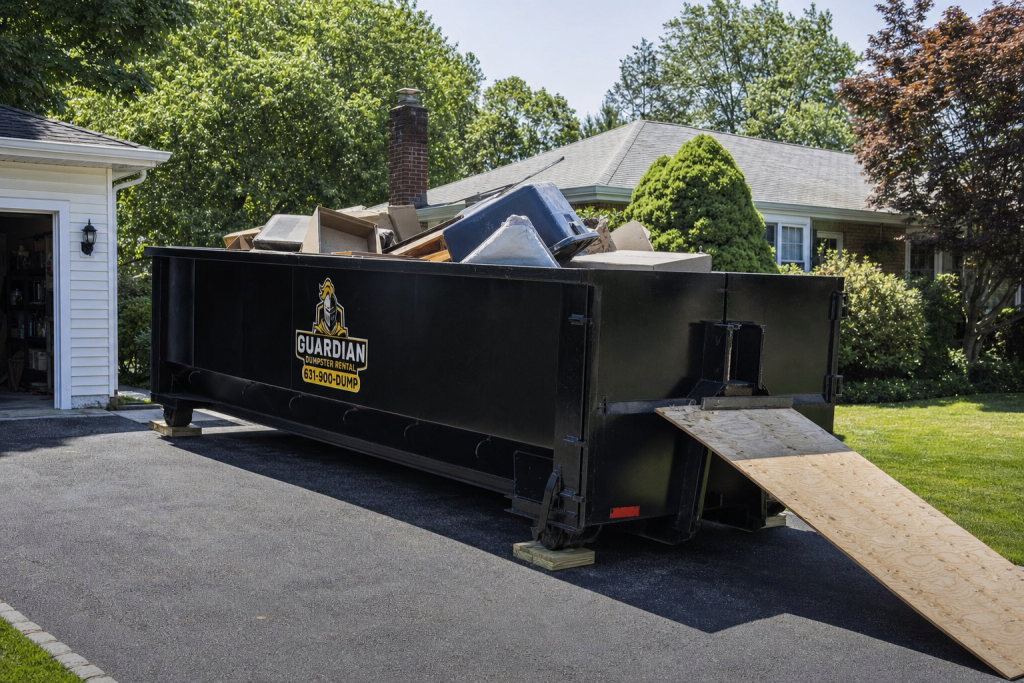
Sort your basement one zone at a time using four piles: keep, donate, sell, and toss. Work in short sessions of two to three hours, finish each zone completely before moving on, and make decisions on the spot rather than shuffling items between corners. This keeps a decades-deep basement cleanout manageable instead of paralyzing.
Most NY basements didn’t fill up in a weekend, and they won’t empty in one either — but a zone system turns an impossible-looking job into a series of small, finishable tasks.
Break the Basement Into Zones
Before you touch a single box, walk the space and mentally divide it into sections: the area under the stairs, the wall of shelving, the corner with holiday decorations, the space around the furnace. Then commit to clearing one zone per session. The psychological win of a fully finished zone keeps momentum going in a way that randomly picking through the whole room never does.
Use the Four-Pile Rule — and Be Honest
- Keep: Items you’ve used in the past year or have a concrete plan for. Store these in sealed plastic bins, not cardboard, before they go back downstairs.
- Donate: Clean, working items in good condition. Box them as you go so they’re ready to load into the car the same day.
- Sell: Only items genuinely worth the effort of listing and meeting buyers. If it’s been “worth something” for ten years and you haven’t sold it, it belongs in donate or toss.
- Toss: Everything broken, water-stained, rusted, or unidentifiable. This pile is usually the biggest, and that’s fine — it’s why you’re renting a dumpster.
Dealing With Humidity Damage and Mold
New York basements are humid, and long-term storage pays the price. Handle questionable items with a few ground rules:
- Soft, sagging, or water-ringed cardboard boxes: Assume the contents are compromised until proven otherwise. Open them outside or near a window, not in a closed basement.
- Moldy fabrics, mattresses, and upholstered furniture: Don’t try to salvage them. Bag smaller items before carrying them upstairs so you’re not trailing spores through the house.
- Wear a mask and gloves when opening old boxes — dust, mildew, and the occasional mouse nest are common in long-untouched storage.
- Paper and photos: Set anything sentimental aside in a single “decide later” bin so it doesn’t stall your sorting rhythm. Give yourself one bin, not five.
Set a Decision Deadline
The biggest time sink isn’t lifting — it’s deliberating. Give yourself ten seconds per ordinary item. If you’re stuck, ask one question: would I pay to move this to a new house? If the answer is no, it goes. For a step-by-step schedule you can adapt to a basement, our weekend cleanout dumpster plan lays out how to pace sorting and loading over two days.
What Size Dumpster Do I Need for a Basement Cleanout?
Most basement cleanouts fit a 10 or 20 yard dumpster. A 10 yard handles a partial cleanout of boxes and small furniture, a 20 yard suits a full finished-basement purge, and a 30 yard covers a basement plus other areas of the house. When in doubt, size up one level.
Dumpster sizes are measured in cubic yards of volume, not weight alone. Picking the right size matters because ordering a second dumpster mid-project almost always costs more than renting one size larger from the start. Here’s how each size maps to real basement scenarios.
10 Yard: The Partial Cleanout
A 10 yard dumpster holds roughly the equivalent of three to four pickup truck loads. It’s the right call when you’re clearing a section of the basement rather than the whole thing. Typical 10-yard projects include:
- A few decades of accumulated boxes, holiday decorations, and old paperwork
- One or two large items — an old couch, a broken dresser, a treadmill — plus general clutter
- Clearing out a storage corner or a single finished room
Because 10 yard containers have a smaller footprint, they also work well on tight NY driveways and shorter urban lots.
20 Yard: The Full Finished-Basement Purge
The 20 yard is the workhorse for a complete basement cleanout. If you’re emptying a finished basement wall to wall — furniture, shelving, rugs, an old entertainment setup, bins of stored belongings — this size gives you room without much wasted space. It also handles light demolition debris like paneling or old carpet if your cleanout turns into a mini renovation.
30 Yard: Whole House Plus Basement
Choose a 30 yard dumpster when the basement is just one part of a bigger clearout — an estate cleanout, preparing a house for sale, or tackling the basement, attic, and garage in one sweep. Bulky items like sectional sofas, mattresses, and large appliances eat volume fast, and the 30 yard’s higher walls accommodate them without constant Tetris-style rearranging.
How to Estimate Your Volume Before You Order
You don’t need to guess. Once you’ve built your toss pile, measure it:
- Use the pickup-truck rule: one full-size pickup load is roughly 2–3 cubic yards. Estimate how many truckloads your pile represents and match it to a dumpster size.
- Measure the pile: multiply length × width × height in feet, then divide by 27 to get cubic yards.
- Add a buffer: piles compress in your mind but not in the container. Add 20–25% to your estimate, because nearly everyone finds more to toss once the dumpster is sitting in the driveway.
- Flag heavy materials: if your cleanout includes concrete, tile, or wet, water-damaged items, mention it when you book — weight limits can matter more than volume for dense debris.
If your estimate lands between two sizes, go bigger. Extra space costs little; an overflowing dumpster creates real headaches.
Where Should I Stage Items Before the Dumpster Arrives?
Stage items in your garage or on a covered porch, as close to the driveway as possible. Pick a spot with a straight, obstacle-free path from the basement stairs to where the dumpster will sit, and keep everything under cover or tarped so a surprise summer storm doesn’t soak boxes and furniture before loading day.
A good staging plan is the difference between a smooth one-day load and a weekend of double-handling. The goal is simple: touch each item as few times as possible between the basement and the dumpster.
Pick a Covered Staging Zone
The garage is usually the best option because it’s dry, close to the driveway, and lets you keep working after dark or during a downpour. If your garage is full, a covered porch or carport works too. Before you start hauling, clear a footprint large enough for your sorted piles and leave walking lanes between them so you’re not climbing over stacks later.
Plan the Shortest Carry Path
Walk the route from the bottom of the basement stairs to the driveway before you carry a single box. Then:
- Remove tripping hazards like hoses, kids’ toys, doormats, and loose extension cords.
- Prop doors open with wedges so you’re never fumbling for a knob with full hands.
- Protect stair treads and door frames with moving blankets or cardboard if you’re hauling bulky furniture.
- Position heavier items closest to the driveway end of the staging area so the hardest carries are the shortest ones once the dumpster arrives.
Storm-Proof Your Staged Piles
New York summer thunderstorms can roll in fast, and wet cardboard, upholstered furniture, and carpet get dramatically heavier — which matters when you’re paying by weight. Keep a few heavy-duty tarps and bungee cords on hand, elevate boxes on pallets or scrap lumber so ground runoff can’t reach them, and put anything moisture-sensitive deepest under cover. If you’re staging outdoors even briefly, tarp piles at the end of every work session, not just when rain is forecast.
Prep the Dumpster Placement Spot
Decide exactly where the container will sit before delivery day, and confirm the spot with your rental company. To get it ready:
- Clear vehicles from the driveway and ask neighbors to move cars if street placement is involved.
- Check overhead clearance — the truck needs room above for the lift, so watch for low branches and wires.
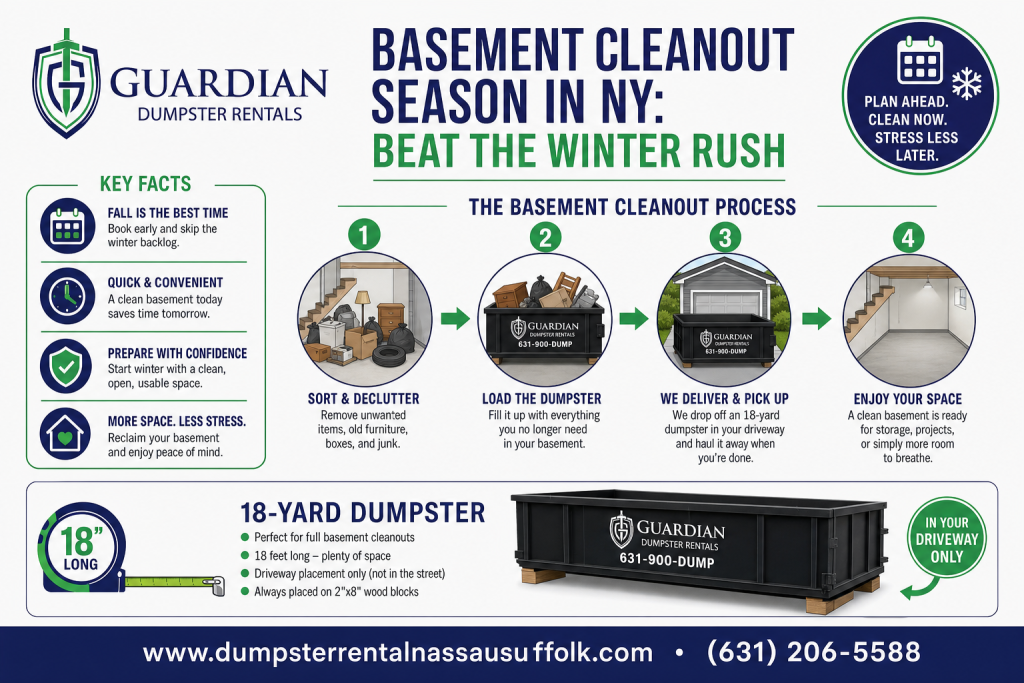
- Lay down plywood sheets where the container will rest to protect asphalt or pavers, especially in summer heat when driveways soften.
- Keep the swing-open door end facing your staging area so you can walk heavy items in rather than lifting everything over the wall.
With staging done right, the actual basement cleanout becomes an assembly line: basement to staging area before the dumpster arrives, staging area to dumpster once it does.
How Do I Load a Dumpster Safely in Summer Heat and Storm Season?
Load heavy items first through the dumpster’s walk-in door, distribute weight evenly across the floor, and fill gaps with smaller items to maximize space. In summer, work during cooler morning hours, take regular hydration breaks, and keep the dumpster tarped when you’re not loading so afternoon storms don’t add water weight to your load.
A basement cleanout means hauling everything up at least one flight of stairs, so a smart loading strategy saves your back and your rental budget. Here’s how to do it right in New York’s hottest, stormiest months.
Load in the Right Order
- Heavy and bulky items go in first. Old furniture, appliances, and boxes of books belong on the dumpster floor, spread evenly from front to back. This keeps the container stable and safe to haul.
- Use the swing door. Most roll-off dumpsters have a door on one end. Walk heavy items in rather than lifting them over the wall — it’s easier on your body and lets you place things deliberately instead of tossing them.
- Break things down. Disassemble furniture, flatten boxes, and cut carpet into rolls. Air pockets waste space you’re paying for.
- Fill the gaps. Tuck bagged items, cushions, and small debris into voids between larger pieces. A tightly packed dumpster often holds far more than a hastily loaded one.
- Keep the load level. Never fill above the top rail — drivers can refuse overloaded containers, and debris that shifts in transit is a road hazard.
Beat the Heat
- Start early. Aim to do the heaviest lifting before late morning. Carrying boxes up basement stairs in peak afternoon heat is a recipe for exhaustion.
- Hydrate on a schedule. Don’t wait until you’re thirsty. Keep water at the top of the stairs and take a break every 30 to 45 minutes.
- Dress for the job. Lightweight clothing, gloves, and closed-toe shoes protect you without trapping heat. A basement may feel cool, but the trips outside add up fast.
- Know the warning signs. Dizziness, headache, or cramping means stop, get to shade, and cool down before continuing.
Plan Around Afternoon Storms
New York summers bring pop-up thunderstorms, and an open dumpster is essentially a giant rain bucket. Water soaks into mattresses, upholstered furniture, and cardboard, adding significant weight — and many haulers charge by the ton. Keep a heavy-duty tarp on hand and cover the container whenever you stop loading, especially overnight and before forecast storms. Secure it with bungee cords or weights so wind doesn’t peel it off.
Wet debris is also harder to handle. If rain catches you mid-project, stage the remaining items inside and wait for a dry window rather than wrestling soggy, slippery loads up the stairs.
What Can’t Go in the Dumpster During a Basement Cleanout?
Hazardous materials — paint, solvents, pesticides, batteries, propane tanks, and appliances containing refrigerant — cannot go in a rental dumpster. Heavy debris like brick, concrete, dirt, and yard waste is also excluded from standard household dumpsters. These items need special disposal through hazardous waste collection events, retailer take-back programs, or dedicated heavy-debris containers.
Basements are exactly where prohibited items tend to pile up. That half-used can of deck stain, the old dehumidifier, the box of dead batteries — they’ve been sitting down there for years, and it’s tempting to toss them in with everything else. Resist the urge. Hazardous items in a dumpster can trigger extra fees, a refused pickup, or environmental fines, and they put haulers and landfill workers at risk.
Common Prohibited Items Hiding in NY Basements
- Paint, stains, and solvents — even partially empty cans of liquid paint are banned. Fully dried latex paint may be acceptable in some areas, but liquid paint never is.
- Household chemicals — pesticides, herbicides, pool chemicals, drain cleaners, motor oil, and antifreeze.
- Batteries — car batteries, rechargeable batteries, and lithium-ion packs, which are a serious fire hazard in trucks and transfer stations.
- Appliances with refrigerant — refrigerators, freezers, dehumidifiers, window AC units, and water coolers must have the refrigerant professionally recovered first.
- Propane tanks and fuel containers — even ones that seem empty.
- Tires — most haulers prohibit them or charge a per-tire fee.
Heavy Debris Doesn’t Belong in a Household Dumpster Either
Brick, concrete, dirt, rock, and yard waste aren’t hazardous, but they’re extremely dense and can push a container past legal road-weight limits fast. Standard basement cleanout dumpsters aren’t rated for them. If your project includes busting out an old concrete floor or hauling fill dirt, ask your hauler about a dedicated clean-fill or heavy-debris container instead of mixing it in.
Where NY Homeowners Can Dispose of These Items
- Household hazardous waste (HHW) collection events — most New York counties host periodic drop-off days for paint, chemicals, and batteries. The New York State Department of Environmental Conservation is a good starting point for finding programs in your county.
- Retailer take-back programs — many home improvement and auto parts stores accept rechargeable batteries, motor oil, and car batteries.
- Appliance recycling — many utilities and municipal transfer stations accept refrigerant-containing appliances, often for a small fee, and some utilities offer pickup programs.
- Municipal transfer stations — most accept tires, scrap metal, and yard waste separately from household trash.
For general guidance on identifying and handling hazardous household products safely, the EPA’s household hazardous waste page is a reliable reference. Set these items aside early in your basement cleanout so they never end up near the dumpster in the first place — your hauler, and your final bill, will thank you.
2-3 weeks ahead of your target cleanout weekend in fall
Best booking window
7-10 days for most residential dumpster rentals
Typical rental period
10-20 yard containers cover most single-basement jobs
Common size for basements
Plan on 3-4 sorting categories: keep, donate, recycle, toss
Sorting rule of thumb
Basement Cleanout Dumpster Sizes: Which One Fits Your Project?
| Dumpster Size | Best For | Typical Capacity | Space Needed for Placement |
|---|---|---|---|
| 10-yard | Small basement or single-room cleanout | Roughly 3 pickup truck loads | Standard driveway spot |
| 20-yard | Basement plus garage or attic overflow | Roughly 6 pickup truck loads | Full driveway length |
| 30-yard | Whole-home cleanout or estate clearing | Roughly 9 pickup truck loads | Long driveway or street permit may be required |
Illustrative Example: A Two-Weekend Basement Cleanout Done Right
Illustrative example
Consider a hypothetical Hauppauge homeowner facing a basement packed with two decades of storage bins, old furniture, and a broken freezer. In this composite scenario, they spent the first weekend sorting everything into keep, donate, and toss zones before the dumpster ever arrived, then booked a 10-yard container for the following week. Because heavy items were staged near the walkout door and loaded first, the family filled the dumpster efficiently in a single Saturday. By finishing in mid-October, they avoided the pre-winter booking crunch and cleared the space before snow made hauling anything up the bulkhead stairs miserable. This example is illustrative, but it reflects the sequence — sort first, stage smart, book early — that makes fall cleanouts go smoothly.
Frequently asked questions
How much does a basement cleanout cost in NY?
Costs vary widely depending on how much you haul yourself. Renting a residential dumpster is usually the cheapest route if you can do the labor, typically a few hundred dollars for a week depending on size and your location in New York. Full-service junk removal costs more because you’re paying for labor, often several times the dumpster price for a packed basement. Get quotes from at least two local providers, and ask about weight limits and overage fees before booking.
How long does it take to clean out a full basement?
For an average cluttered basement, plan on one full weekend with two people: one day to sort and one day to stage and load. A heavily packed basement, or one with decades of accumulation, can take two to three weekends. Sorting almost always takes longer than loading, especially if you’re making keep-or-toss decisions on sentimental items. Booking your dumpster for a full week gives you buffer without rushing.
What size dumpster do I need for a basement cleanout?
A 10-yard dumpster handles most standard basement cleanouts, roughly the equivalent of three pickup truck loads. If your basement is large, finished, or packed floor to ceiling, step up to a 20-yard. It’s usually cheaper to rent one size larger than to pay for a second haul or overage fees. Describe your basement honestly to the rental company and let them recommend a size.
What can’t you throw in a residential dumpster?
Most rental companies prohibit hazardous materials: paint, solvents, motor oil, propane tanks, batteries, tires, and anything with refrigerant like fridges, freezers, and AC units. Electronics are restricted in New York, which has e-waste disposal laws requiring separate recycling. Mattresses and appliances are sometimes allowed for an extra fee. Ask for your company’s prohibited items list upfront, since surprise items left in the dumpster can trigger extra charges.
Is it worth renting a dumpster or should I just hire junk removal?
Rent a dumpster if you’re able-bodied, have help, and want to save money, since you’re only paying for the container and haul-away. Hire junk removal if you’re short on time, can’t lift heavy items, or the basement involves stairs you’d rather not climb fifty times. A middle option: sort everything yourself first, then hire haulers only for the heavy lifting. That cuts labor time and keeps the bill down.
Why should I do a basement cleanout before winter instead of waiting for spring?
Winter makes every step harder: dumpsters sit on snow and ice, footing gets dangerous carrying loads up basement stairs, daylight hours shrink, and frozen items stick together. In spring, demand for dumpsters spikes, so prices rise and availability tightens. Fall gives you mild weather, easier scheduling, and often better rates. You also head into winter with clear space for storage instead of clutter you’ll trip over all season.
What’s the biggest mistake people make during a basement cleanout?
Loading the dumpster without sorting first. When you skip staging, you end up tossing things you could have sold or donated, burying heavy items you needed on the bottom, and wasting dumpster space with air pockets from awkwardly stacked junk. Sort into keep, donate, sell, and trash piles before the dumpster arrives, then load flat and dense, heavy items first. Poor loading is the top reason people run out of room.
Do I need a permit to put a dumpster in my driveway in New York?
Usually not for a dumpster placed entirely on your own driveway or private property. Permits typically come into play when the dumpster sits on a public street or sidewalk, and rules vary by municipality across New York. Check with your town or city before delivery, and ask your rental company, since they deal with local requirements daily and can often tell you exactly what applies at your address.
What should I do with stuff from the basement that’s moldy or water damaged?
Most moldy or water-damaged items like cardboard, fabric, carpet, and particleboard furniture belong in the dumpster; they’re rarely salvageable and can spread spores. Bag heavily moldy items before tossing to limit exposure while carrying them upstairs. Wear a mask and gloves when handling them. If you find widespread mold on the walls or floor itself, that’s a moisture problem worth fixing before you refill the space, or the new stuff gets ruined too.
How do I get heavy furniture out of a basement by myself?
Honestly, don’t try alone if you can avoid it, since basement stairs plus heavy loads cause real injuries. If you must, disassemble everything possible first: remove drawers, legs, and shelves. Use a hand truck with stair-climbing capability, furniture sliders, and lifting straps. Break truly worthless items like old particleboard shelving into pieces with a hammer or saw rather than carrying them whole. For anything you can’t manage safely, hire labor-only help for an hour or two.
Related local pages
- Dumpster Rental Babylon New York: Sizing, Placement, And Same-Week Delivery For South Shore Projects
- Dumpster Rental Bay Shore New York — 10, 20, And 30 Yard Roll-Offs Sized For South Shore Homes And Job Sites
- Dumpster Rental Commack New York: Roll-Off Sizes, Straight Pricing, And Driveway-Safe Delivery For Suffolk County Projects
Ready to clear out your basement before the cold sets in? Call us today to reserve your 10, 20, or 30 yard dumpster and get same-week delivery anywhere in NY. Get in touch.
Last updated: August 16, 2026
Recent Comments